Welcome to 2020’s Euromoney 25, our annual snapshot of the performance of the world’s most important banks. Once again, we have spoken to senior figures at financial institutions across the world to assess the state of play in the industry.
The backdrop is, of course, the coronavirus pandemic. As with our 2020 Awards for Excellence in July and September, our analyses look at how financial institutions have navigated the crisis both for themselves and for their clients.
In these annual report cards we also seek to look through the year’s turmoil to put banks’ performance into a longer-term context that considers the strategic path they were on as they headed into 2020. We also examine what their priorities are – or should be – in 2021.
We’ve tweaked the list of banks in our 25 with the objective of broadening geographic and business model representation in the group. New to the review in 2020 are Crédit Agricole, Macquarie, Sberbank, State Bank of India and Wells Fargo.
With many sectors largely shut down for parts of the year by Covid-19, banks’ financials have reflected fears over the trouble that lies ahead as fiscal support by national governments begins to be unwound. For banks, that has shown up most obviously in loan-loss provisions.
And those provisions are of extraordinary scale. In some jurisdictions this has been accentuated by the introduction of new provisioning standards, as in the US with its current expected credit loss regime that forces banks to consider possible lifetime losses upfront.
The result, once the pandemic was perceived as a widespread and monumental shock in the first quarter of 2020, has been credit provision charges of $180 billion in the first nine months of 2020 at our group of 25 banks.
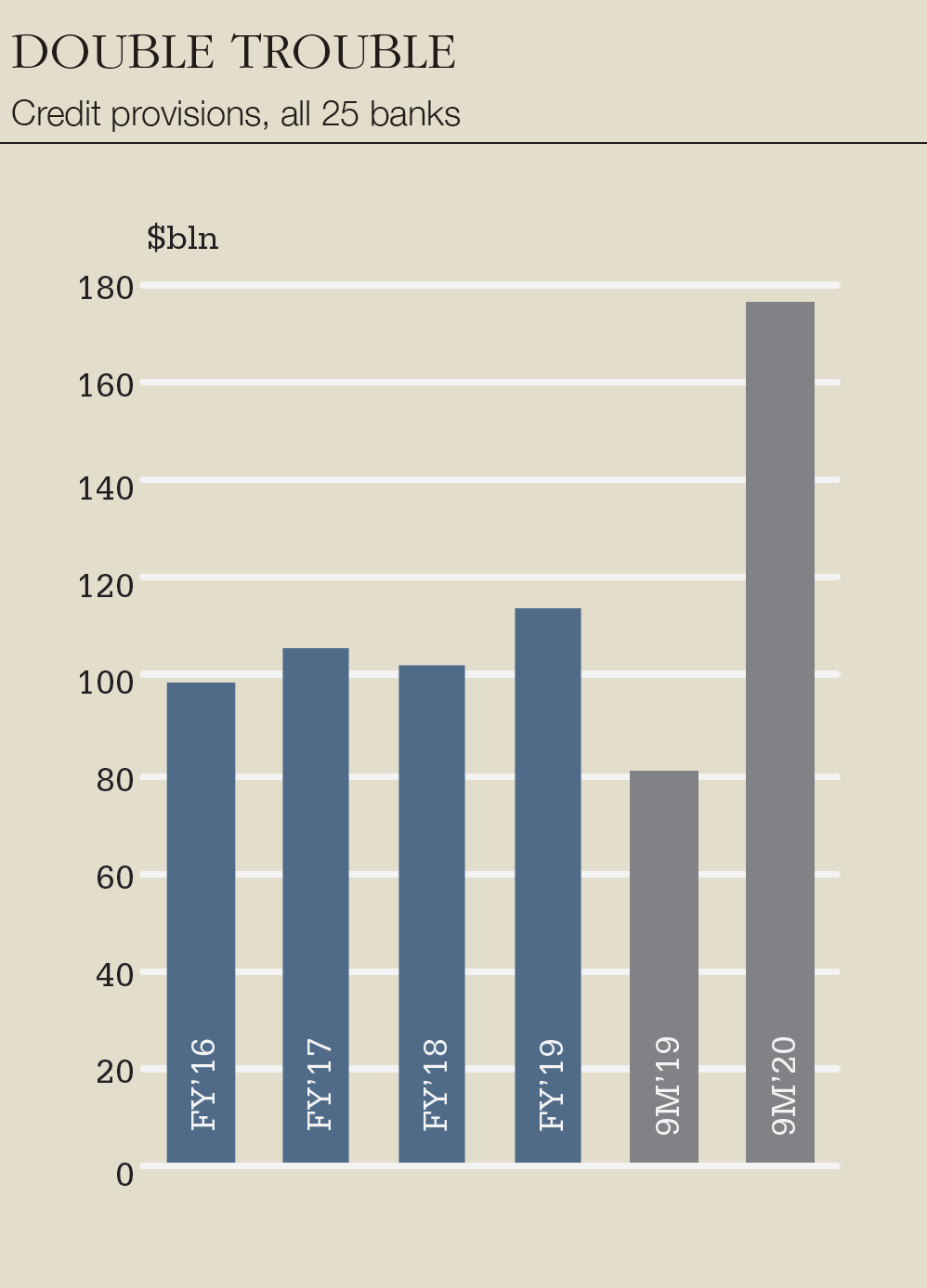
That’s more than double the $80 billion that the same banks put through their income statements in the same period in 2019.
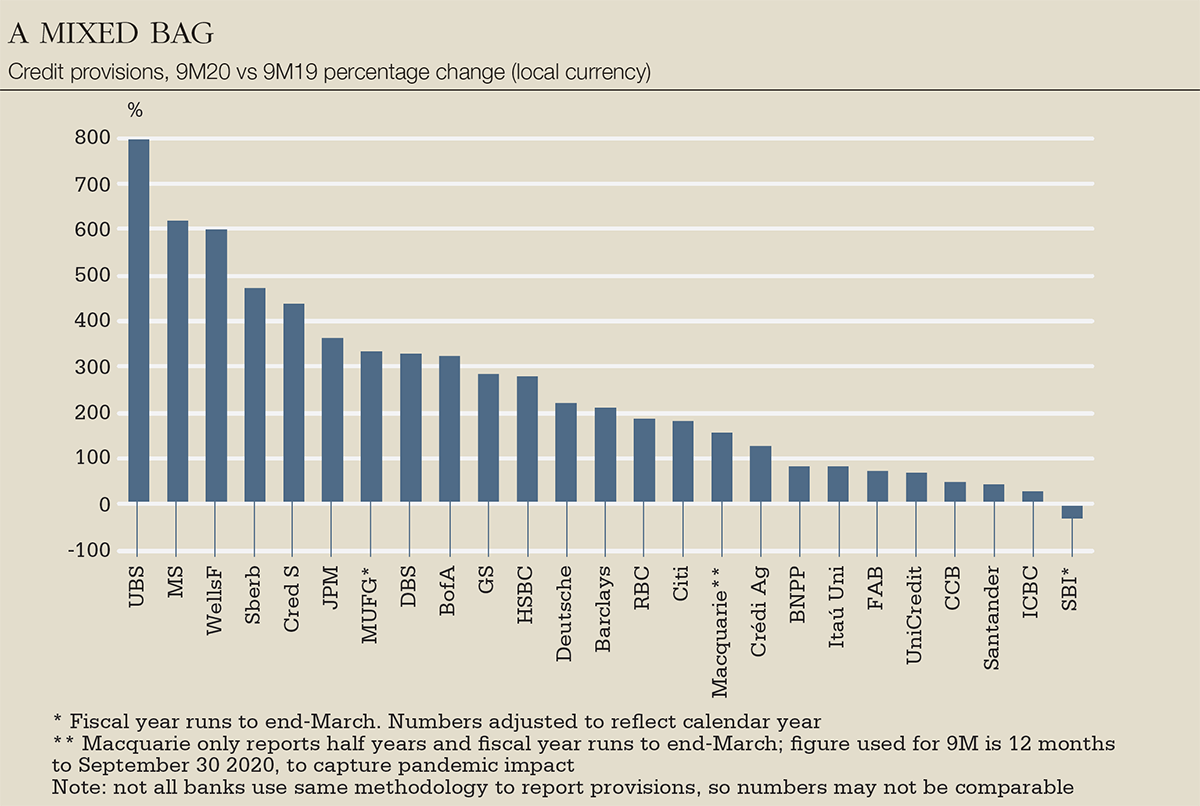
On a year-on-year relative basis, the biggest moves have been at UBS and Morgan Stanley, where small rises in absolute terms can still lead to outsized percentage increases. This is unsurprising.
But two things are more striking. The bulk of new provisions inevitably sit in the large commercial banks, but some of those – notably Wells Fargo, Sberbank and JPMorgan – are also among the biggest year-on-year percentage rises.
Secondly, as we discuss elsewhere in this issue, there is a distinct relationship between the extent of provisioning and a bank’s ability to set aside resources to do so – its underlying profitability.
Regulators want more than ever to make banks plan for the worst-case scenarios. But for as long as banks have the discretion to do so, they will build models that work for them.