
Awards for Excellence 2018
|
|
|
Also shortlisted |
Credit Suisse |
Julius Baer |
| View full 2018 results |

It has already been an eventful 2018 for UBS. At the beginning of the year, the bank’s chief executive, Sergio Ermotti, announced that UBS would integrate the international wealth management business with UBS Wealth Management Americas – something the bank had implied it would never do.
Did it pay off? Well, the bank’s profits before tax rose 17% year on year in the first quarter on the back of new records in the Americas and Asia Pacific.
The combined unit is co-headed by Tom Naratil and Martin Blessing.
Naratil, who formerly headed UBS Americas, says that the united business brings a focus that had not been there previously and that the wealth manager’s aim is to serve clients with global needs.
“It’s hard to see a future that isn’t more global – not less. And through the integration, our teams around the world are now conversing more,” says Naratil. “You could call it intellectual capital arbitrage. If a deal is done in Switzerland, the team can reach out to the US and convert that into an opportunity there. That process was happening prior to the merger but not consistently.”
He adds that as the US wealth management business has boomed (it represents 51% of UBS Global Wealth Management’s assets), more US clients were seeking access to international ideas and investments.
“Similarly, clients from Asia whose children may be coming to universities in the US may be looking for a financial adviser here. That process is much more seamless now,” says Naratil.
Blessing agrees. “There’s one P&L and one bonus pool now – we’re all now focused on working together across the globe.”
No other bank has a wealth management presence in the US and Asia to the same extent as UBS – and those two geographies are undoubtedly where any global wealth manager should be.
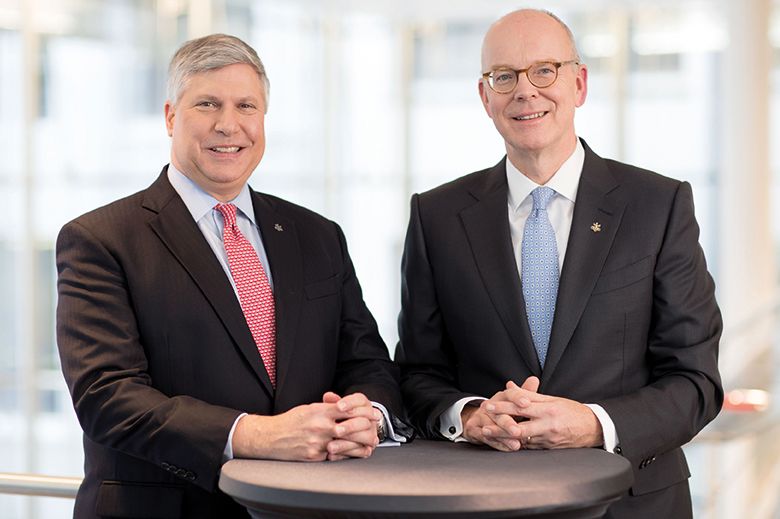 |
| Tom Naratil and Martin Blessing |
Half the world’s billionaires bank with UBS, and a third of the world’s billionaires are in the US and China. While Asia may be where many global wealth managers are putting their efforts, it will be at least another 10 years before Asia overtakes the US as the biggest wealth market, points out Naratil. The two markets are crucial for long-term growth.
Although UBS runs its Asia business out of Singapore and Hong Kong, it has focused on Greater China for growth – and it has been smart about it. Last year, it formed a joint venture with Qianhai Financial Holdings, setting up a wealth management business in Qianhai, often called the Silicon Valley of China. That means access to China’s up-and-coming tech entrepreneurs. UBS is also at the forefront of Chinese philanthropy – with a global perspective that Chinese domestic private banks do not have.
The fruits of its Asia commitment – even up against a strong competitor such as Credit Suisse – are evident in its assets. In 2017, UBS’s Global Wealth Management Asia-Pacific business became the first wealth management business in Asia to exceed SFr300 billion ($303 billion) in assets – by the first quarter of 2018 that figure was SFr379 billion. Net new money for the year was SFr28.4 billion, up 37% year on year.
The last few years have not been the smoothest ride for UBS in Europe. Novakovic points out that frequent changes in strategy slowed asset growth in some of her new markets several years ago, but she is expecting the region to be profitable this year.In western Europe, UBS operates an onshore model in all the biggest markets – France, Germany, Spain, Italy, the UK, Luxemburg, Monaco and Austria. Christine Novakovic took over the business in February having previously run the corporate and investment bank in Switzerland.
In 2017, UBS in France entered into a joint venture with private investment club La Maison and its shareholders, which include some of the wealthiest families in the country, to build an asset management company dedicated to private wealth clients.
UBS’s chief investment office house view is still seen as the jewel in UBS’s crown – although many of its competitors have adopted the same central research and global view across their wealth management operations. Its research is unparalleled, however – research on the impact of Trump administration’s initiatives for clients in Asia is not something anyone else can do with the speed and depth as UBS, says Naratil.
Now UBS is taking its CIO model to the next level.
“In May, we introduced tactical asset allocation to our managed portfolios based on the CIO view, implementing 450,000 trades into those mandates,” says Blessing. “It is an automated engine to transmit and transform the CIO view not only into investment advice but into transactions – no other bank is doing this.”
And finally, UBS leads globally in philanthropy and creating investments that are socially and environmentally positive. Its Optimus Foundation matches UBS’s philanthropic dollars with those of its clients. And the bank is moving towards a reporting model for clients where their portfolios are given a score on environmental impact.


