 |
|
“We’ll have four broad categories of investable assets: foreign exchange reserves, public pension funds, reserves in the special account managed by the ministry of finance, and funds arising from government real estate” |
More on sovereign wealth funds
On a shelf in a third-floor office of the Sangiin-Kaikan, the house of councillors of the Japanese Diet (parliament), there sits a photograph. Five or six rows of men in dark suits stare dourly out of the picture, but in the centre of the foremost row there’s an exception: one Japanese man is resplendent in an electric-pink suit, smiling right at the camera.
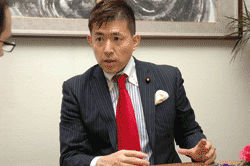
Kotaro Tamura, senator of the Liberal Democrat Party and general secretary of the panel promoting the idea of a Japanese sovereign wealth fund, likes to stand out. A previous job overseeing a family business empire that included a tailoring company accounts for his taste in eye-catching suits but Tamura’s fondness for flair goes beyond mere attire. There’s the ever-growing list of languages he speaks, the collection of degrees from the world’s top universities next to the photo of himself on his card, the mentions of hobbies including competitive dancing and kickboxing and the blog that keeps track of it all in near real time. “Just put in that I’m good,” he says with a grin as Euromoney jots down the list of achievements he reels off when prompted.
Revolution
All this might be seen as mere preening and baseless self-promotion were it not for the evidence of an agile and contrarian mind at work behind the ostentation. Tamura is in charge of a project that could revolutionize Japan’s stalling domestic markets, its bloated balance sheet and its dwindling reputation in the international capital markets. That project is the much-debated creation of a Japanese sovereign wealth fund.
“We were originally supposed to propose a scheme to the prime minister at the end of this month [April],” says Tamura, “but that’s been postponed because of the current political turmoil. So we expect to complete a first draft in mid-May, with a bill to pass in mid-December, and then hopefully we’ll launch the fund in March 2009 and start investing immediately.”
This isn’t the first time that Tamura has proposed such a scheme: having studied the activities of the hugely influential sovereign fund Temasek in Singapore, he proposed a Japanese SWF to the Koizumi administration more than three years ago. Working with Junichiro Koizumi and his pro-privatization finance minister Heizo Takenaka on balance sheet reform, Tamura proposed an SWF as one part of the solution and says that further progress might have been made had Koizumi not stepped down in 2006. The pattern would be repeated in the next administration: prime minister Shinzo Abe voiced his support for more active management of the country’s huge foreign exchange reserves during his period in power, only for the idea to stall when he suddenly resigned in September 2007.
Few people in Japan regard the incumbent prime minister, Yasuo Fukuda, as a strong decision maker, if his sub-30% approval ratings and the agonizing debacle surrounding the delayed appointment of a new Bank of Japan chief are anything to judge him by. Tamura does not criticize Fukuda but says delicately that the party is at present very strong in relation to the top-tier executive and this might make reform easier to push through. “The prime minister’s popularity has been down recently,” he says, “and if he wants to be seen as a reformer this is an easy way to show that, since it’s a project that makes use of existing assets… Ultimately, it all depends on how persuasive we are.”
So what will a Japanese sovereign fund look like, and why should anyone outside this notoriously isolationist market care?
“I can’t tell what the total assets of the fund we’re envisioning might be,” says Tamura, “but it won’t be small, put it that way. We’ll have four broad categories of investable assets: foreign exchange reserves, public pension funds, reserves in the special account managed by the ministry of finance, and funds arising from government real estate.” That last category is more important than it might sound: Tamura estimates that the government owns roughly one quarter of Japan.
But regardless of the eventual size and composition of the fund, perhaps its real impact as far as foreign market participants are concerned will be its international flavour. The bulk of the foreign-currency reserves (which crept over $1 trillion this March) will be invested overseas: since these assets are mostly in dollars, Tamura says that US treasuries, stocks, derivatives and even real estate will be the main targets for investment.
Salary men
Moreover, Tamura says that the fund will be managed by the “best and brightest that the market has to offer, regardless of nationality”. That raises a potential political issue: in order to get such lofty talent, Japan will have to pay the market rate for a top fund manager and that will almost certainly mean a salary much higher than even the most senior LDP members.
“I think CIC [China’s sovereign wealth fund] is facing that problem now,” says Tamura wryly. “But look, under any draft of the SWF proposal we’ve made so far we put right at the top that we will pay as much as other top financial institutions on a performance basis, otherwise we simply won’t get the best talent. We’ve already done a first round of informal interviews, during some of my visits to the Middle East, China and so on, and fund managers and top executives we’ve seen have been very frank. They say that if Japan’s really serious about this project, they’re ready to come and work here.”
There follows some rhetoric about Japan’s many merits as a place to live over certain arid, intemperate and/or over-governed alternatives that Euromoney will spare the reader, but it’s clear that Tamura is extremely optimistic about the SWF bill’s chances of passing. Third time lucky, perhaps.
Although Tamura says that the opposition party, the DPJ, broadly supports the idea of reducing Japan’s public assets, not everyone in Japan is as enthusiastic as he is about the idea of a Japanese SWF. The local media have often been critical of the project, noting the losses made on some funds’ more high-profile investments in recent months – CIC’s stakes in Morgan Stanley and Blackstone come to mind.
Tamura also argues that the Japanese media are often innately distrustful of financial markets because of activist investors who attempt to influence media companies’ activities. He mentions ‘Horiemon’ (Takafumi Horie), the discredited maverick businessman who launched a bid through his media company Livedoor for Nippon Broadcasting System, as an example of an activist investor whose efforts have damaged the reputation of the practice.
There are sounder arguments against the SWF project. The most telling cuts to the heart of Japan’s real problem: its ruinous levels of debt, estimated by the OECD as being at a staggering 180% of GDP by the end of 2007. As Takahira Ogawa, director of sovereign and international public finance ratings for Standard & Poor’s, says: “The main issue in balance sheet management for Japan is reducing its mountain of public debt. To me setting up an SWF adds more complication to the situation. We need to scrutinize the composition of Japan’s FX reserves very carefully: a substantial part of them are tied to short-term paper on the other side of the balance sheet, so they’re not pure assets as, say, Singapore’s tend to be.”
How cheap it is
Tamura counters this argument by noting how cheap Japan’s debt is. He doesn’t deny that reducing the outstanding total is a priority but points out that when foreign-currency paper costs Japan around 1.5% the fund need only make a 2% return to improve the situation. In answering Ogawa’s second main concern, that political interference and a lack of transparency might dilute the fund’s effectiveness and reputation, he is cautious but firm.
“I’ve spoken with CIC and Temasek,” he says, “and they face similar concerns. Governance is undoubtedly a key issue. We’re talking about public money so of course the government should have some influence on the fund. But to get the best returns you absolutely need transparency. The advisory committee contains a mix of government officials and financial professionals and they’re actively discussing exactly how much authority the government should have.”
Public support
Tamura’s fervent hope is that a well-run Japanese SWF will actually be a promoter of transparency in Japan’s capital markets. “I think Japan could actually learn a lot from having this entity in the market; if the SWF makes money then people may have to change their way of thinking,” he says. “The fund will be a friendly activist, and because it’s investing the Japanese people’s money the public will support it and companies will have to listen.”
He goes on to mention the recent case of UK hedge fund TCI’s failed attempt to raise its stake in electricity wholesaler J-Power from 9.9% to 20%, a move that was blocked by the government. “Activism has been failing here,” he says, “but the SWF could be a powerful catalyst for change in that regard.”