Digital banking in South Korea is a tale of mixed fortunes. Two such banks have been operational for the last two years.
One has become, by some measures, the most successful digital bank in the world. The other has made barely any inroads and is in a desperate battle for new funding. It is a curious environment into which a further two banks may be ushered later this year.
The story of these divergent outcomes starts in 2015, when the Financial Services Commission (FSC) of South Korea approved two new digital banks. One was kakaobank, owned by Korea Investment Holdings alongside Kakao Corp, KB Kookmin and Tencent; the other, K Bank, has shareholders including Woori Financial Group and KT Corp, the telecommunications leader, alongside China’s Ant Financial and the videogame developer Smilegate. There were big ambitions. At the time the FSC said it wanted the new banks to transform financial services in the country.
Both became operational within months of one another in 2017, but their experiences have been very different.
kakaobank crossed the 10 million customer mark at the remarkably precise moment of 10.25pm on July 11. At the end of June, it had W17.6 trillion ($14.7 billion) in deposits, and total outstanding loans of W11.3 trillion. These are some of the best numbers in any pure-play digital bank in the world. It has twice raised funds in considerable scale – a combined $1 billion from raisings in September 2017 and April 2018 – and it will probably list next year. It turned profitable in the first quarter.
K Bank, on the other hand, is struggling. It needs more capital and appeared to have a simple route to it: one of its shareholders, the telecoms group KT, wanted to expand its stake in the business from 10% to 34% following a change in the law. K Bank would have raised W592 billion from a rights issue to support it, a deal that should have happened in April.
Banks are worried about cut-throat competition… It’s going to get more fierce – Yoseop Jun, FSC
But, instead, in an unrelated matter, Korea’s Fair Trade Commission fined all four of Korea’s big telecom-cable companies a combined W13.38 billion for collusion, with KT identified as the driving force, and referred the matter to the prosecutors for further action. That prompted the FSC to review KT’s application to up its stake in K Bank; it has said it will wait until the investigation concludes before reaching a judgement.
So, what does the regulator make of all this? At the FSC’s offices in Seoul, director Yoseop Jun presents Euromoney with a positive but honest view.
“Since the launch of the digital banks, one has been doing good and one has some capital problems,” says Jun. “But overall they have brought transformation and information to the banking sector and the financial system in general.
“The competition between digital banks is getting stronger, in particular to the conventional banks that were operating mainly based on physical branches. They are very much influenced by the innovative and new services launched by the digital banks. We think the digital banks are a great influence.”
So much so that in July the FSC announced it will approve one or two more.
Among the positive impacts he mentions, there is an ID verification process that one has to go through in South Korea when internet banking. Conventional banks have maintained these accredited certificates, but digital banks have ditched them in favour of doing the accreditation themselves, and eventually conventional banks have followed suit. The regulator didn’t ask them to. It was market forces.
“That’s one example of the huge change brought by digital banks,” says Jun.
Success story
Euromoney visits kakaobank not in central Seoul but about an hour to the south, in Pangyo, in a characteristically fintech-not-a-bank environment. There is a sleeping room. Some of the workplace cubicles have massage chairs. Most of the staff, 40% of whom hail from IT backgrounds, have adopted western first names.
Our interview with chief executive Hoyoung ‘Daniel’ Yun takes place over a delicious mango smoothie.
 |
| Hoyoung Yun, kakaobank |
Despite its hipster trappings, Yun is keen to place kakaobank in context as a proper bank following the proper norms. He calls Chinese powerhouses like Tencent and Ant Financial techfin businesses – as, indeed, do Tencent and Ant themselves – in that they are first and foremost tech companies that have found their way into financial services because there’s an opportunity.
Yun sees kakaobank as a fintech: “In fintech, finance is the core, the centre. If we like to make some disruptive innovation in the finance sector, that means we need a licence.”
In Korea, if you’re going to launch a digital bank, you need a full set of licences to do it. Jun at the FSC says there is a discussion taking place about introducing ‘small’ licence systems, as is the case in the UK and Japan, but, for the moment, there is a deliberate level of regulation for digital banks.
Despite this, kakaobank is, at heart, a single app.
“The single application is everything for us,” says Yun.
The bank’s success or otherwise depends entirely upon the convenience of this app and its ability to attract people away from conventional banks.
“We have to be a survivor, so we have to be different,” says Yun. “The primary strategy is speed and convenience in mobile applications. Our difference is that incumbent banks are selling their products, not solving the problems of customers. We are about service, not product.”
The bank has sidestepped the desktop and laptop completely. “We focus only on mobile applications: we want to be a mobile bank, not a website bank.”
We focus only on mobile applications: we want to be a mobile bank, not a website bank – Hoyoung Yun, kakaobank
The app is, indeed, streamlined and convenient: a fingerprint scan gets you right to the account page without further certification. It fits in with the mainstream needs of modern life: transferring money among friends, splitting a bill at a restaurant, although it also gets into more value-added areas, including cross-border remittance and lending.
Korea is, clearly, a good place to try something like this. According to the Pew Research Center in the US, South Korea has the highest rate of smartphone ownership in the world, at 94% of adults (in the UK, for example, the figure is 72%, and in Japan just 59%, which is also the global median). South Korea has an affluent population that is capable and comfortable when it comes to transacting through phone apps.
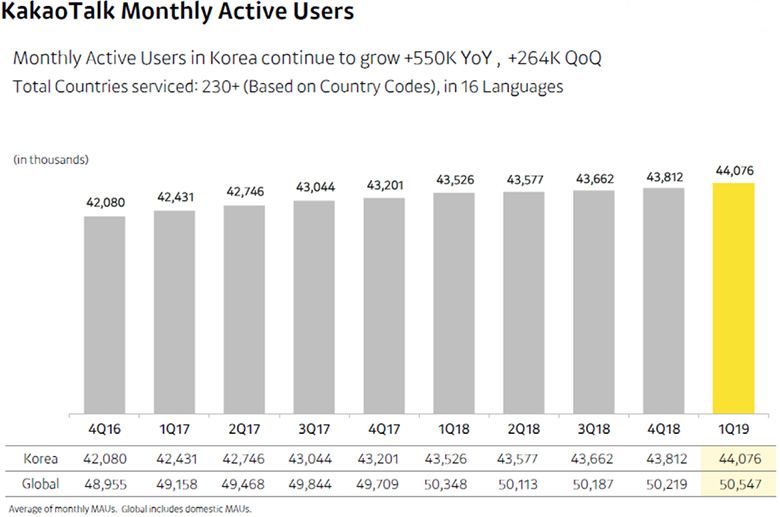
But the kakaobank success story is at least partly about another platform. Kakao Corp, a founding shareholder that wants to become the majority owner, operates South Korea’s ubiquitous messaging app KakaoTalk, which in the first quarter of 2019 was used by 44 million Koreans – 88% of the national population. It is everywhere, well branded and convenient. It uses popular cartoon characters, “more famous than Marvel,” as Yun says, and incorporates them into its message options.
Source: Kakao Corp
It was not immediately the plan to put the kakaobank app on KakaoTalk, but when it was done, it became a transformative method of distribution, even though the two are quite separate companies. Seeing the branding power, the bank has put the same cartoon characters on the app and on a debit card it offers.
To Jun at the FSC, this power of distribution is what has made kakaobank viable.
“Since they do not have any physical branches, they can save a lot of money from that [KakaoTalk], and can instead lower loan interest rates and provide comparatively high deposit rates to customers,” he says. “They are lessening customer burdens.”
Foreign currency remittance rates are as little as one fifth or even one 10th of the conventional norm, he says.
Kakaobank turned profitable in the first quarter, earning W6.3 billion, and is likely to list next year. It has a clear plan in mind. It wants to find partners to leverage its platform and so shift to gaining more fee income than interest income.
|
|
|
Yongwoo Lee, kakaobank |
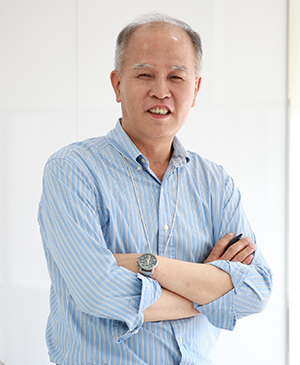
Yongwoo Lee, co-chief executive, describes the finance platform model as “kakaobank’s destination.” The bank wants to “become a platform like Amazon or Facebook in the finance sector,” he says, providing “a virtual place where our customers and financial companies can meet and buy and sell activities.”
Global expansion will follow, starting out in countries with a Korean immigrant population and well-developed IT infrastructure. Lee expects southeast Asia to be a priority: “We don’t have a timeframe yet, but after we establish our business model in Korea then we can have some partnership with global partners.”
Biggest challenge
K Bank, meanwhile, is stuck. Whereas kakobank has now become profitable, K Bank posted a net loss of W79.7 billion won in 2018, worse than the year before by W4.1 billion, according to data from the Korea Federation of Banks.
It actually got out of the blocks first, opening in April 2017 with W250 billion in startup capital; kakaobank came three months later. K Bank opened 35,000 accounts on its first day. Interviewed by Asiamoney last year it said that by September 2018 it had disbursed $1.18 billion of loans to 810,000 customers and taken $1.72 billion in deposits – dramatically behind kakaobank. Approached this year, K Bank said it had nothing to add and would not be giving an interview until the funding matter was resolved.
Still, the FSC is not giving up on it.
“It is true that kakao has a more advanced platform, but K Bank also has huge potential,” says Jun. It has a good loan product and the advantage of receiving customer data from KT, from which it runs a credit scoring system. “So they have large potential if they don’t have funding problems.”
On the funding matter, it really is all about KT; if that shareholder can pass the eligibility test then the problem is largely solved.
“It is desirable for KT to become the largest shareholder of K Bank,” says Jun, “but since it has not passed the eligibility test, we are now discussing measures for other financial players to temporarily inject money and take the management on a temporary basis.”
Woori is thought to be at the front of this process.
K Bank did achieve a capital increase of W27.6 billion on July 12, increasing the total capital to W505.1 billion, but a spokesperson describes that as “a kind of bridge funding” – clearly it needs more.
The biggest challenge we have faced is the issues regarding the law – Yoseop Jun
In a statement to Euromoney, the bank says: “Banks will set the stage for another leap forward with large capital increase and will do their best to provide more innovative financial products and services to customers.”
You might ask why KT, which has plenty of scope to invest, didn’t come in as a bigger shareholder in the first place. That was a legal matter. Up until January, information and communication technology companies could only own up to 10% of an internet bank – and only 4% was allowed to carry voting rights.
A new law, called the Special Act on the Establishment and Operation of Online-only Banks, took effect on January 17, raising that ceiling to 34%; now Kakao Corp is trying to reach that threshold in kakaobank, and KT in K Bank.
You can see that the FSC, which lobbied for this change in the law, wants to be supportive but is somewhat limited in what it can do.
“The biggest challenge we have faced is the issues regarding the law,” says Jun. “Without easing the regulation, we thought that ICT companies could not take a leading role in creating and managing digital banks. We have exerted a lot of effort to ease this regulation.”
But the work is not complete.
“There are lots of other limitations and regulations limiting the qualification of the largest shareholder of a digital bank,” Jun adds. “The laws and regulations are still too tight. That’s the main challenge we have to overcome.”
In a vibrant democracy like South Korea, changing that is easier said than done.
“Changing any law is a very difficult task,” Jun says. “We are right now in the process of discussing the amendment of the related laws with the interested parties, but there are those who are opposed to changing the law due to investor protection issues. I do not think it is going to be easy to amend the law.”
Mixed success
You can’t yet argue that digital banks have really transformed the market beyond kicking the conventional banks into action on matters of simplicity and accreditation. The FSC refers frequently to Japan and the UK as countries to learn from; Jun says there, digital banks take about 4% of the market, whereas in Korea it’s still only about 1%.
“I think we have even greater potential for digital banks to take market share of more than 4%,” Jun says.
 |
| Yoseop Jun, FSC |
It’s certainly not there yet. A report by Moody’s in June found that the two virtual banks had captured only 0.6% of the market share in domestic loans in their first 18 months of operation, “and have brought modest pricing competition,” according to author and analyst Tae Jong Ok.
Tae calls the new entrants “a limited threat to incumbent banks”, positioned as collaborators rather than direct competitors. Fintech will increase competition but open up new revenue sources, Tae says. Competition will increase particularly in retail, meaning weaker loan pricing, but banks will benefit from regulatory moves to diversify payment channels of consumers and will be able to expand in the transactions market, thus developing new areas of fee income.
The mixed successes and modest penetration of the existing digital banks has not stopped the FSC pressing on with plans for more.
Earlier this year the regulator said it intended to approve one or two more digital banks, although it eventually concluded that the only two applicants – Kiwoom and Toss – were not strong enough to receive preliminary approval.
In June, however, the FSC said it would resume a new round of procedures, again aiming at licensing one or two new banks. Jun says they are expected to receive preliminary approval this year, with another year until they reach full operation. Launching any more beyond that would depend on market conditions, he says.
The July announcement says that the application period for the new banks will be from October 10 to 14 this year; and that an announcement of preliminary approval will come within 60 days of application. This time the Financial Supervisory Service, a financial regulator that operates under the oversight of the FSC, will offer consultation throughout the application process to help them through, with the FSC itself on hand too.
In the meantime, the conventional industry is watching with great interest. Jun says the reaction has been both positive and negative.
Conventional banks see digital players within the broader context of open banking, through which financial technology firms will gain access to the payment networks of commercial banks. Open banking should be launched in phases through this year, hopefully with the first going live by December. The second phase will be to legislate the open banking system and the third to open the financial payment network to fintech firms.
“The positive side is that banks are welcoming open banking because they can provide more products to customers of other banks,” Jun says, “and they can have access to all the customers.”
On the other hand, conventional banks are going to have to lower service charges, impacting profitability, and they are concerned about security.
“Banks are worried about cut-throat competition,” says Jun. “It’s going to get more fierce.”