|
|
|
View the Euromoney 25 |

For as long as anyone can remember, the Middle East’s banks have been ripe for consolidation, yet large mergers have been few and far between.
Even the 2007 fusion of Emirates Bank International and National Bank of Dubai (to create ENBD) failed to trigger the expected wave of consolidations.
Now, 10 years on from the formation of ENBD, two of Abu Dhabi’s largest financial institutions, First Gulf Bank (FGB) and National Bank of Abu Dhabi (NBAD), are following in its footsteps.
The result of that merger is First Abu Dhabi Bank (FAB), a bank with Dh644 billion ($175 billion) in assets and a net profit of Dh8 billion, as of the end of September 2017. Although it has much still to prove, the bank has the potential to become a leading player not just in the Gulf but also internationally.
It had long been clear that Abu Dhabi’s banking sector was too densely populated. Perhaps the high oil price that benefited oil-rich Abu Dhabi for so long lulled its bankers into a fall sense of security, as opposed to their neighbours in Dubai, where banks had to be more innovative to generate returns.
But whether the merger was brought about by the vision of a senior royal, as is so often the case in the region, or by the desire to create a new banking titan for the Gulf, FAB is full of promise.
While their businesses overlap in a number of ways, FGB’s strong consumer banking and wealth management franchise should complement NBAD’s wholesale banking proposition.
It is still too early to assess how prominent a position FAB will hold in the region, whether it will inspire copycat mergers or, importantly, whether it will be able to challenge Qatar National Bank, which for several years now has been the Middle East’s financial champion with a prominent position in Africa too.
FAB has an international network in 19 countries, well behind QNB’s 30 and likely below where it should be, especially as it aims to strengthen and facilitate trade flows between the UAE and its trading partners. FAB’s business outside the UAE represents just 12.6% of the group’s total revenue – at QNB it is three times as much.
The merged bank lost an internationalist in Alex Thursby, who had been the chief executive of NBAD, by far the largest of the two banks, for the three years before the merger.
Speaking to Euromoney in 2015, Thursby insisted he would see through the bank’s expansion: “Unless I get knocked over by a bus”. Less than a year later, he was out.
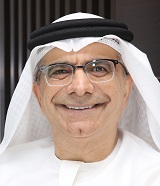 |
| Abdulhamid Saeed |
Instead of Thursby, Abdulhamid Saeed, formerly FGB’s managing director and a board member, became the first chief executive of FAB. Beyond his role at the bank, he also sits on the board of directors of Mubadala, Abu Dhabi Finance Group, Emirates Investment Authority and Sky News Arabia.
For now, Saeed’s primary task is to integrate two complex organizations. The process to combine back-office activities and IT systems is underway, but the overall integration and realization of all the synergies will take a while longer.
Still, Saeed is happy with the work done so far.
“As we approach the end of 2017, I am very pleased with the excellent progress we have made in our integration journey,” he says.
By the end of the third quarter, cost synergies totalled Dh280 million, already exceeding the full-year guidance of Dh250 million. Also reassuring is the fact that one-time integration costs were Dh268 million, well below the full-year projection of Dh386 million.
Saeed says the bank is on track to meet the year’s targets. FAB already delivered a group net profit of Dh8.09 billion for the first nine months of 2017, and Dh2.61 billion in the third quarter, up 2%, thanks to a notable improvement in the cost of risk and the early realization of synergies.
That the merger is going smoothly so far should not mean FAB can take its foot off the gas. It will need to expand well beyond its base and work hard to avoid NBAD’s historic dependence on public-sector debt if it is to compete with its primary rival, QNB, and move beyond any kind of reliance on oil.
If FAB’s formation sparks a wave of consolidations, the bank will also have a whole new set of large, home-grown competitors to contend with. In other words, there are plenty reasons to get a move on.