more on ant’s ipo

Guo Shuqing rarely minces his words. When there’s something to say, he does not hold back. True to form, speaking virtually to participants at Singapore’s Fintech Festival on Tuesday, the chief banking regulator took a sword to China’s once mighty – and now more than a little wobbly – financial technology giants.
Five weeks after Beijing moved to cancel Ant Group’s blockbuster IPO, the head of the China Banking and Insurance Regulatory Commission delivered a carefully crafted speech heavy with undisguised intent.
Guo began gently, bearing carrots, not sticks. Fintech had made financial services “more efficient and inclusive”, he said. Digital credit had improved the lot of farmers and smaller enterprises, and alleviated poverty.
A concerted push to digitalize the entire economy over the past decade, starting with finance, inadvertently prepared China for black swan events like Covid.
We met some problems, learned lessons and gained experience
Guo Shuqing, CBIRC
This part of his speech directed listeners to applaud not big fintech companies like Ant and Tencent, but the technology itself – with Guo consciously putting the state, not the private sector, at the heart of that process. More online activity, from buying clothes and insurance to taking out loans, could only be a good thing, he implied.
Then – down came the hammer.
Guo used the ‘cross the river by feeling the stones’ metaphor, a phrase coined by former leader Deng Xiaoping, to explain how Beijing let financial technology flourish.
Regulators initially opted to give the market a surprising amount of freedom. “We met some problems, learned lessons and gained experience,” he said. It was an approach that made good sense. Let the flowers grow, then pick them.
As problems occurred, which they did, authorities moved in to correct mistakes. Peer-to-peer lending was the first industry to get out of control. “It was originally supposed to be just an information intermediary,” Guo said.
In reality, P2P platforms directed their attention to lucrative products like lending and wealth management. Non-performing loans rose sharply, and the industry morphed into a threat to national financial stability. As of November 2020, he said, all of the country’s peer-to-peer platforms had been shuttered.
Upstart services
Then he switched tack to focus on the big financial technology platforms, who had, he suggested, overplayed their hand.
Ant Group’s Yu’e Bao – although not name-checked by Guo – is a case in point. Introduced in 2013, the service, which means ‘leftover treasure’ in Chinese, was a clever idea. Realizing customers were leaving money untended in Alipay, its digital payments platform, Ant set out to create a money market fund.
As Guo admitted, customers were big fans and for good reason. By putting their cash to work in these largely unregulated funds, they earned outsized returns and could redeem money at any time. But Yu’e Bao and its imitators, Guo said, “greatly rattled the banking deposits and asset management business”.
Again, authorities moved on the upstart services, forcing payment companies to deposit reserve funds with the central bank.
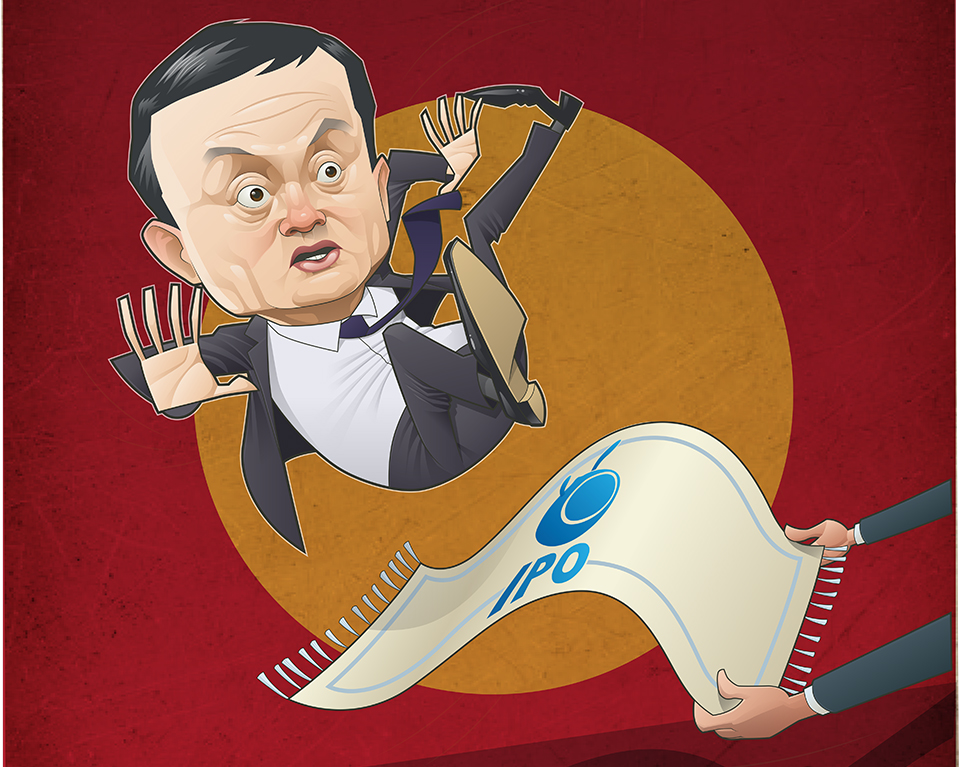
Which brings us to the move by regulators in the first week of November to nix Ant Group’s Hong Kong-Shanghai IPO, a deal slated to raise upward of $34.4 billion.
What surprised many in Ant’s prospectus was the sheer scale of its CreditTech division, which accounted for about 40% of group revenues in the first half of 2020. It enabled Ant to act as the ultimate middleman, sucking in capital from third-party providers – mostly banks – then on-lending it to individuals and smaller firms.
In effect, Ant was acting as a bank, but it wasn’t regulated like one.
Guo didn’t cite this specific threat, pointing instead to the threat of ‘internet financial companies’ inducing people to borrow and spend too much. “They even offered loans to students without repayment abilities,” he sniffed. When defaults ensued, they pursued a “coercive” approach to debt collection, leading to “many social problems”.
In Beijing’s eyes, it was time to rein in these firms. “Fintech’s honeymoon is over,” said Fraser Howie, the author of Privatizing China. “The Empire just struck back.”
Existential threats
The final stretch of Guo’s speech explored the existential threats big fintech poses, in the eyes of mainland regulators, to society and government and to free-and-fair competition.
It’s a debate the West is still grappling with, but here, one of China’s most powerful men shone a harsh light on two of the issues that every country and person faces.
The first is data privacy. China’s government, he said, now recognizes data as a fourth production factor, along with labour, capital and technology.
To that end, he said, it was time for all nation states, including China, to decide who owns this ocean of incredibly valuable personal information, and how it should be stored and used, by whom and where.
It was, he said, time for people to know how their data is used. Companies that fail to tell consumers how it is collected and put to work “seriously violate business interests and individual privacy”.
Guo pointed to efforts to “plug the holes”, noting the unveiling in October of a draft Personal Data Protection Law designed to “prevent data leak and abuse”.
For data to be priced efficiently, he said, we need to figure out who owns it. Will it be the state or the big fintech companies? This matters greatly. If Ant loses sole ownership of its oceans of personal data, investors will need to reappraise its value.
That will hurt the Hangzhou-based technology group. Even if it manages to relaunch its IPO in 2021, it will be massively reduced, not in interest – it will retain its fascination, albeit for new reasons – but in size.
Beijing has grown to distrust and even fear the big fintech firms it once fostered and allowed to flourish
Guo’s second volley took aim at the anti-competitive way big fintech works. It is, he said bluntly, a “winner takes all” industry. The biggest players are data monopolies that “hinder fair competition and seek excess profits”.
Traditional anti-monopoly laws focus on tackling cartels and market abuse, but the industry presents “new phenomena and problems”.
The unparalleled speed of their rise and accumulation of power forces regulators to ask new questions: do these titans of digital industry block competition, collect data in lawful ways, disclose all relevant information to customers, and mislead (or not) users and consumers?
There’s a lot to unpack here, but at the heart of the matter is a simple problem: Beijing has grown to distrust and even fear the big fintech firms it once fostered and allowed to flourish.
This emotion is palpable. You hear it when Guo refers to “new systemic risks” and to a few non-bank lenders having become “too big to fail”. And when he says it is time to “closely follow the spillover of those complex risks and take timely and targeted measures to prevent new systemic risks” from cropping up.
When China’s politicians do not trust you, it does not bode well. It’s hard to see regulators closing down the big fintech operators, as they did with the once-mighty P2P industry, but Guo’s speech left no-one in the audience – and beyond – in any doubt.
For China’s big fintech companies, the golden age is over. The era of big regulation has only just begun.