| Canadian dollar vs Gold |
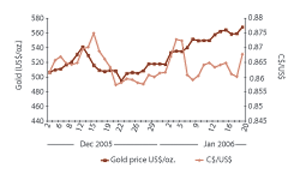 |
| Source: Reuters |
The Canadian dollar was the best-performing G10 currency in 2005. There are various reasons for this, including the fact that the currency has been used as a proxy for plays on certain commodities (see table).
However, as gold has risen against the US dollar by about 9% in 2006, the Canadian dollar has fallen against the greenback by about 3%. This suggests that the relationship between the precious metal and the currency has broken down, perhaps removing one of the major supports for the Canadian dollar’s strength.
Adam Cole, senior currency strategist at RBC, says that the initial weakness seen in the Canadian dollar this year is a result of short-term factors, such as some profit-taking and also some fears that the general election held on January 23 would lead to political uncertainty. He adds that another factor was an easing of natural gas prices. “Of all the commodities that correlate with the Canadian dollar, natural gas is the strongest. It came off the highs and that’s not seen as supportive for the Canadian dollar,” he says. “Also, correlations shift through time, so the impact of moves in gold [on the Canadian dollar] will not always be the same,” he adds.
Tony Norfield, global head of foreign exchange strategy at ABN Amro, is also not particularly convinced about the relevance of the Canadian dollar’s correlation to gold. “The correlation may just be by chance,” he says. “The Canadian dollar has traded a little strangely so far this year, but the liquidity in Canada is not great. It’s a lot less than you might expect,” he adds.
Norfield says the lack of liquidity has exaggerated some of the moves seen in the market, often squeezing people out of their generally long Canadian dollar positions. “There are often pockets of illiquidity, which makes the Canada hard to trade,” says Norfield.
| Correlation $/C$ | ||
| Five-year | One-year | |
| CRB Index | 0.93 | 0.64 |
| WTI Crude (US$) | 0.88 | 0.61 |
| Gold | 0.91 | 0.81 |
| Natural gas | 0.76 | 0.90 |
| Source: RBC Capital Markets | ||
But ABN Amro remains bullish about the Canadian dollar. Norfield’s colleague, Peter Frank, believes that firm commodity prices will continue to support the currency and that the general election, which at the time of writing looked likely to lead to a majority Conservative government, would remove the political certainty. Furthermore, the Bank of Canada is expected to tighten monetary policy throughout 2006. ABN Amro is predicting that the Canadian dollar will post record highs against its US counterpart and that it will move from its current level of around 1.15 to 1.05 by the end of 2006.
Looks good
Lehman Brothers is also mildly bullish on the Canadian dollar. In its 2006 outlook, Lehman wrote: “On both a qualitative and quantitative basis, the Canadian dollar still looks good relative to its peers (other perceived commodity currencies) and the greenback… So intense has the interest been in the energy sector that M&A activity into Canada continues to hit multi-year highs… However, we note that the powerful 9% rally since May [2005] may already reflect all the news… we estimate US$/C$ should be trading in the range 1.10 to 1.20. Hence we are comfortable with our forecast at 1.10 by year-end 2006.”
 |
“The Canadian dollar has traded a little strangely so far this year, but the liquidity in Canada is not great. It’s a lot less than you might expect” |
RBC also feels that the Canadian dollar will be range-bound but it is not bullish. In contrast, it believes that short Canadian dollar positions should be put on if further strength, resulting in a move to the 1.12 area against the US dollar, is seen. RBC feels that support for the currency is eroding, pointing out that the strong M&A inflows seen in 2005 will slow significantly. RBC also believes that although the central bank will tighten, the current interest rate differential with the US will remain relatively constant. Finally, RBC states that there is a high chance that the price of natural gas will come off once the January cold snap ends. Against this backdrop, the price of gold looks unlikely to be a major factor in the Canadian dollar’s performance, at least for the time being.