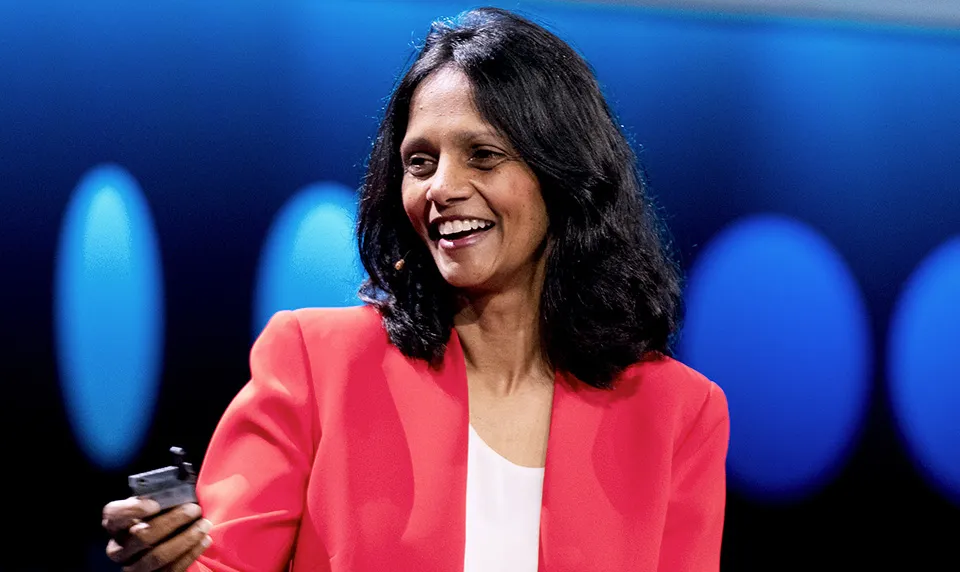

At Macquarie’s most recent results – announced in October and covering the six months to September 30, 2021 – chief executive Shemara Wikramanayake announced not only a 107% year-on-year increase in first half profit to A$2.04 billion ($1.5 billion) but also a A$1.5 billion capital raising.
That capital raising is, in the main, dry powder, with nothing specific earmarked for its deployment. It represents a level of confidence that Macquarie, across its disparate businesses, is going to find good ways to put that money to work.
Where might that happen? At the half year, all four of Macquarie’s core underlying businesses were not only growing but already spending. Between them they had already deployed A$5.5 billion of capital over the 12 months to September: A$900 million through Macquarie Asset Management, which has bought Waddell & Reed in the US and a portfolio of fixed income business from AMP; A$400 million through banking and financial services on the home loan portfolio; A$2 billion in commodities and global markets, driven by platform growth; and A$1.7 billion by Macquarie Capital, particularly through investment in green energy and infrastructure projects, as well as principal financing activities across North America and Europe, Middle East and Africa (EMEA).
One can count on Macquarie to find good places to keep spending simply because it is everywhere. International income accounted for 72% of business in the first half of 2022. When Euromoney asks Wikramanayake how the group will be affected by China tension, she is able to shrug it off and point to a business so diversified that Asia, while employing more than 60,000 people one way or another, accounts for just 7% of total income. These days Macquarie’s happiest hunting grounds are the Americas (39%) and EMEA (26%) – and nowhere more so than in infrastructure.
We are using our human capital to create new assets and find new assets in times of dislocation
Shemara Wikramanayake
So on the same day as the results announcement, Macquarie said it was to buy Thyssengas, Germany’s second largest gas transmission system operator. One can think of it as a metaphor for Macquarie itself: Thyssengas operates a 4,400 kilometre underground network, unseen and largely unnoticed but vital and geared into a much bigger ecosystem. A similar initiative in North America was the prompt to Macquarie’s unexpected record year in the middle of the pandemic as Texas lurched into an energy crisis.
One can also assume that Macquarie will cement its leadership position in renewable infrastructure. It has over 300 green projects under development or construction, with a pipeline of more than 35 gigawatts. Increasingly, rather than just buying assets, it gets in a step earlier and builds them itself before flipping a stake to a super fund or a sovereign wealth vehicle. Not only spotting a trend but driving and shaping it is very much the Macquarie ethos.
“What we try to do is go deep into a sector where we have specialization and deliver much stronger returns than beta,” says Wikramanayake. “We are using our human capital to create new assets and find new assets in times of dislocation.”