It has been a good year for Deutsche Bank, as customers and investors see growing evidence of delivery on the transformation plan set out in July 2019.
Back then, Deutsche had first promised to do a much better job on costs, which have now been inching down for 11 consecutive quarters, although earnings headed the same way at the start. But the bank also grew revenues in 2020, delivering positive operating leverage for four quarters in a row.
The share price is up almost 29% for the year to mid November. Moody’s has the bank on a positive ratings outlook thanks to improved earnings, strong capital and liquidity and low loan losses.
The investment bank has performed much better than expected. For the third quarter of 2020 it brought in revenues 43% ahead of the same quarter in 2019.
Market share
All banks active in the capital markets benefited from higher volumes, greater volatility and wider bid-offer spreads, especially in rates and foreign exchange, which are among the areas Deutsche chose to focus on back in 2019.
But strong performance is not all down to the pandemic. The firm is winning back market share, with 80% of revenues coming in businesses where it is ranked in the top five.
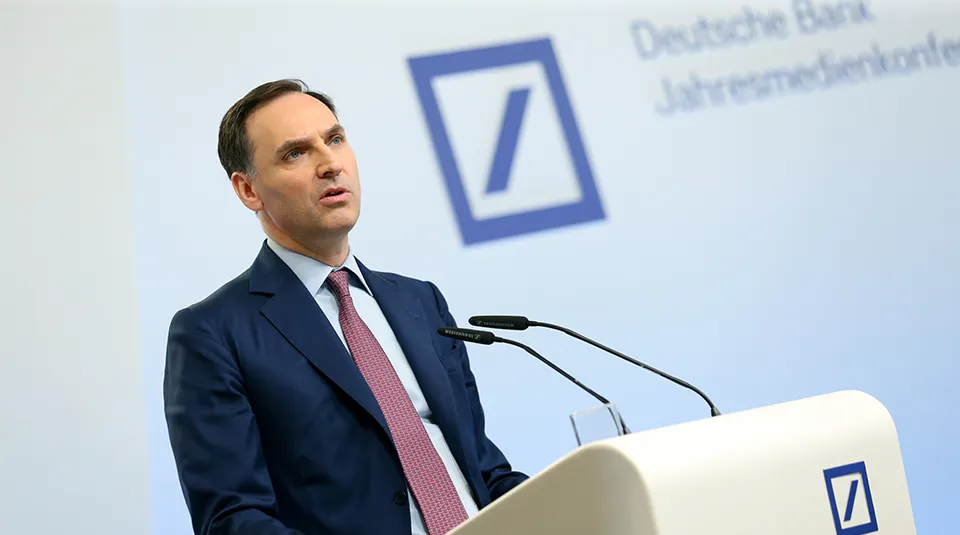
“Back in 2019 we were talking about stabilizing revenues in the investment bank,” Deutsche’s chief financial officer, James von Moltke, tells Euromoney. “In 2020, we have done much more than that. We have grown them and shown market-share improvements.”
Clearly the pandemic has brought frothy market conditions that will normalize. But von Moltke points out that “the decisions we took back in 2019 to focus the business positioned us to participate in the favourable market conditions of 2020.
“We see strong evidence that a large proportion of that revenue will prove sustainable because it is based on franchise improvements and market-share gains. And remember that not all of the businesses we focused on – such as credit and emerging markets – have benefited from the pandemic in the same way as macro rates.
“We saw monthly numbers consistently showing year-on-year improvements in the 12 months starting in October 2019, not just in the periods of elevated activity due to the pandemic,” he adds.
We have been clear that consolidation is necessary and is coming
James von Moltke
Almost as important as what Deutsche did do in 2020 was what it didn’t. It didn’t blow up. Provisions for credit losses have stayed low.
“The question was always: even if we delivered on our transformation, would Deutsche Bank be vulnerable to a downturn? We have been tested on that much earlier than we expected, and shown our resilience,” says von Moltke.
It helps being headquartered in Germany perhaps, where the government has coped much better with the health crisis than other countries, such as the UK. But there is another validation here.
“We have spent a lot of time talking to investors about the strength of the balance sheet, how conservatively we underwrite credit, manage concentrations, secure exposures and hedge risks,” says von Moltke. “But there was still some scepticism back in April when we guided to credit loss provisions of 35 to 45 basis points for the full year.”
Many banks were taking big increases in provisions and saying they had no visibility for the rest of 2020. Come mid November, Deutsche was still guiding to 35bp to 45bp.
“A concern has been whether the fiscal bridging support will fall away before economies are back on their feet,” says von Moltke. “Renewed limitations will diminish GDP in the fourth quarter of 2020 but may push pent-up growth into 2021. We do not see a cliff effect.”
In 2021, we will learn whether or not Deutsche has found its way into a positive feedback loop. Its credit strength may attract more customer business as well as helping margins through lower wholesale funding costs.
European reward
In a speech in November, chief executive Christian Sewing pointed out that Europe is a business partner of both the US and China in a period of greater tension between those two and a less open world. That’s a tricky position that might require hard choices to be made.
Might European clients prefer to give more business to a regional investment bank to reduce dependence on the US firms? Sewing and von Moltke hope so.
“We do see some evidence of there being a reward to the European banks for sticking with their clients in the period of greatest market uncertainty,” says von Moltke. “Back in March and April, there were a couple of syndicated credits where non-European lenders stepped away and European banks filled the gap – and that was appreciated.”
Surely, the only way for European banks to get stronger is to consolidate?
“We have been clear that consolidation is necessary and is coming and that we would expect Deutsche Bank to participate,” agrees von Moltke. “But it is too early to say how that translates into our future. We have been extremely focused on fixing our own house.”
For Deutsche, 2020 may be the year in which it managed to move the terms of that eventual trade in its favour.