Awards for Excellence 2018
|
Who you gonna call? How Citi became clients’ go-to global investment bank |
|
|

A year ago, Euromoney sat with Citi’s Asia chief executive, Francisco Aristeguieta, as he outlined the progress Citi was making with a regional transformation: in consumer, in digital, in China and in trade corridors. Citi was sure it had a winning formula, but we said we needed to see evidence of it working.
One year on, Citi has delivered. The first-quarter 2018 results for Asia represented the seventh consecutive quarter of growth; the $4.13 billion of revenues from the region was up 18% year on year, while net income, at $1.12 billion, was up 48%.
That was just the first quarter. Net income hit $4 billion over the last 12 months, up 22% and representing 26% of Citi’s global profit. For comparison, the standout locally domiciled bank in the region, DBS – which also had an excellent year – saw full-year net profit of $3.28 billion equivalent, up 4%.
Citi’s momentum comes from a number of sources. Any conversation with Aristeguieta is quickly caught up in the revamp of the consumer banking business, which involves trying to be not only relevant in 17 markets but profitable as well. Some of this has been a fairly standard process of branch-hacking – there are 42% fewer branches in Asia than when Aristeguieta joined, with attention instead focused on 69 wealth hubs across the region filled with relationship managers – but it is also predicated on one of the boldest digital strategies in Asia.
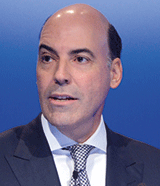 |
| Francisco Aristeguieta |
Citi’s model has been to build numerous digital partnerships to embed the bank in the daily life of customers, whether through Chinese fintech firms like Alipay and WeChat, southeast Asian ride-sharing platform Grab, local e-commerce groups like Line and Lazada, or western tech blue chips like Amazon and Facebook.
Three quarters of Citi credit cards in China are now settled by Alipay, while one in three cards and 40% of new loans are acquired online (up 20% and 126% respectively year on year). Three million customers in Asia are enrolled in Citi’s voice biometrics programme. The mining of data on Citi’s 16 million consumer customers in the region is a priority.
It is telling that Citi was able to hire former eBay chief data officer Zoher Karu and, having done so, had him report to the head of consumer banking, not a technology department.
The result of all of this is the neat trick of increasing consumer deposits by 3% year on year to over $95 billion in Asia, despite having reduced the physical network by 31% at the same time. Numbers like this explain why profits are looking so robust.
Impressively diverse
The consumer and digital revamp has helped Citi come up with numbers that are impressively diverse in their sources. A Citi mantra is that no one country accounts for more than 19% of revenues (a clear reference to HSBC’s heavy tilt to Greater China), and in fact seven generated over $500 million in revenues in 2017/18. A look at earnings before interest and tax by country shows double digit improvement in eight key markets; while frontier Vietnam stands out at 64% growth, what is more impressive is the 29% in Singapore and 35% in Hong Kong, both established developed markets.
But it is not just about consumer by any means. Citi excels in most areas it handles. Its transaction banking and markets businesses, for example, are among the best in the region. Big but innovative, it is the name to beat in cash management and trade finance, embedding itself in the supply chain of its clients.
The corporate banking group has undergone a revamp of its own under Gerry Keefe, who reorganized it into a more integrated structure. (Keefe forms an energetic double act with his effervescent tech-geek Asia-Pacific corporate and investment banking head, Jan Metzger.) The signature development here has been a focus on seven intra-Asian trade corridors, such as China-Taiwan, Korea-Vietnam and Japan-Asean, with staff deployed to support them, such as Koreans being placed in Vietnam. While not purely a play on the Belt and Road Initiative, arrangements like this help strongly at a bank that is present in 58 of 65 BRI countries.
In the past, investment banking – particularly in China – has been seen as a relative weak point, but competitors say Citi is the house that saw the clearest improvement during Euromoney’s review period. Colin Banfield’s advisory presence is consistently excellent, clued-in and forward-thinking, while China investment banking is improving under Guorong Jiang, hired from UBS in June. Citi was on nine of the 12 China tech IPOs that listed in Hong Kong and the US in 2017, while signs of progress include roles on deals for Ant Financial, the Chinese sovereign and the take-private of Changyou.com. It is a rare year when Citi sits near the top of regional ECM league tables.
Meanwhile, traditional areas of strength remain solid. Citi wins our best bank award in Taiwan this year and is always in the mix both as a bank and an investment bank in India.
Aristeguieta and his team can reflect on a satisfying achievement: doing what they said they would do.




