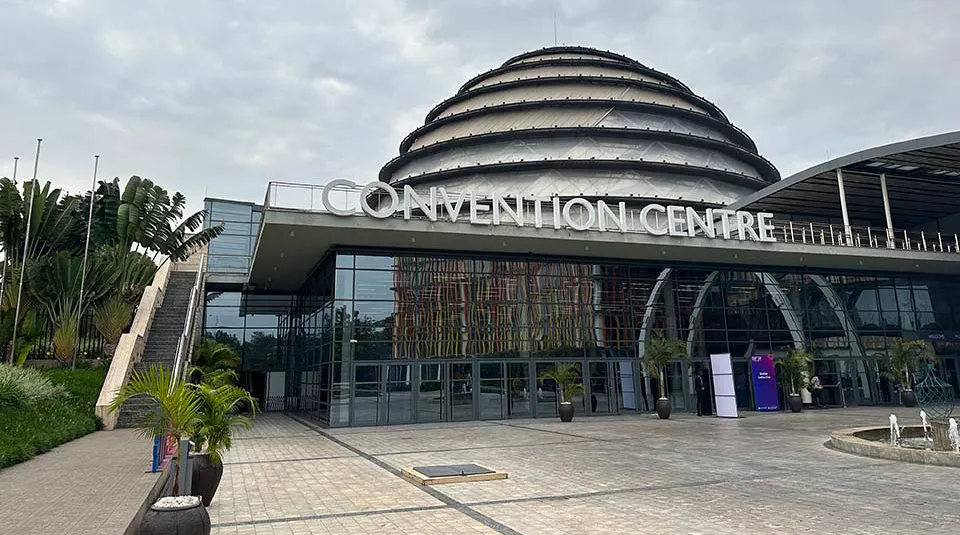
Two vastly different yet curiously similar worlds met at the Inclusive Fintech Forum in a conference centre in Kigali in June. Rwanda was the host of the event, through its Kigali International Financial Centre; but just as prominent – and very much an enabler of the event – was Singapore.
RELATED READING
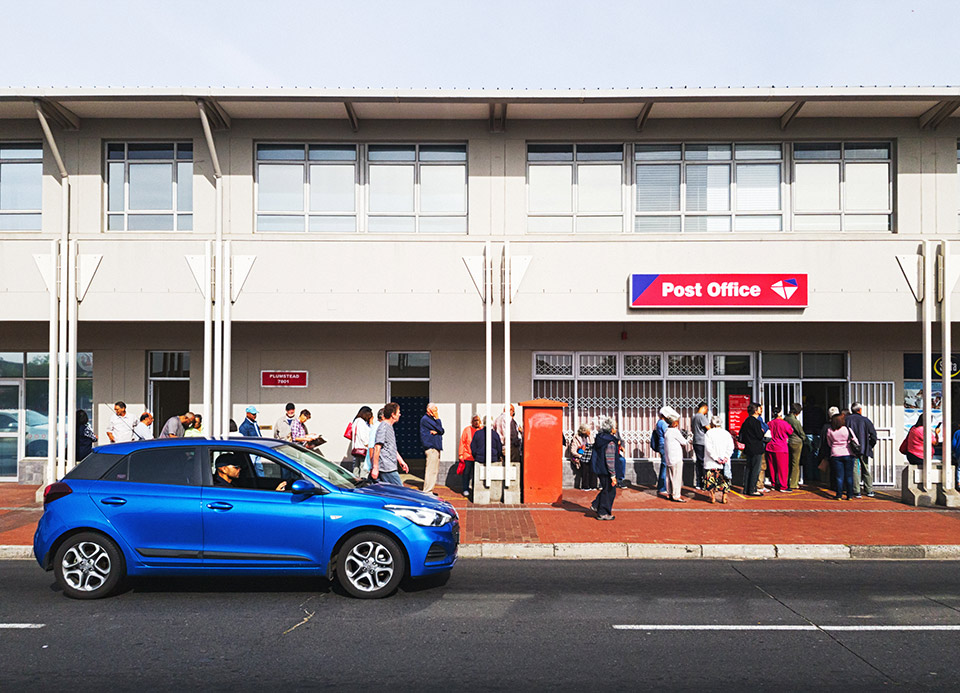
The differences between a spotless Asian nation state that is the gold standard for efficiency in financial services and an African country that many people internationally associate chiefly with the 1994 genocide appear stark.
But there is more in common than you might think. Both are dwarfed by their neighbours in size and population. Singapore’s five million inhabitants on a single small island sit next to the 270 million of Indonesia, the world’s 15th largest country by land mass. Rwanda’s 13 million people, in a country the size of Wales, neighbour the Democratic Republic of the Congo, 11th largest in the world, with 96 million people. Another 64 million live on the opposite side in Tanzania. Enabling their home-grown businesses to reach out from their own modest populations to the huge regional ones is a priority for both Singapore and Rwanda.
Both have a reputation for being the cleanest and safest countries in their region. Both, bluntly, have democracies with a tendency towards autocracy.
But the reason for this conference, and this alliance, is the firm belief in both locations in the power of digital banking technology as an enabler of economic growth and (although Singapore barely needs this anymore) social inclusion. When you come to Kigali you hear a lot of people telling you it’s the Singapore of Africa.
No doubt there’s a geopolitical, soft power angle to all of this: Singapore, one of the two indisputable international financial hubs of Asia, seeking ties with a country that aspires to be its equivalent in Africa. The megatrends of food security, evolving trade corridors and even China’s infrastructure influence in Africa might also be in the mix.
Certainly, Singapore took this conference very seriously. The event was organized by Elevandi, a conference business that grew out of the Monetary Authority of Singapore (MAS) and its vast Fintech Festival event. Speakers who flew over to Kigali included Ravi Menon, MAS’s managing director, and Sopnendu Mohanty, the chief fintech officer at MAS and the brains behind many of the regulator’s experimental sandbox ideas. DBS chief executive Piyush Gupta gave a video address. Reflecting the importance on the African side, two presidents – Rwanda’s own Paul Kagame and Zambia’s Hakainde Hichilema – both spoke, alongside a host of Rwanda’s most senior ministerial and central bank figures.
Growth opportunity
The opportunity is beyond dispute. The projected growth in the 15 to 24 age demographic in Africa by 2030 is 42%. Bank branches aren’t going to reach them all: there are 4.5 branches per 100,000 people in sub-Saharan Africa compared with 30 in the US.
Africa’s mobile penetration is 80% – 47% for internet – at the same time 65% of sub-Saharan Africa’s population is either underbanked or completely unbanked. Half of the world’s registered mobile money customers are based in Africa; and sub-Saharan African accounted for around 70% of 2021 global mobile money transactions, mainly person-to-person transfers. Around 33% of adults in sub-Saharan Africa have a mobile money account, the highest level of any area in the world.
Around 85% of employment in Africa is in the informal economy and it accounts for about half of its economic output. Bringing that into regulated finance is also a considerable opportunity.
But progress tends to be highly specialized within a few markets. Kenya, where the game-changing M-Pesa service was established in 2007, today leads the ‘buy now pay later’ sector by a mile, with $3.6 billion of payments in 2022 and an expected compound annual growth rate of 52.5% between then and 2028. South Africa, Egypt and Nigeria, who follow in the ranking, are the others who dominate progress.
There were 21 neobanks in Africa by 2021 and all but four of them are in South Africa and Nigeria. OPay, the Nigerian mobile money wallet, had more customers in 2021 than the other nine members of the top 10 put together. Africa has 54 countries and most are not yet part of the story.
The number-one driver in the world is innovation. It’s not raw materials, it’s not natural endowment, it’s intellectual capital, innovation, soft power
Tidjane Thiam, Rwanda Finance
Speakers at the conference spoke along two broad lines: optimism about the future and realism about the challenges of getting there.
Setting the stage was Tidjane Thiam, taking a welcome break from being asked about Credit Suisse to use his role as board chairman of Rwanda Finance to talk about experiences dating back to his time as chief executive of the National Bureau for Technical Studies in Cote d’Ivoire, his home country. Back then, he remembers, it fell to him to introduce the first free mobile licences in the country in 1995.
“For six months we were blocked with the World Bank who simply did not believe that mobile could succeed in Africa,” he says. “We had to fight to get those three licences. The logic was people were not educated enough to use phones… the rest is history,” he recalled. His lesson: don’t listen to the sceptics.
For Thiam: “The number-one driver in the world is innovation. It’s not raw materials, it’s not natural endowment, it’s intellectual capital, innovation, soft power.
“That’s good news, as it’s where we are most equal as Africans. We have the brains. I do believe that brainpower is equally allocated on the planet.”
Moving forward
That’s the ambition. But three messages came through repeatedly about what Rwanda and Africa needs in order to move forward through fintechs – capital, regulatory harmony and talent.
“Banks are not natural providers of equity capital,” Thiam says. “What is needed is equity capital, not lending. It’s easier for insurance companies to provide than banks.” It needs practical thinking too. Thiam remembers securing the funding for a toll bridge in Abidjan and to close the deal he got the army pension fund to provide the last $50 million of equity, convincing them that in order to pay the pensions of the nation’s soldiers they needed a generative cash flow asset.
Africa proudly boasts seven unicorns, including Nigeria’s $3 billion valued Flutterwave and Egypt’s MNT-Halan, and one day most will list. But is Nasdaq really a natural home for them?
“What we’ve realized from having IPO’d several companies on Nasdaq is that Nasdaq doesn’t really like African companies,” says Iyinoluwa Aboyeji, founder of Fund for Africa’s Future, an innovation fund. “But our markets are excited about us. Local markets want to invest because they see the product and the impact every day. Markets like Nigeria are ready to take startups public.”
What we’ve realized from having IPO’d several companies on Nasdaq is that Nasdaq doesn’t really like African companies
Iyinoluwa Aboyeji, Fund for Africa’s Future
Arjuna Costa, founder and managing partner of Flourish Ventures, bemoans the lack of available local currency debt, among other sources. “As an early stage investor, who’s going to fund the next round for that company? Where’s follow-on capital going to come from? We need depth in local venture markets, private equity markets.”
He would like local pension funds to step up as well. “I would push to see what the allocation of every pension fund in the continent is. How much is going to ventures… it’s abysmally low. You don’t get the flow moving until you solve these problems.”
Aboyeji agrees. “You have to address the question of capital allocation,” he says. “When we talk about pension funds, we are talking about teachers’ pensions: we can’t be reckless. But now we can answer the question and be a practical part of the conversation.”
Beata Habyarimana chief executive of Rwanda’s BK Group calls for the setting up of electronic payment platforms. “It’s a must.” She would like to see harmonized regulation and flexible dispute resolution mechanisms.
Regulation bugbear
Regulation is a bugbear because it’s not enough for one nation to be on track. Here, Singapore and Rwanda, small nations surrounded by big ones, agree.
“If you’re operating in a traditional sector, manufacturing or logistics, as an SME in a small country it means you have to go cross border, beyond Singapore and Rwanda,” says MAS chief Ravi Menon. “That’s not easy. The advantage is in the fintech space you don’t need to set up hard infrastructure because payment rails allow you to access overseas markets and almost overnight you have made the world your market and resource.
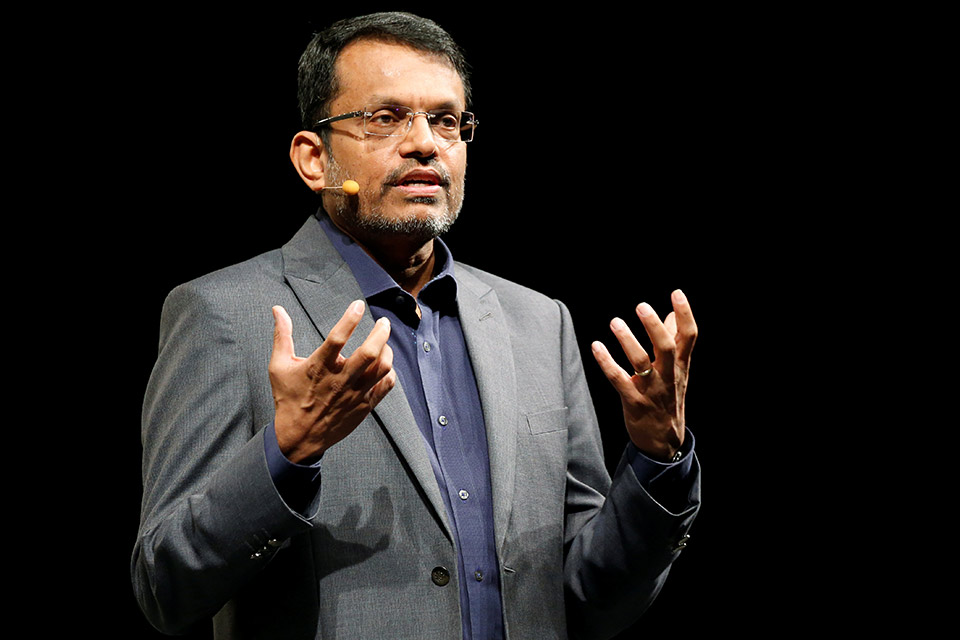
“But what are the disadvantages of being small? Mostly regulation. To access markets, there are digital roads but also checkpoints. Regulations are not harmonized.”
John Rwangombwa, governor of the National Bank of Rwanda, agrees. “The challenge we still have is regulation that is not harmonized and it is difficult to be facing different regulatory requirements,” he says. “Before we achieve monetary union, which is an ambition of the region, we want to be sure we have harmonized regulation for financial sector players.”
The Continental Free Trade Area, which seeks to create a single continental market for goods and services in Africa, would be a game changer for Rwanda. “It would take our market from a population of 13 million to 1.3 billion, a GDP of $1.4 trillion,” Rwangombwa says.
We need to be very clear what governments and policymakers can do. And one thing they cannot do is innovation
Ravi Menon, MAS
It’s a huge ambition but perhaps that’s the scale of intent that is needed. “Doing this bilaterally is not an efficient way to go,” says Menon about harmonizing systems and regulation. “Free trade agreements involve a lot of excruciating details. You have to multi-lateralize, which is what the WTO [World Trade Organization] used to do.”
It would certainly make life easier. Costa notes that harmonization needs to go beyond the central bank level into “the guts of the system” with reporting requirements. “If I start in Rwanda, with supervisory tech, I press a button and I go to the next step.” But as soon as he goes to the next market, without the same expertise and system: “I need to get engineers in. The potential is there, the scalability is there, but there is so much friction to overcome.”
What should regulators be doing? Singapore has some suggestions.
“We need to be very clear what governments and policymakers can do,” says Menon. “And one thing they cannot do is innovation. That’s why they’re in government. Governments and policymakers should create the conditions for innovation to flourish.”
Part of that is policy itself, but the other part is infrastructure: “For the digital economy, where what moves is not people or goods but data and insight and knowledge. It is payment rails, digital identities, connectivity. Those are the public goods in the digital realm we need to look at.”
Infrastructure investment
Rwanda’s Rwangombwa has long been on board with this idea. He remembers his time as finance minister in 2010 when president Paul Kagame insisted they should lay fibre-optic cable across the mountainous country.
“It wasn’t easy for me to understand the value at the time, but the understanding of the need to invest in infrastructure was key,” he says. “If you really want to promote fintech or innovation, infrastructure matters a lot.” In fact information and communication technology was embedded in Rwanda’s national vision back in 2001.
Rwanda has created a sandbox system for innovation, as has Nigeria, Kenya, Mozambique, Zambia and Liberia, with others on the way from Angola and Mauritania.
“It can be challenging balancing: you want innovation but don’t want products just popping into the market that create instability,” says Rwangombwa. “That’s why we have a sandbox, to test products in a live environment.”
Also present in Kigali was Elsadiq Hamour, managing director, financial institutions at the Qatar Financial Centre Authority. Relations between Qatar and Rwanda are also developing warmly, aided by a non-stop flight between Doha and Kigali. Qatar’s own model has been to build a centre, the QFC, whose rules and regulations are quite independent of those of the rest of the country, although Hamour stopped short of making that an outright recommendation for Rwanda. Among other things, Rwanda doesn’t have an equivalent of the Qatar Investment Authority, the sovereign wealth fund, to spur things along.
“Regulatory support is very important,” says Hamour. “I believe every jurisdiction has its own challenges. There is no framework you can take off the shelf. But the worst thing you can have is no regulation.”
Then there is the issue of talent development. “Size does not matter and speed does not matter: our central banks and commercial banks are very slow,” says Lacina Koné, director general of Smart Africa, an accelerator for African sustainable socio-economic development launched by seven African heads of state in 2013. What matters is: “A young vibrant population. We need to be engaging in capacity building our young people if by 2050 truly 40% of the world’s workforce is going to come from Africa.”
Fintechs themselves come up with another requirement: data. “In the western world economies are based on trust and in the African world they are based on truth,” says Koné. “The difference between trust and truth? Trust is based on eKYCs [electronic know your customer checks]. They are well defined; your home address is known in a data economy. But in Africa, you don’t have a credit card. That’s the truth.
“Until you resolve the issue of the eKYC in Africa, the foundation of digital ID, we will not make it.”