 |
|
CENTRAL & EASTERN EUROPE |
| Prosperity Capital Management |
| PPF Group |
| Galt & Taggart Securities |
| Société Générale |
| Erste Asset Management |
| Return to main index |
IT’S SAID THAT wisdom comes with age. That would seem to be the case with Prosperity Capital Management, a Russia-focused equity fund manager founded in 1996 that over the past 13 years has established itself as the largest foreign asset manager in the region, with about $1.5 billion under management. Despite the seesaw nature of the Russian stock markets, PCM has delivered consistently strong results for investors. The firm’s flagship investment vehicle, the Russian Prosperity Fund, has delivered an average annual return of 16% since launch in 1996. That amounts to a fivefold increase since inception while the headline RTS index of Russian stocks grew by three times. PCM’s other main offering, the Prosperity Quest Fund launched in 1999, has performed even better, delivering an average 35% return over its lifetime, up 15-fold compared with a five-fold increase for the RTS over the same period.
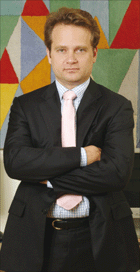
Chief executive Mattias Westman, who co-founded PCM in 1996, believes that the firm’s success is based on its unashamedly proprietorial attitude towards its investments. “We always tell ourselves that we own part of a company, not a piece of paper. Our holdings are not just share certificates someone might pay more for tomorrow.” As part of that investment philosophy, the company takes an active part in running many of the companies it invests in – it is a member of their boards. These companies account for some 40% of assets under management.
Corporate governance risks
Westman was a co-founder of Russia’s Investor Protection Association. To his credit he’s the first to acknowledge that corporate governance standards in Russia are still far from ideal. “There are serious corporate governance issues in Russia, with a lot of immature companies and a weak judiciary,” he says. But he argues that PCM’s activist shareholder stance has played a key role in reducing those risks. “As an active shareholder we try to mitigate the corporate governance risks, which is an important part of the value added we bring to the table,” he says. Westman says that for PCM, shareholder activism means having a cooperative as much as a combative relationship with companies it invests in. “We try to cooperate with firms wherever possible,” he says. “We look to help our companies with advice on M&A transactions and raising capital for example, rather than have a hostile attitude.” Where necessary, though, the company is never afraid to criticize and push for improvements. “We do defend our rights at all times and as a major fund manager we can get things changed,” he says.
|
“Once the financial pressures on owners in Russia are reduced, we will see an improvement in corporate governance” Mattias Westman, Prosperity Capital Management |
 |
Westman feels that the corporate governance risks associated with Russia are declining, rather than increasing. “The level of corporate governance has improved a lot – 10 years ago it was terrible,” he says. He acknowledges that the global economic crisis has brought about a reversal of the improvement in corporate governance standards to some extent but claims: “Once the financial pressures on owners in Russia are reduced, we will see an improvement in corporate governance.” And he points out that on a long-term basis poor corporate governance records have backfired on business owners. “Many of the early oligarchs in Russia have gone out of business,” he says. Although 2008 was a year to forget from an equity market perspective in Russia – the country’s stock market was the worst performing of any big economy, with the RTS index posting a 75% drop – Westman retains a sanguine attitude. “Last year was pretty traumatic not just for Russia, but also for the whole world,” he says. But Westman believes that Russia will be a prime beneficiary of any recovery in the global economy. “We are seeing a shift from a west-oriented to an east-oriented global economy and Russia is best placed to benefit from that shift – there’s still enormous demand for commodities of which Russia has large reserves and the country is physically close to major markets such as China and Europe,” he says.
With regard to the vexed question of whether the Russian economy remains a one-trick investment pony – a high-beta play on oil and gas prices – Westman points out that the energy sector accounts for only 25% of Russian GDP – down from 40% as recently as 2003. Furthermore, he says that even though a large amount of Russia’s current account surplus will always come from commodities, there are plenty of successful economies based on the resource-plus model – such as Sweden, Canada and Australia. He points out that Russia also boasts plenty of manufacturing and consumption plays that will benefit from any recovery in domestic and international demand. “Russia has a lot of large, very good companies with very solid financials and very little debt,” he says, adding that the overall Russian equity market is nevertheless trading at an historically low P/E ratio of five. “So there’s substantial upside left in Russia.”
Much healthier than in 1998
Although acknowledging that the Russian economy faces the bleak prospect of a sharp decline in GDP in 2009 – the latest forecast from the European Bank for Reconstruction and Development is that GDP will fall by 7.5% this year – Westman argues that the economy is far stronger than it was in 1998 when it collapsed under the burden of spiralling sovereign debts. Since then government debt has fallen from 80% of GDP to just 6%, and the government’s foreign exchange reserves have risen 51-fold over the same period to about $385 billion and now cover 19 months of imports – the biggest safety margin of any big economy. “The most important anti-crisis measure undertaken by the government was to save the money from oil revenues to build up reserves, which has given it the means to fix economic problems,” Westman says. He says that while the authorities in the Kremlin – just like those in the White House – were initially slow to realize just how serious the global economic crisis would get, he believes they have ultimately reacted well. “Once they realized the severity of the crisis they have acted responsibly,” he says, adding that the Russian government has not resorted to wholesale nationalization or quantitative easing alongside a successful, albeit costly managed devaluation of the rouble that avoided a meltdown of the banking system. On the microeconomic level Westman claims that there has also been a positive response. “A lot of companies are taking advantage of the crisis to make productivity gains and improve efficiency,” he says.
While acknowledging that there are plenty of short-term economic uncertainties in Russia, Westman says PCM remains confident in the country’s longer-term prospects. “We don’t know what’s going to happen in Russia next week but we do think we know what’s going to happen in the next three years,” he says. As a result he remains confident that the firm’s long-only investment bias is the right investment approach to take. “If you’re a trader you should be using derivatives but not if you’re a long-term investor,” he says. “Fundamentally if you want to be in Russia, you want to be long.”
Westman says that the firm’s investor base, which includes sovereign wealth funds, insurance companies, pension funds, private banks and family offices, remains comfortable with PCM’s long-term vision. “We didn’t have to gate any of the funds in either 2008 or 1998,” he says. He adds that many of PCM’s investors, especially those from Scandinavia, have long-established business interests of their own in Russia, which he claims gives them a better understanding of the country, which he says is still generally the subject of a lot of misinformation and myth-making. “Around 500,000 Swedes have invested in Russia, which is probably more than in any other country,” he says. He adds that while the Swedish press has tended to focus on the positives of doing business in Russia – highlighting the fortunes made by Swedish companies such as Ikea and Oriflame, for example, he says that media coverage in other countries has often concentrated on negatives such as corruption scandals. “Every country has its own set of problems, but given the difficulty and size of the task that Russia faced at independence in 1991 the country has come a long way.”
New Cold War a myth
Westman is particularly dismissive of the notion that there is the danger of a new Cold War. “The Russians have no interest whatsoever in resurrecting Cold War politics – there is no real ideological difference between Russia and the West,” he says. “Russians want the same as everybody else – to live in a free country, to have a job, a house, a car and for their children to have access to good education and healthcare services.” Westman welcomes the so-called reset policy being pursued by the US administration under president Barack Obama that is designed to engineer a thaw in US-Russian relations. He says that while the new policy will arguably help to boost US investment in Russia, he believes that ultimately Europe is better positioned to benefit from Russia’s transition to a fully fledged, prosperous market economy given its greater physical proximity and stronger cultural and business links.
As a native of sport-mad Sweden, Westman says that decades of friendly rivalry with Russia on ice hockey rinks or over biathlon courses have given fund managers such as Prosperity Capital Management the insight into the country that will help to ensure that there is real substance behind the firm’s name.


