 |
|
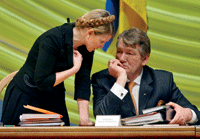
Yushchenko and Tymoshenko: political uncertainties might hold investors back |
Foreign investors say growing signs of division between president Viktor Yushchenko and prime minister Yulia Tymoshenko of Ukraine are causing concern. The president and his cabinet have seemed increasingly at odds over the past month, which investors identify as one of the main obstacles to increased investment in the country. Odeniyaz Dzharaparov, fund manager at hedge fund Griffin Capital Management, said on the sidelines of Renaissance Capital’s Russia and Ukraine conference: “The economic situation is OK there. It’s the political uncertainty that’s holding investment back. People still have enthusiasm for the country after the Orange Revolution, but the enthusiasm is fading.”
Tymoshenko and Yushchenko stood side by side in Kiev’s Maidan Square as the two leaders of last December’s Orange Revolution. They are the two most popular politicians in the country. There are signs, however, that their relationship is increasingly tense.
Boris Nemtsov, former deputy prime minister of Russia and an adviser to president Yushchenko, says: “They’re like that American film where two people who hate each other are handcuffed together, so they have to work together. And that handcuff is public opinion. They need each other.”
The two have fallen out over Tymoshenko’s handling of the country’s petroleum problems. Shortly after taking power at the beginning of the year, the cabinet passed a law fixing petrol prices. Importers, mainly from Russia, responded by exporting less petrol to Ukraine, leading to a shortage in the country. Tymoshenko accused Moscow oil oligarchs of deliberate economic sabotage, and threatened to re-nationalize their Ukraine refineries.
At this point, the president intervened and cancelled all government price fixing in the petroleum market. It was not the only move by Tymoshenko to set prices. She ordered similar price-fixing in the meat market. Nemtsov says: “I visited a burgeoning, boisterous meat market in Kiev. There were policemen standing at the counters, but no meat on them.” Again, the president intervened to liberalize prices.
The two are also sharply at odds over the sensitive issue of reprivatization. One of the pair’s pre-election pledges was to revisit those privatizations that were undertaken unfairly during the previous regime. However, the politicians’ perception of what this entails are very different.
Viktor Ivchenko, chairman of Ukraine’s national depositary system and an adviser to Tymoshenko, says: “For the president, property is inviolate. And the argument that, because someone stole something from someone else, the state should reprivatize it, is inadmissible to him.” The president has suggested reprivatizing about 30 enterprises at most.
Tymoshenko, by contrast, has spoken of reprivatizing 3,000 enterprises. She has been supporting a law being read in the Ukrainian parliament now that would let
the government nationalize companies for reasons ranging from ‘non-transparent privatizations’ to ‘unfair prices’.
“This law is a catastrophe. It’s a disaster,” says Nemtsov. The dispute over how to handle reprivatizations has dragged on for six months, damaging prospects for foreign investment, which only reached $1.6 billion last year.
Beneath these arguments is a deeper ideological dispute. Yushchenko is an avowed free-market liberal, and has repeatedly told foreign investors of his desire to make Ukraine an attractive investment location, where government will not interfere where it’s not needed.
Tymoshenko, by contrast, has pursued much more interventionist policies since coming to power. Nemtsov, another free-market liberal, says: “She’s a proponent of something called Solidarism [an early twentieth century Christian economic theory that places ethics above market forces] which is basically socialist utopianism. She doesn’t have the faintest idea how business actually works.”
Some wonder if Tymoshenko’s populist and socialist rhetoric is actually clever political manoeuvring ahead of the country’s parliamentary elections in March 2006. The country’s constitution, under an agreement made during the Orange Revolution, will be changed on September 1, so that, in effect, the prime minister becomes responsible for most domestic policy while the president is, as in Poland, responsible solely for defence and foreign policy.
The winner of the parliamentary elections in March would be the most powerful person in the country.
“If Tymoshenko’s party won that election and she continued as prime minister, it would be very damaging for the country,” says Nemtsov. “On the other hand, she’s very pragmatic. Maybe she would change her policies once she won.”


