

WHEN BLUE MOUNTAIN chief executive Andrew Feldstein wrote to investors in the firm’s Credit Alternatives Fund on November 3 informing them of his redemption and recapitalization plan for the $3.1 billion fund, it was a clear sign that the difficulties faced by credit fund managers had reached a new intensity. The Blue Mountain Credit Alternatives fund is one of the largest and most successful credit hedge funds in the market, having returned 17.4% in 2006 and 8.8% in 2007. But on October 31, the fund was down 2.4% year to date. Feldstein wrote that he was moved to take action on redemptions from the fund, despite "both our distinguished performance through the credit crisis and some of the best investment opportunities we’ve ever seen".
All investors in the fund were given the stark choice of redeeming their existing investment or exchanging it into three new locked-up classes with longer lock-up periods (90 days, one year and two years). "Put simply, the bid-offer around mid-market valuations is at exceptional and unprecedented levels," wrote Feldstein. "If we were to unwind or sell positions to meet current redemptions, the severe liquidation costs would be borne inequitably by the remaining investors. Moreover, selling our most liquid positions would further disadvantage remaining investors and later redeemers by leaving them with a less liquid portfolio."
Blue Mountain’s decision to halt redemptions from this fund has attracted much attention. However, it is just the latest example of the hammering that many credit funds have taken this year. Several other large hedge funds have been scrambling to shore up their credit vehicles: for example, GSO Capital (which is owned by Blackstone) has had to raise an additional $100 million from investors to meet margin calls and GoldenTree has been forced to tap investors for an additional $250 million of rescue capital (see Credit opportunity funds: Hedge fund deleveraging kills opportunity funds, Euromoney, November 2008). Citi has also folded its Corporate Special Opportunities fund. Forced deleveraging is hitting funds large and small: in London, several managers, including Elgin Capital Threadneedle Asset Management and RAB Capital have shuttered or halted redemptions from funds. "It is amazing how many hedge funds are hanging on by a thread," says a US credit hedge fund manager. "Those that are down 25% will never make their high-water mark again. There is simply no incentive for them to keep going."
But the incentive for funds that can position themselves to take advantage of the extraordinary times in credit is not in question. Hedge fund manager John Paulson, having shorted the market since 2006, positioned himself to begin buying US RMBS at the beginning of October. Via a new fund, the Paulson Recovery Fund, he will look at distressed sub-prime mortgage securities and LBO debt. In Europe, spreads on triple-A ABS have gone from less than 10 basis points before the crunch to more than 400bp now, which is a phenomenal opportunity for investors that are in a position to go long. But that is what many credit opportunity fund investors thought a year ago, and they have paid a heavy price for betting against what turned out to be a relentlessly falling market. And the impact of Hank Paulson’s decision to divert the Troubled Assets Relief Progamme’s (Tarp) focus away from mortgage-backed securities was for the market to lurch yet wider – after the announcement the ABX HE triple A index lost 3.1 points in one day. So how can credit investors make sure that this time their strategies are bomb-proof?
New spirit of creativity
The first and most obvious approach is to minimise any exposure to redemptions. "It is better to address the current market with locked up capital. Callable capital is suitable for overnight deposits," says Tim Frost, director at Cairn Capital in London. "In the credit market the violence of the mark-to-market moves has made a mark-to-market approach very challenging to operate successfully. But there is some new money proximate to the market and there are certainly a plethora of opportunities out there." Cairn was one of the first credit funds to feel the force of the looming storm in credit when it was forced to restructure its $1.6 billion Cairn High Grade Funding SIV-lite vehicle in August 2007. It won many plaudits for the speed with which it addressed the problems in that structure, and has subsequently been busy advising other funds in the market on restructuring issues. The firm recently hired ex-Lehman Global Real Estate managing director Peter Hansell and is poised to launch its first commercial real estate fund to take advantage of distressed opportunities in that sector. In November, Cairn’s website carried a quote from early 20th-century Czech economist and political scientist Joseph Schumpeter: "Out of destruction a new spirit of creativity arises". This is something that all in the credit market are fervently hoping remains the case.
A spirit of creativity is certainly arising out of the spread dislocation and dysfunction that has resulted from marking to market. Just how anomalous some of the pricing in credit is was highlighted recently at the Reuters Global Finance Summit. Blackrock president Robert Kapito pointed out that a $30 billion portfolio of mortgage risk that the firm acquired in a distressed sale from Bear Stearns earlier this year was performing as expected. "The cashflows are coming in very close to what we had anticipated from the very beginning," he said. The portfolio was marked at $26.8 billion at the end of September but Kapito pointed out: "I would say that the cashflows on these securities predict a higher value than what is currently marked to market."
That chronic illiquidity has resulted in illogical marks is hardly news. "There is complete dislocation in all instruments," says Neil Neilinger, CIO and vice-chairman at Aladdin Capital in Stamford, Connecticut. "Long-only will be a great business to be in right now."
Income generation
Unlevered ABS investors have traditionally been few and far between – with triple-As at Libor plus 8bp it was an almost impossible approach to take. But in today’s market it is the only approach to take. "Now is the time to like credit," states Alex Veroude, head of credit at Insight Investment in London. "The opportunities are always the greatest when there is the least amount of capital available." Veroude joined Insight, the asset management arm of HBOS, from GIB in May 2007 as head of credit. Insight is poised to launch a new credit fund, the Absolute Insight Credit Fund, by the end of this year. The Dublin-domiciled credit fund is Ucits III structured and will invest in a wide range of fixed-income securities. It will have a minimum investment of £250,000 and a management fee of 1% a year, with a 10% performance fee. "We made a conscious decision not to run funds with leverage and we have not pursued high-risk assets," says Veroude. "We have a very clean slate in credit. We think that the premiums we are accessing now overcompensate for the risks taken."
| Structured squeeze |
| Cumulative and monthly structured credit hedge fund index returns |
 |
| Source: Palomar Capital Advisors |
Veroude identifies income generation as a possible next trend in credit, and suggests that this could be a very important consideration for pension funds and other investors with similar strategies. "There was plenty of income available for these funds when base rates were at 6% but they are now at 3% and heading for 2%," he says. "Where will they get income from in this environment? From credit would be one answer." In an echo of Kapito’s comments, Veroude insists that the assets backing many fixed-income securities will perform much better than their price suggests. "The only thing distressed about these assets is their price," he says. "We are buying markets that were driven by leverage: the ABS market was shored up by levered money, as was the European loan market. As this process goes into reverse, spreads will inevitably overshoot."
If these sentiments sound familiar it is because they were exactly the argument made by the many credit opportunity funds that were set up 12 to 18 months ago. Many of these funds have struggled as asset prices have stubbornly refused to find a floor. But Veroude argues that the time is now right. "With hindsight, many of these credit opportunity funds launched at the wrong time and with the wrong strategy," he says. "The differentials in 2006 were so tiny that you had to lever very hard in order to take advantage of them. Now you do not need to run any leverage for a credit opportunity fund to work. You can take non-directional risk and make a healthy return."
Exploiting volatility
But not everyone agrees that the tipping point has come with regard to going long in credit. Nevertheless, there are other approaches that can take advantage of continuing volatility in the sector. One new fund, the Chenavari Credit Dislocation Fund, is due to launch shortly at an expected size of $75 million to $100 million. The fund is being launched by alternative investment management firm Chenavari Credit Partners, which was set up by ex-Calyon global head of structured credit Loïc Fery in May. Fery was at Calyon for six years before his departure in October 2007, following the discovery of an unauthorized credit position in New York. "A lot of people are talking about distressed investing but I don’t share their view that this is yet the time to invest in distressed debt," says Fery. "I was amazed when I saw firms like Pimco and TCW setting up credit opportunity funds in the first half of 2008 – it was clearly still too early. We think that there is still some mark-to-market downside potential for corporate debt levels when corporate defaults start to kick in. We will gradually move into distressed investing but credit dislocation opportunities are not just limited to distressed investing."
 |
| "Most investors that suffered losses in credit got burned in straight credit investing, not through credit hedge fund investing. Credit hedge funds are due for a very strong performance in the next two to three years"
Loïc Fery, Chenavari Credit Partners |
Chenavari’s strategy is to be credit spread neutral but with a strong convexity profile to benefit from volatility. "If you want to benefit from dislocation opportunities then you should look to liquid products that can capture volatility," Fery says. "We will have very limited use of leverage and will deal in the very liquid parts of the market: single-tranche indices and single-name CDS." Fery argues that volatility will remain in credit markets for some time to come, and capturing that volatility is key to taking advantage of the dislocation. "The indices have traded very well and there are still 25 to 30 banks out there with outstanding correlation books with sensitivity to volatilities. It will take at least two years to clear these books’ imbalances," he predicts. Fery has a robustly positive view on credit, stating that he does not even believe that the size of the credit market will shrink, just that it will "change – become less structured". He believes that the hedge fund industry will see new entrants in credit. "What happened recently in the hedge fund industry showed that big is not always beautiful. Most investors that suffered losses in credit got burned in straight credit investing, not through credit hedge fund investing. Credit hedge funds are due for a very strong performance in the next two to three years," he claims.
Not all credit hedge fund investors might agree that losses have not been suffered, however, particularly those that bought into structured credit hedge funds. The Palomar Structured Credit Hedge Fund Index, which comprises 25 constituent funds with $12 billion in assets under management, shows that the gross asset value of the funds fell 1.62% in August. Since January 2005, the index is down 6.92% (gross) and 8.73% (net). But Palomar notes that "the declines posted by the opportunistic, long junior value-oriented and multi-strategy funds were marginally offset by gains in relative value and correlation strategies". Indeed, 11 of the 24 funds in the index reported positive monthly results in August.
Credit’s new dimensions
The success of new credit funds – be they credit hedge funds or credit opportunity funds – will depend on the severity of the downturn and the resulting asset performance. But they will also depend on a starkly new approach to investing in credit. "Some people are only just starting to realize that it is not about spread, seniority and rating any more," says Fery. "It is essential that the new dimensions of credit markets are volatility, dispersion, correlation and recovery."
Certainly recovery rates have swiftly moved to the top of the agenda for many of the new credit funds. The thinking is that spreads are now at such a level that it is difficult to see how some trades can fail. "At a certain point an asset class just becomes stupid in terms of spreads – in any scenario you will make money," muses Neilinger, who joined Connecticut-based fixed-income specialist investor Aladdin in November from Calyon, where he was global head of credit sales and trading for 10 months. "Some structures just don’t break," he says.
Veroude at Insight Investment certainly believes that certain ABS sectors have now reached this point. "The current yield in the triple-A European ABS market is 400bp," he says. "These are three- to four-year assets and we can’t get to any number higher than early double digits that is a true representation of the risk involved."
The key is to identify markets that are in overshoot but that also have momentum. The structured nature of ABS can offer significant opportunities to exploit inefficiency – for example, through timely positioning before a prepayment. "You need markets with a tailwind so that you are not under pressure to identify every single opportunity," Veroude advises. But some markets with a headwind can also bear fruit. Insight launched its Libor Plus fund in December 2007 (when triple-A ABS spreads were at 100bp) which has made returns in line with sterling Libor.
| Down but not out |
| Net asset flow from credit hedge funds... |
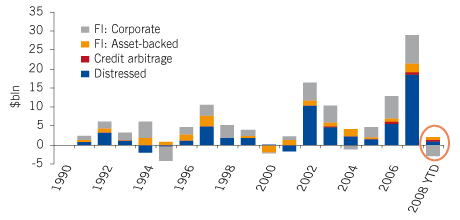 |
| ...But credit hedge fund assets are still well above 2006 levels |
 |
| Source: Hedge Fund Research, Morgan Stanley Research |
Analysts at Aladdin have stressed some deals in certain asset classes – for example credit card ABS – and found that even at 60% default rates recoveries are still above zero. "You need to look at recovery rates and ask: ‘Are they cheap compared with where I can stay secured as a lender?’," explains Neilinger. "For example, if a deal is trading at 60 you may still be able to recover 65 – but that does not mean that it will not go to 50 mark to market," he warns. Certainly a look at where LevX is trading should give potential buyers a great deal of comfort. Loans have been trading at between 65 and 75 in both the US and Europe – which is essentially their traditional recovery rate. Ratul Roy, credit analyst at Citi in New York, calculates that with LevX trading at 1,300bp this implies an annual default rate of near 25% where Standard & Poor’s estimates a default range of between 6.1% and 9.6% for 2009. There are many reasons to question default rates based on historical data (see Euromoney, November 2008, page 18) but the investment rationale for anyone in a position to act is compelling. Roy points out that distressed prices in the European loan market will now allow investors to achieve yields in excess of 10%.
Chasing yield
Although many rules of market logic have been jettisoned during this extraordinary downturn, the premise that the market is self-correcting and that buyers will return at the right levels – although sorely tested – should still hold true. "There are still a lot of smart people out there who can see the value in investing," says Veroude. With traditional credit investors hobbled by deleveraging, many have predicted that new sources of investment could come from buyers such as pension funds and insurance companies. Speaking to Euromoney last month, a global head of DCM dismissed this suggestion, stating that the capacity of, for example, insurance companies to take any sort of sizeable allocation in credit was being vastly exaggerated. Roy at Citi says that they are starting to see private equity funds and insurance companies buying into the loan market but that there are substantial obstacles to such buyers. "Insurance companies are fixed-rate buyers so buying into floating-rate loans is a significant shift," he says. "We are seeing some buyers, but not a tide of money. Insurance companies now account for less than 3% of loan buyers, but even if this figure rises to 10% that represents a big increase." Some US insurance companies have been moving into the triple-A tranches of CLOs as a way to take a structured approach to the loan market. Roy expects to see a shift by pension funds away from their traditional private equity and equity mandates but that again the process will take time. "Pension funds had such a huge allocation to equities and they understand that they need to move into fixed income but do not want to unwind their equity positions at a loss."
Veroude insists, however, that this income-generating trend could develop over the next one to three years and that the yields in credit will increasingly attract non-traditional investors. "You should not approach this market with a trading mentality. This is an allocation over a long-term time horizon."
Long-term approach
A long-term approach is certainly a prerequisite in the more volatile credit asset classes. Neilinger at Aladdin is still extremely wary of RMBS and, unlike Veroude at Insight, does not see the asset class as attractive even at today’s illogical spreads. "I would not touch generic US RMBS with a 10-foot bargepole," he says. "There is so much regulatory risk associated with it that cannot be quantified. Once you start getting housing market falls of 40% to 50%, that 400bp over for triple-A RMBS no longer looks so cheap." Aladdin Capital has $16 billion under management, including CLOs, relative value funds and structured credit funds. It was forced to liquidate its synthetic CLO, the $430 million LETTRS fund, earlier this year.
Neilinger joined the firm to spearhead global growth, and sees opportunity on several fronts. "We are trying to make acquisitions in companies," says Neilinger. "You can buy something today at 50% of book value that will be worth two to three times book value in a few years."
Only time will tell whether the funds now being established have called it right in credit and will emerge successful from the most difficult environment the credit market has ever seen. Leverage – or more accurately its absence – will spell the difference between success and failure. "If you have locked-up capital, now is the time to advertise it so that the next time a distressed seller comes along you are in a good position to take advantage of that fact," says Frost at Cairn Capital.
