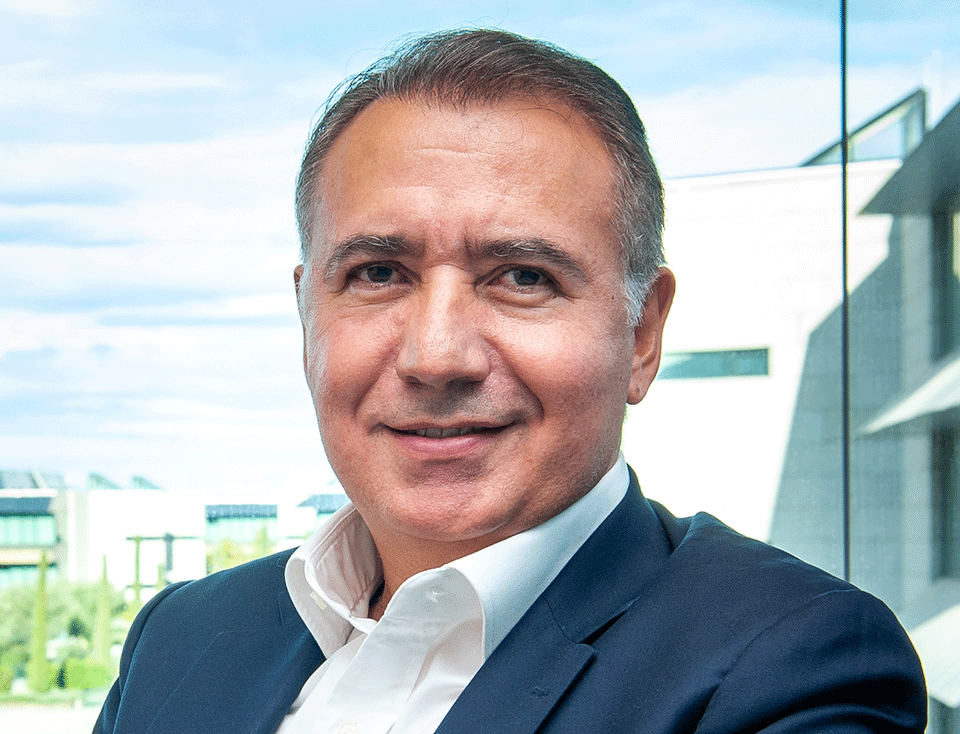
FROM HIS OFFICE high above Dubai Creek, Ibrahim Belsalah exudes an air of confidence that everything will be ready on time for the IMF/World Bank meetings in September 2003 when 14,000 politicians, bankers and journalists will descend on the emirate.
Belsalah, the general coordinator of Dubai 2003, faces a daunting logistical challenge in preparing the city state, which 30 years ago was little more than a village at the southern end of the Gulf.
For Dubai will not just be hosting a meeting in September 2003 but presenting its political and economic philosophy to the outside world. Visitors to the next IMF/World Bank meetings will find a state that has not only been physically transformed into a modern city but is also intellectually committed to the values of western capitalism.
Hosting the meetings is seen as an opportunity for the government to present and promote Dubai, one of the seven emirates making up the United Arab Emirates (UAE), as a well-regulated international financial centre that will appeal to the world’s leading banks and investors.
Government officials are confident that those attending the meetings will be able to see the foundations of the most ambitious project to date, which is to set up the Dubai International Financial Centre (DIFC), a combination of capital, insurance and money markets.
Dubai’s ambitious plans for a financial centre are unlikely to be achieved overnight. Questions about ultimate regulatory responsibility for financial institutions, which has until now been a purely federal matter within the UAE, remain to be resolved. There is tough regional competition and some political hostility in the Gulf to setting up cross-border markets.
However, Dubai has shrewdly marketed the IMF/World bank event as an opportunity to promote the region and Belsalah has no doubts that the emirate will live up to this billing by being ready for the largest and most important international event since the UAE gained independence from the UK in 1971.
“Everything is going according to plan. The construction of the conference centre is going smoothly and will be completed in the first quarter of next year and the adjoining hotel will open a couple of months later,” he says.
There will be plenty of hotel rooms as well, with the 426-room Shangri La and the 600-room Grand Hyatt joining the wide range of city and beach properties that have helped to make Dubai a popular tourism and business destination.
Belsalah is also determined that Dubai’s hoteliers will not be able to make a financial killing by exploiting the demand for rooms. “We have put a ceiling on hotel prices with everyone receiving a corporate rate, which for five-star hotels will be below $700 a night,” he says.
There will be pressure on the city state’s infrastructure, which at times appears to creak even under the levels of normal demand. However, Dubai’s first-class international airport, which has just embarked on an additional Dh15 billion ($4.1 billion) expansion programme, and its highly rated airline, Emirates, are ready.
Emirates, which started to rebuild its passenger loads within weeks of the September 11 terrorists attacks, is starting direct transatlantic flights well in time for the meeting. “Dubai has an excellent record for facilitating events and I am confident that we will do a good job,” says Shaikh Ahmed bin Saeed Al Maktoum, chairman of Emirates airline and president of the department of civil aviation, which has responsibility for the airport.
The main concern for locals is how Dubai will cope with the double whammy of increased traffic and the level of security that inevitably accompanies these events and slows down all movement. At the best of times, rush-hour car travel – there is extremely limited public transport – is a slow crawl. There are now even traffic jams in July and August, when very few business travellers and tourists visit the emirate.
Dubai has tried to address the problem by building more roads and limiting access to the city for lorries, but this approach has failed to keep up with increased demand. Belsalah, though, insists that new roads, due to open in the coming months, and traffic diversions to keep lorries away will ensure that delays are kept to the minimum during the IMF/World Bank meetings.
A smoothly run conference has an additional importance to Dubai because its appeal as an efficient, liberal city with an excellent infrastructure and top-quality leisure facilities has been of critical importance in establishing it as a regional headquarters for international banks and businesses. A growing number of banks – most recently Citibank – have moved their regional quarters to Dubai. HSBC now bases its global Islamic banking operation in the emirate.
Dubai’s government now wants to broaden this appeal and attract the leading international investment banks, brokers and investors by establishing a global business and financial market, which is expected to have an important role in the UAE economy as well as boosting Dubai. “The current contribution of the financial services sector to the UAE economy is approximately 10% of GDP. We aim to double this by 2010,” says Anis Al Jallaf, the DIFC’s chairman.
There has been no slowing of the momentum since the plan was announced earlier this year to create a market that was regulated to the highest international standards. The present plan is to have the first elements of the legal structure in place by the end of September, with formal licences issued by the end of the year.
The DIFC’s managers are confident they can attract the world’s leading investment banks and investors to participate in the areas that the centre will focus on – asset management, Islamic finance, reinsurance, a regional stock market and a back-office operation. The DIFC says it has had expressions of interest from 90 financial institutions including the leading banks in the west and the region. It is confident that the reinsurance market could be working by the end of the year though the international stock exchange will take longer to establish.
A stock exchange for the region
In Dubai, bankers believe there is a need for such a market to attract back Arab money that has until now been directly invested in the west and to attract the foreign investment need to finance infrastructure projects in the region and the privatization of state-owned companies.
“The concept has been thought through very carefully. It is very plausible and they have not held back on hiring qualified people. I think it will be a catalyst for change in the region’s financial markets,” says Andrew Dixon, chairman of HSBC Middle East.
Some bankers, though, are a little more cautious. “This is a brave idea. In the past Dubai has been extremely successful in developing tourism and industrial free zones. This is a big and a difficult challenge and, if they succeed, the rewards will be very great,” says Hussain Sajwani, chairman of the Dubai conglomerate, Damac.
Negotiations are now taking place with a number of western stock exchanges to be the DIFC’s partner in developing the equity market. Deutsche Börse is emerging as the early favourite to win the contract. “They have been much quicker to respond than the others,” says one banker.
The offices of the DIFC, which are currently housed in the Emirates Towers building, will be in a 50-storey-high twin-towered building, with 9 million square feet of offices, whose financing will partly be covered by a Dh1.85 billion bond.
This bond, which will have Islamic and conventional elements, will be launched later this year and is likely to set off a series of issues, including one for Dubai 2003 of Dh1.5 billion to part finance the IMF/World Bank meetings. The World Bank has also announced plans to raise money in the DIFC.
Standard Bank has said that it may domicile its planned $750 million North Africa and Middle East energy fund at the DIFC.
Most of these bonds will, like the earlier issue on the Dubai stock exchange for Emirates Airlines that raised Dh1.5 billion last year, appeal to local investors.
The test for the DIFC is whether it can attract international financial institutions. The key to this will be the regulatory system.
“I am a big supporter of the DIFC – the most critical factor is that they have recognized the importance of establishing a credible regulatory authority. They are not cutting corners and are hiring people with a credible track record,” says Ziad Makkawi, executive managing director of Dubai-based investment bank Shuaa Capital.
The chairman of the regulatory council is Ian Hay Davison, a former chief executive of Lloyd’s of London and ex managing partner at Arthur Andersen, and the chief commissioner of the agency is Philip Thorpe. His track record includes spells as chief executive of the Hong Kong Futures Exchange and London Commodity Exchange, as well as being chief executive of IMR, which was responsible for the regulation of all insurance, banking, securities and investment business in the UK. Thorpe has now begun the task of hiring up to 50 full-time experienced regulators.
Questions remain about the relationship between the DIFC’s regulators and the UAE central bank. Until now regulation of the financial sector has ultimately been a federal responsibility, with the central bank governor taking full responsibility for these issues throughout the UAE. The creation of the DIFC would end this.
The DIFC says that negotiations are nearing completion on a decree issued by the amir of Dubai that will exempt the centre from federal law and enable it to establish its own regulations for financial services and companies. Thorpe has also said that a memorandum of understanding will be signed with the central bank, agreeing on the sharing of information and enabling local banks to set up operations in the DIFC without difficulties.
However some bankers in Dubai say that the central bank governor, Sultan bin Nasser Al Suwaidi, remains unenthusiastic about the project. The central bank is said to question whether it is possible to have a separate regulatory structure within the country.
“The most important thing is that the DIFC needs to find a modus vivendi with the central bank and other regulators within the region. Without this they will be penalized by the global players, who will instinctively look first to the central bank. The only way this can be done is if the central bank agrees to delegate some responsibility on specific areas,” says one Dubai banker.
If the DIFC is to achieve its goal of getting 150 regional companies quoted on its equity market, it will need the agreement of Saudi Arabia, which is still the largest stock exchange in the region.
Bankers in Saudi Arabia and Dubai believe that the Saudi Arabian Monetary Agency (SAMA) will be reluctant to allow any of its companies to become vulnerable to the flows of global capital.
However there is a consensus in the region that Arab states need to create a large, sophisticated market to attract investors and that the situation in western stock exchanges offers an unprecedented opportunity for this to happen.
There has not exactly been a flood of Arab money back to the Middle East in the aftermath of the September 11 terrorists attacks and in response to the poor performance of European and American stock markets.
But the buoyancy of Gulf stock exchanges, higher levels of money supply across the region and greater caution about the way new money is invested suggest that there is a significant amount of Arab money looking for a new home. Money is no longer automatically shipped out to western markets and property developments. As a result, even comparatively small exchanges such as Qatar are attracting investors and delivering good profits.
“More and more money is coming back in to the Gulf, following the bursting of the IT bubble in the United States. These decisions are taken by businessmen who decide what to do on commercial grounds,” says Sajwani, who has shifted his company’s financial investments from the US to Middle Eastern markets.
Confidence in local markets
At Shuaa Capital, whose mandate is to develop regional asset management, Makkawi says that the bank’s “assets under management have grown rapidly and the number of clients has quadrupled.” Shuaa’s confidence in local markets is shown by its recent decision to launch a UAE equity fund and the first Arab fixed-income fund. It has plans to launch a GCC equities fund.
|
Financial district: A new, well-regulated regional market may win back Middle Eastern money from falling western markets. |
||||||
The other indication of greater liquidity in the region is the rapid boom in property development, which is being further fuelled by the Dubai government’s decision to part sponsor the building of large estates along the Shaikh Zaued Road that links Dubai with Abu Dhabi and to allow foreign ownership.
There is some concern that this will lead to a property bubble similar to that which did serious damage to Dubai’s commercial and banking sector in the mid 1980s. But bankers say that demand continues to be strong at the top end of the market and that a large proportion of most projects are being funded prudently.
“Without a proper capital market, there is clearly a dependence on bank finance. But there are a number of developments that are financed entirely through cash, which gives a lot of comfort. Where finance is arranged it is nearer 30% of total costs and certainly nowhere near the 100% figure of the mid 1980s,” says a senior banker at one of Dubai most conservative financial institutions.
There is renewed demand for residential property, after prices have declined in recent months. Dubai’s newspapers are now full of stories about the speed at which new developments are being sold out. Damac Properties, for example, is developing a 1 million square foot apartment block at Dubai Marina.
This trend will shift the Dubai property development market away from its reliance on rental clients. Several banks are already looking to offer mortgage finance. Amlak Finance, a wholly owned subsidiary of Emaar Properties, one of Dubai’s leading property developers, is already offering 90% financing over 25 years.