Few banks in 2025 could match the range of financing solutions BNP Paribas delivered for clients. From nuclear project finance in the UK to leveraged buyouts in France, from ECA-backed green steel in Sweden to battery manufacturing in Morocco, the bank operated across every financing product, every credit profile and every geography where sophisticated capital was required – and led or co-led the defining transaction in most of them.
In the financing categories where BNP Paribas competes on a genuinely global basis – project finance, export finance, aviation and shipping – it ranked first or second globally in 2025. In project finance it ranked first globally as bookrunner. In export finance, first globally as bookrunner and second as mandated lead arranger. In aviation financing, second globally; in shipping, second globally. These positions reflect a platform with origination, structuring and distribution capability that operates competitively against every institution in the world across infrastructure-heavy financing categories.
In EMEA, the bank ranked first in the loan bookrunner table with a 7.6% market share – almost two full percentage points ahead of the nearest competitor – across 342 transactions. The more instructive metric is penetration of event-driven acquisition financing, where the bank was present on 75% to 80% of the top 15 EMEA acquisition financings above €1 billion, with the four banks ranking below it in that subset all US. Consistently outperforming the bulge bracket on the most complex event-driven mandates in Europe while defending volume leadership in plain vanilla refinancings requires a capital markets platform with genuine depth across both dimensions.

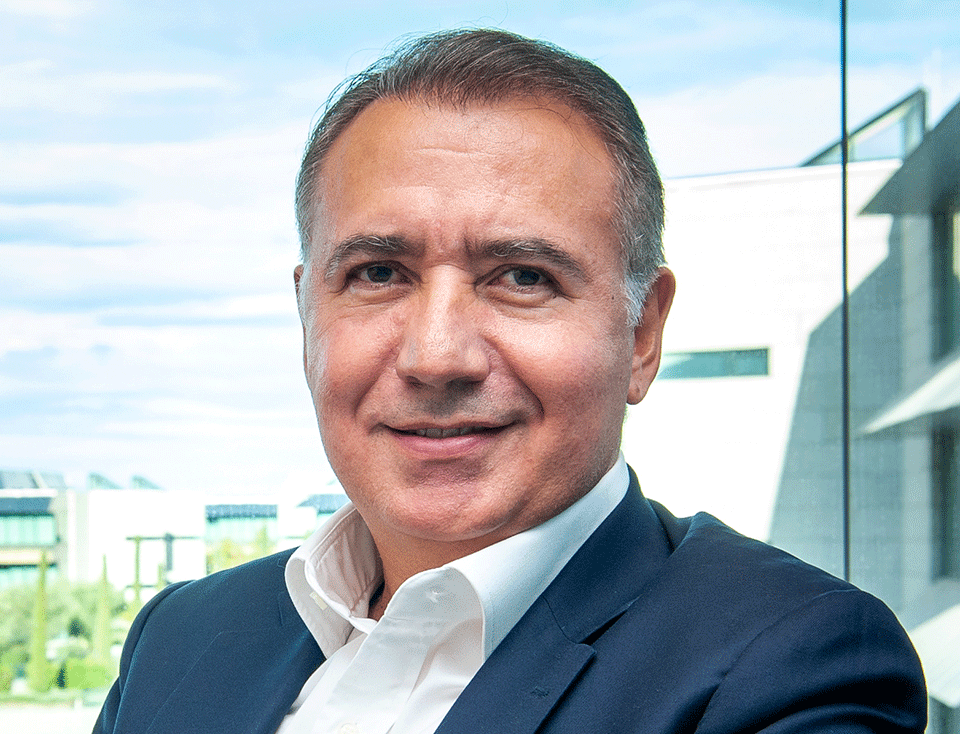
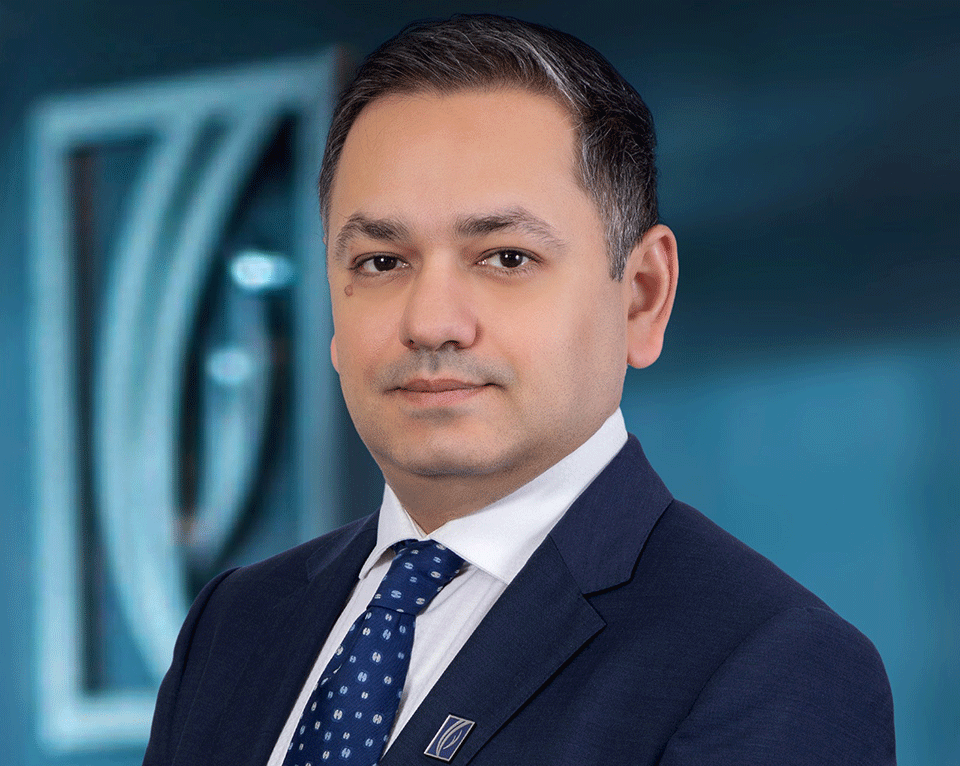
We are not product people anymore. We are capital structure advisers. The goal is always what works for clients
Nicolas Rabier
The Prada-Versace acquisition financing illustrates the balance sheet dimension. To close in May required underwriting in April, at the precise moment when Liberation Day announcements had paralysed most financing activity across the market. Where competitors paused, BNP Paribas committed, distributed successfully when conditions stabilised and captured the mandate from a client that Italian banks would also have sought.
The €12 billion TenneT Germany revolving credit facility, the first time the business had raised standalone financing independent of its Dutch parent, required months of advisory work on capital structure, market capacity and future funding architecture before a single term sheet was issued. Both transactions reflect the same underlying approach: early engagement, cross-capital-structure thinking and balance sheet deployment when conviction supports it.
Not product people
In leveraged finance, BNP Paribas ranked second in both EMEA leveraged loans at 7.9% and high-yield bonds at 7.6%, acting as bookrunner on approximately 300 deals and left-lead or active bookrunner on nearly half. Opella, the largest European LBO since the global financial crisis; MASORANGE, the largest euro-denominated term loan B of the year; and the debut market entries of 19 new issuers across leveraged loans and high yield demonstrate a franchise extending its balance sheet for inaugural transactions in ways that develops markets rather than merely follows them.
On the project and infrastructure side, Sizewell C’s £5.5 billion financing – the first nuclear project financed using the UK’s Regulated Asset Base model – required three years of regulatory framework development with the UK government before commercial banks could commit capital. East Anglia 3’s £3.6 billion offshore wind debt package, the €6 billion Baltyk 2 and 3 financing in Poland, the Apollo-Orsted Hornsea 3 acquisition financing, and the Encavis take-private – where the bank backstopped a portion of KKR’s equity commitment – demonstrate execution across the full energy transition spectrum.
The IONITY EV charging financing, the largest EV debt transaction in European history across 24 countries, and a greenfield lithium extraction project in Germany extend the franchise into technologies at the frontier of what commercial banks will currently underwrite.
In export finance, the global bookrunner ranking was built on transactions spanning SSAB’s green steel facility in Sweden, Morocco’s first large-scale battery manufacturing facility and the KSA Vision 2030 solar programme.
In ECM, the bank ranked first in EMEA by deal count with 77 transactions, capturing 13 of 19 convertible bond issuances as the market reopened. The Ørsted €8 billion rights issue – where willingness to underwrite €1.25 billion of equity risk was informed by concurrent intelligence from the DCM and hybrid desks on the stability of the debt complex – illustrates the cross-franchise integration that produces specific client outcomes rather than simply parallel product coverage.
“We are not product people anymore,” says Nicolas Rabier, global co-head of IG financing. “We are capital structure advisers. The goal is always what works for clients – if the answer is a combination of two products, or starting with one and switching to another, we bring the right expertise at the right moment. That mindset, applied consistently across teams that actually know each other and work together, is what builds a gap of two market share points.”