
Last year was one of contradictions: tight credit spreads coexisting with episodic volatility, near-record investment grade issuance volumes running alongside corrosive geopolitical and tariff-driven uncertainty. Any DCM franchise capable of operating at the top of the market in all such conditions was the core test of quality. By that measure, Barclays produced the year’s most compelling performance across all three major DCM segments on both sides of the Atlantic.
The global DCM market in 2025 was extraordinary in scale. According to LSEG data, global investmentgrade corporate debt offerings totalled $5.8 trillion during the full year, up 13% compared to 2024 and the strongest full-year period for global high-grade corporate debt on record.
Barclays’ DCM franchise not only maintained volume but deepened its cross-border reach – the bank reported a 7% year-on-year increase in DCM fees in Q4 alone, and in its full-year results confirmed it had maintained its traditional strength in DCM globally while growing share in both ECM and advisory.
The transatlantic architecture that underpins the franchise – a top-five European platform operating alongside a well-established US capital markets presence – gave Barclays a structural advantage over many of its peers in this climate.
A global franchise built on cross-border execution
The defining structural feature of Barclays’ DCM proposition is its cross-currency and cross-border capability. In 2025, this was most visible in reverse Yankee issuance, where US corporates turned to European markets to capture cost advantages, net investment hedging capacity and investor depth. Barclays was a lead manager on several of the year’s most prominent transactions: Alphabet’s inaugural €6.75 billion five-tranche euro offering – the third-largest inaugural euro corporate deal on record and the largest corporate euro issue since 2020 – with books peaking near €33 billion and pricing landing around 30 basis points inside initial guidance.
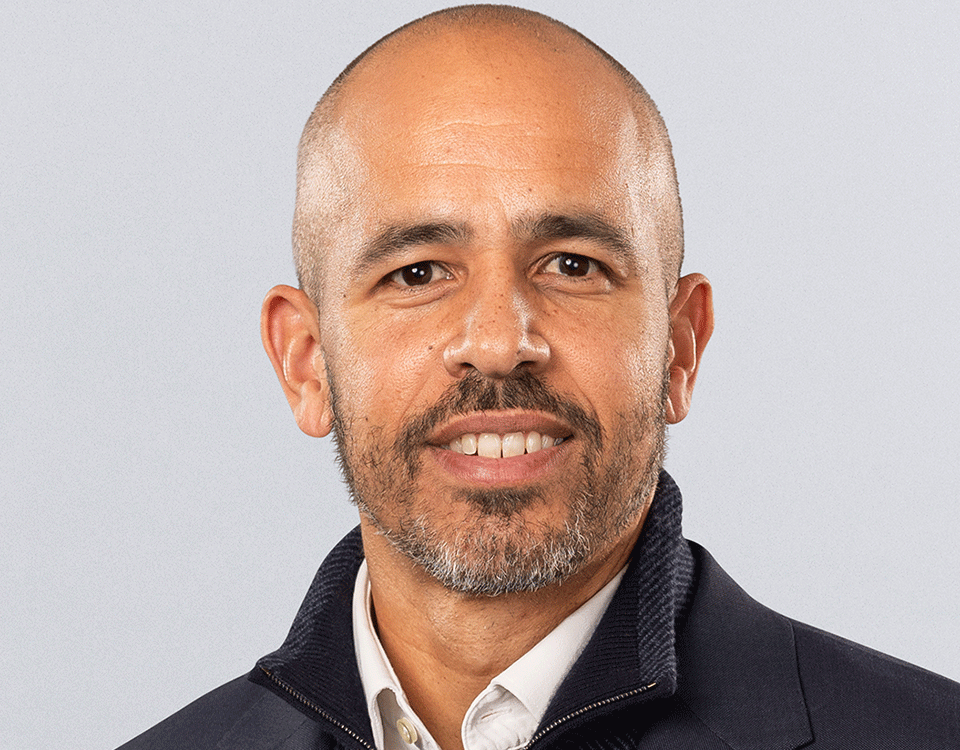
Who do they want by their side? We are proud and grateful that many clients choose to work with us repeatedly and across the major currency markets
Travis Barnes
It also acted on Visa’s €3.5 billion multi-tranche, Pfizer’s €3.3 billion four-part, and multiple euro issues for Caterpillar, American Tower and Parker Hannifin. In the opposite direction, Barclays supported European corporates in accessing US dollar liquidity at scale, including Merck KGaA’s $4 billion four-tranche re-entry to the dollar market – its first USD bond in over a decade – which attracted $15 billion in combined orders, and Siemens’ $7 billion transaction. That bi-directional fluency, helping clients move between currencies at scale, is what the bank’s leadership identifies as its primary differentiating capability.
“The moment of maximum exposure for an issuer is entering public markets and announcing something new – the next important transaction, an innovative deal, potentially at a challenging time for the market or in a new currency,” says Travis Barnes, co-head of global treasury coverage. “Who do they want by their side? We are proud and grateful that many clients choose to work with us repeatedly and across the major currency markets. That can be quantified to assess the calibre of our advice. Our Treasury Coverage model delivers more holistic, differentiated solutions to our clients globally, ultimately driving flywheels across the broader financing, liquidity and risk management ecosystem.”
SSA: The duration franchise
In sovereign, supranational and agency (SSA) markets, Barclays’ global positioning was established by a consistent record of executing in the year’s hardest windows. Ranking in the top three for long-end USD SSA issuance for the third consecutive year – and the only non-US institution to do so – the bank demonstrated that its transatlantic platform is not simply European with US capacity appended, but a genuinely integrated operation.
The Bank of England’s $2.5 billion five-year set an issuer record for USD order book size; EIB’s $3 billion 10-year attracted $25.5 billion in orders, the largest 10-year USD SSA book of the year; Canada’s $3.5 billion five-year assembled the largest USD order book for that sovereign in 15 years, priced under escalating tariff tensions between the US and Canada.
In euros, the bank led approximately one third of all long-end SSA syndications, including Germany’s €6 billion 30-year in the immediate aftermath of the fiscal overhaul announcement – the largest single-day move in German 10-year yields since 1990 – and an €11 billion dual-tranche EU transaction executed on the day of the French parliamentary no-confidence vote.
In sterling, Barclays extended a six-year record of top three positioning, supporting the UK DMO across three milestone syndications and bringing two new borrowers to the sterling SSA market.
FIG and corporate: Depth through complexity
In financial institutions DCM, Barclays reopened the AT1 market three times during 2025 – in January, May following Liberation Day, and November post-Q3 results – on each occasion as lead manager on both trades. In corporate DCM, it ranked fourth globally in euro and sterling combined bookrunner volume, first in sterling for the seventh consecutive year, and first for European corporate hybrid capital. Across all three segments, it executed 18 sole-led or underwritten transactions, including the first public MidCo bond since 2021 for Anglian Water.
The result is a franchise that does not simply follow volume – it generates it at the moments of highest client need, across the full range of geographies, currencies and product types that define genuinely global DCM capability.