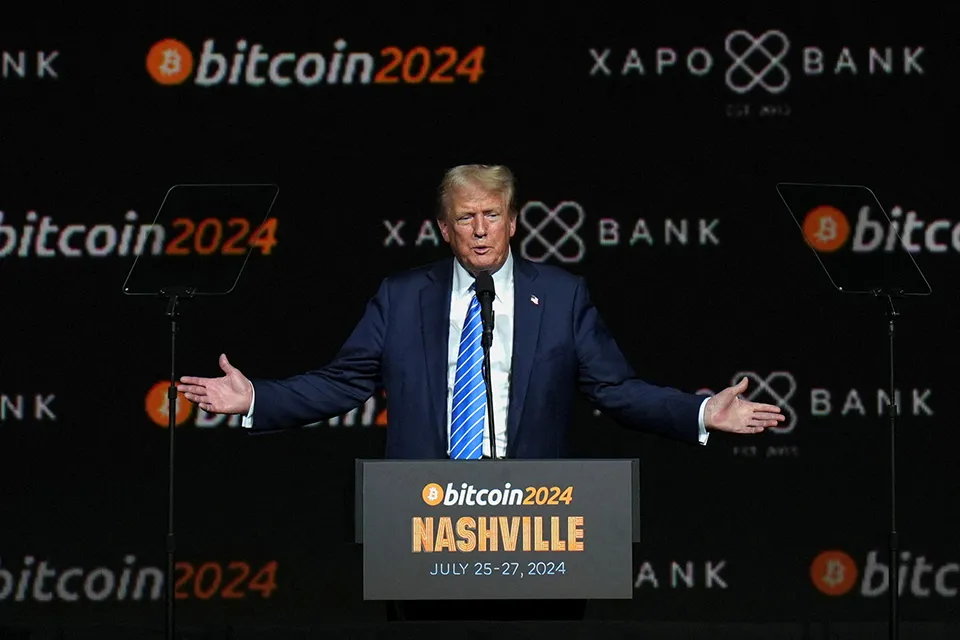
If there is one thing Donald Trump knows, it is how to work a crowd. At the bitcoin conference in Nashville in July, he pumped the crypto congregation like a master faith healer. He promised to end their persecution, to sack SEC chair Gary Gensler and to establish a government bitcoin reserve.
It was all hands in the air, huge cheers and praise be.
Well, the US government already owns a lot of bitcoins. These are ones it has seized from their main users, following criminal investigations. But its boosters never tire of portraying bitcoin as a legitimate asset, worthy of institutional adoption.
In that regard, it was the reaction to Trump’s brush with death rather than to his electioneering that best captures the bitcoin story.
On the first working day after the attempted assassination of the 45th president of the United States, bitcoin surged above $63,000 having traded $10,000 lower earlier in July. In an interesting case of symmetry, that two-week high was $10,000 lower than the record level recorded in March.

Also notable was the fact that the dollar was almost unchanged after the incident in Pennsylvania.
Carlos Martin Doncel, product manager for crypto at Swissquote, observes that bitcoin – and other cryptocurrencies – are, for now at least, still under scrutiny by legislators and therefore more prone to volatility when political views change, especially in key markets such as the US.
“On the other hand, dollar volatility is more often linked to central-bank activity and foreign policy changes and is thus more stable and predictable,” he says. “Bitcoin reacted as equity markets react to executive changes in the US.”
At $1.3 trillion, bitcoin’s market capitalization is tiny compared with traditional currencies, making it more susceptible to rapid price movements based on news events and reflecting its status as a barely emerging asset class. The so-called whales, owners that control a high percentage of coins mined so far, exert influence on the price. Certain investors view it as a potential hedge against inflation and against political uncertainty, which leads to increased buying during times of instability.
Katalin Tischhauser, head of investment research at Sygnum Bank, suggests: “However, it is important to note that as the market matures and liquidity increases – particularly with greater institutional involvement – we may see a reduction in this type of volatility.”
Scrypt chief executive Norman Wooding agrees that investors often turn to bitcoin during crises, similar to how they historically move towards gold.
Political impact
Bitcoin remains at the mercy of the US government in terms of regulation and with Trump now positioning himself as outspoken political proponent of bitcoin in the presidential race, any actions that move polling in favour of the Republicans will be seen as positive for the cryptocurrency.
“This points to the impact that a government that supports digital assets will have on the price of bitcoin,” says John Glover, chief investment officer at Ledn and former Barclays managing director.
As for whether the events of mid-July shifted banks’ perceptions of bitcoin as a tradable currency, Marion Laboure, senior strategist in research at Deutsche Bank, says she has been optimistic about it since late November.
“Looking ahead, we see three factors supporting prices,” she says. “Firstly, we continue to expect the Fed to start cutting rates by 25 basis points in September. Secondly, since the end of Q2, key regulation in the form of the EU Markets in Crypto Assets (MiCA) has become enforceable; and thirdly, ETF democratization will continue.”

But other banks, even in advanced digital economies, are far from convinced.
A spokesperson for Nordea says that although it does not actively participate in the virtual currency market, it follows developments closely.
“Digital/virtual currencies are largely unregulated and represent significant financial crime risks and – in some cases – environmental risks,” adds the spokesperson. “We therefore do not recommend that customers buy bitcoin or other virtual currencies. We support further regulation in this area and have adopted a conservative approach, as the market and regulation matures, focusing on risk and control to protect the bank and our customers.”
Development of scaling solutions continues to improve bitcoin’s transaction capabilities, potentially enhancing its utility as a tradable currency, suggests Sygnum’s Tischhauser.
“While it was initially conceived as a peer-to-peer electronic cash system, it is increasingly seen as a store of value and investment asset rather than being confined to a tradable currency,” she claims. “As the ecosystem matures, we may see bitcoin effectively serving both roles – as an investment asset and a medium of exchange.”
According to Wooding at Scrypt, innovations such as the Lightning Network have made bitcoin transactions faster and cheaper, addressing previous concerns about scalability while developments like bitcoin ordinals are expanding its utility, enabling the creation of non-fungible tokens (NFTs) directly on the blockchain.
“Bitcoin’s utility as a tradable currency is more robust than ever, bolstered by technological progress and institutional adoption,” he says.
Swissquote’s Doncel even suggests that bitcoin has benefitted from the bankruptcies of FTX, Genesis and Celsius, proceeding more smoothly than first expected, allowing for orderly restitution of funds to end clients within reasonable timeframes – unlike Mt Gox, whose creditors have had to wait 10 years for assets to be returned.
Bitcoin may be on track to become a liquid alternative investment, but whether it or other cryptocurrencies will ever be considered a bankable asset class still remains to be seen.
It might depend on what the 47th president decides.