
Since its foundation in 1885 as a cooperative and mutual bank, social usefulness has been central to Crédit Agricole’s business model. It was an early pioneer of sustainable finance. It was one of the first banks to commit to exiting the thermal coal industry by 2030 in OECD countries and by 2040 for the rest of the world.
At the end of 2023 it renewed and increased its commitments, undertaking to finance and invest massively in renewable energy, low-carbon infrastructure, clean technologies and energy-efficiency projects. It has also committed to support all customers big and small in their transitions and to stop financing any new fossil fuel extraction projects.
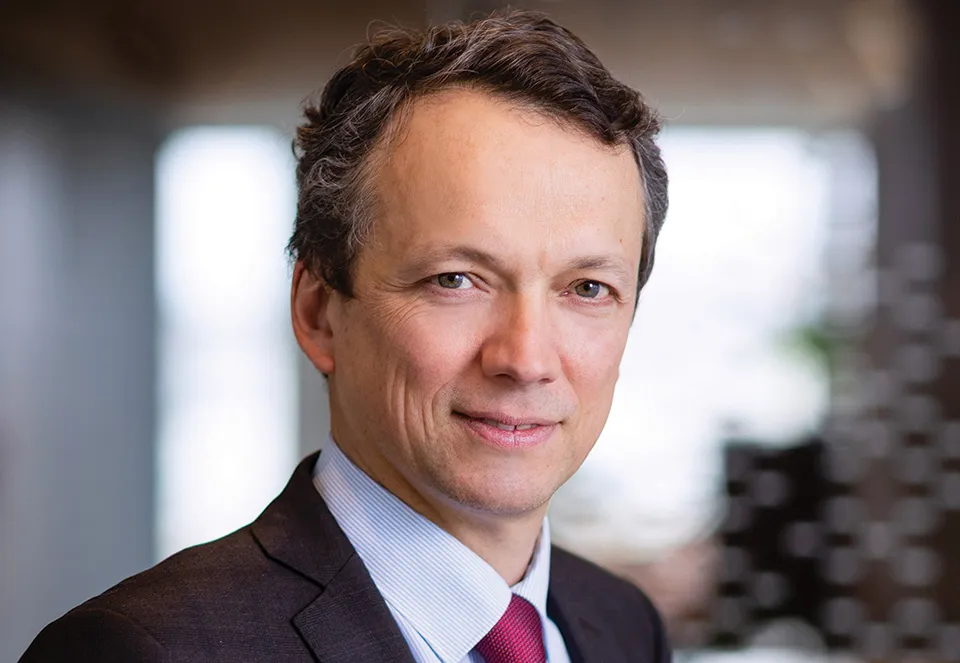
Philippe Brassac, chief executive of Crédit Agricole, put this in the context of a climate emergency, while clarifying that the bank would take a selective approach to supporting energy players engaged in this transition. The aim is to reduce greenhouse gas emissions of this sector twice as fast as the Net Zero 2050 ambition defined by the International Energy Agency.

“We took some strong decisions,” says Tanguy Claquin, head of sustainable banking at Crédit Agricole CIB. “We cannot go too fast because that would hit low-income people hardest. The big aim for us is the just transition and this is about helping millions of households move from brown to green.
“And we are not in the business of being an NGO or a development bank. But we plan to make substantial financing available to renewables and also not finance new fossil fuel extraction projects. We must move from brown to green. We cannot move from old brown to new brown.”
Crédit Agricole CIB was joint structuring advisor on Gasunie’s green financing framework, announced in September 2023 – one of the first to be aligned with the EU’s new Green Bond Standard.
Commercial real estate is one of the 10 sectors in which the bank is focusing efforts to rapidly reduce Scope 3 emissions. Crédit Agricole CIB acted as sole environmental, social and governance (ESG) structurer to support the first green financing framework for a European hotel group in June 2023. The Covivio Hotel transaction includes green eligibility criteria based, among others, on Carbon Risk Real Estate Monitor hotel dedicated pathways.
This award comes at a moment when suddenly it is not so easy to be a champion of sustainable finance. There has been the infamous red state backlash in the US, where governors have banned banks accused of failure to support the oil and gas industry from doing business with state pension funds and treasuries. Some US bankers seem quite happy with this. “We are not like the European banks that have drunk the Kool Aid on ESG,” one tells us.
The aim is to reduce greenhouse gas emissions of this sector twice as fast as the Net Zero 2050 ambition defined by the International Energy Agency
“The ESG reaction in the United States concerns us because we know that the economic model as it works today is not compatible with a planet that is depleting,” says Eric Campos, director of sustainable development and innovation impact at Crédit Agricole.
“In Europe, on the contrary, we are faced with pressure from stakeholders and regulations to accelerate our contribution to a sustainable economy. In the short term, this can be difficult. But we are convinced that companies that develop an effective climate transition plan and whose business development is respectful of the planet will be the leaders of tomorrow. As far as we are concerned, it is this approach that drives us by ensuring that all of society succeeds in this transition pathway.”
Amundi, the fund management arm of the Crédit Agricole group, also plays a big role in this. Timothée Jaulin, head of ESG development and advocacy at Amundi picks up on the ESG backlash.
“Our industry is at a pivotal moment with some asset managers who have been accused of overstepping their fiduciary duties now backtracking and others, like ourselves, continuing our commitment to responsible investing. We see this as an opportunity to clarify the value proposition of integrating precise ESG considerations into investment and voting decisions,” says Jaulin.
“We must be responsible stewards and take account of the impact companies have on the environment.”
Amundi is also keen to mobilize finance for green sectors – it announced a target to have €20 billion of impact assets under management by 2025. “But we will not succeed in the transition without also influencing the heavy industry, high climate-impact sectors,” says Jaulin.