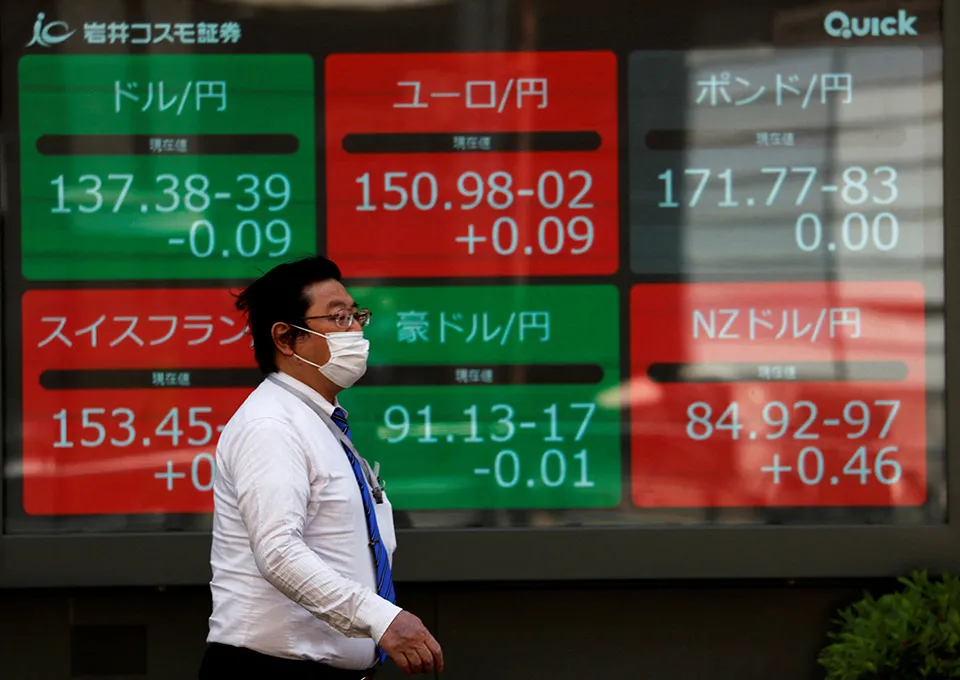
A recent upswing in emerging-market risk sentiment has benefited a number of Asian currencies. According to BNP Paribas’ early warning signals methodology, the Malaysian ringgit is now in the lowest risk category, while the Indonesian rupiah has also been upgraded.
Carry trades have been popular as volatility has subsided in recent months on a flurry of positive signals: hopes that the US Federal reserve is nearing the end of the tightening cycle; a resilient global economy; the lifting of the US debt ceiling; and easing stress in the banking and financial sector.
“Currencies with still-low interest rates – like the Japanese yen – have suffered as a result,” explains Manish Jaradi, strategist at IG Group. “For instance, the MXN/JPY cross was up nearly 30% this year, before retreating recently.”

Up until the July carry unwind, higher yielding currencies in the region had generally done better this year. Lower-yielding currencies need positive idiosyncratic stories about growth and inflows to overcome the negative yield differentials and renminbi correlation.
Joey Chew, head of Asia FX research at HSBC, points to the example of the Korean won, which “has been able to outperform recently because of optimism about the memory-chip cycle turning and corporates’ profit repatriation following tax changes.
“We think the won’s recovery can gain more traction in the coming months.”
The stance of central banks on currencies also matter. For example, USD/INR has been within a tight range of 82 to 83 so far this year, but if the Reserve Bank of India’s FX reserves stop rising in the second half, USD/INR should fall below that level.
Inflation shield
China’s economic struggles and the weak CNY are an important focus for the less-traded currencies around Asia. The yen, on the other hand, has come back from very weak levels because of anticipation that rates are peaking elsewhere and that the Bank of Japan may finally move in the direction of modest policy tightening.
Most emerging Asian countries are export-driven, commodity- and agriculture-based economies.
Qian Ying Goh, vice-president in institutional FX sales at StoneX, notes that trading between Asian countries has increased. This, coupled with higher consumer spending power, has shielded the region from the sharp inflation experienced in other parts of the world.
Peter Rosenstreich, head of investment products at Swissquote, recommends watching the Korean won to lead Asia currencies as sensitivity to improvements in global markets shifts into high gear.
“Improving growth will also keep pressure on Bank of Korea to maintain hawkish rhetoric,” he adds.
Markets will be keeping a close eye on how the Bank of Japan decides to deal with yield curve control
Markets will be keeping a close eye on how the Bank of Japan decides to deal with yield curve control, with the yen stopping short of the 150 level reached last autumn on the back of optimism that this monetary policy tool will be more lightly used.
David Morrison, senior market analyst at Trade Nation, says that if a widening of its yield curve control policy’s trading band by 25 basis points was the precursor to further monetary tightening from the Bank of Japan, it could lead to a more protracted rally in the yen against both its Asian neighbours and the dollar and euro.
“But this could be jumping the gun,” he cautions. “Japanese inflation has fallen since the start of the year. In addition, after so many decades of trying to boost inflation and thereby help to erode Japan’s stunning government debt mountain, policymakers won’t want to choke off inflation as soon as it raises its head. If this is the case, then the yen could weaken further.”
Meanwhile, the recent Chinese GDP numbers were lighter than expected, but CNY has not fully retraced to its recent lows, observes Steve Sosnick, chief strategist at Interactive Brokers.
“A key factor to watch will be whether the People’s Bank of China allows CNY to breach the 7.25 to 7.35 level,” he adds.
As for which Asian currencies are expected to move most in the near future, Kelvin Wong, senior market analyst at Oanda, points to the yen, where the positive US-Japan inflationary differential is likely to narrow as the core-core (excluding food and energy) Japan inflation rate continues to tick higher, reinforced by a robust services sector.
“This is likely to push the Bank of Japan to upgrade its next quarterly outlook on inflation above 2% for fiscal year 2023 and bring forward ultra-dovish monetary policy normalization by widening the upper band of the yield curve control to 0.75%,” he explains. “Hence, USD/JPY may weaken in the later part of H2 2023.”
The dollar picture
Further US dollar weakness in the third quarter would alleviate the external debt burden of countries with large offshore debt holdings. Malaysia’s external debt ratio is around 60% of GDP, which has placed downside pressure on the MYR over the last two months to see a retest at its 4.7750 all-time level. With a smaller external debt overhang, Wong reckons USD/MYR may depreciate further towards 4.25.

According to Jaradi, USD/SGD looks set to resume its depreciation path with any break below a horizontal trendline from 2018 at about 1.30 potentially paving the way towards 1.24. And for the won, “a potential head and shoulders unfolding could expose the downside in USD/KRW toward the February low of 1215,” he says.
USD/CNY is likely to appreciate further if the People’s Bank of China extends its expansionary monetary policy to rejuvenate its economy, says Russell Shor, senior market specialist at FXCM. He thinks the Bank of Japan will keep its yield curve control into 2024.
“However, it is likely that Japan’s government and central bank will act to stop the yen’s decline if it breaches 145 to the dollar,” he says. “Elsewhere, AUD and NZD are beholden to the commodity cycle. If the Chinese economy continues to disappoint, this will likely cap commodities and put downward pressure on AUD and NZD.”
John Hardy, head of FX strategy at Saxo Bank, expects the yen to strengthen over the second half of the year.
“However, we are unsure to what degree the bulk of the move will unfold over the next three months or in the last quarter of the year, as reading the Bank of Japan rhetoric/guidance doesn’t really provide any clues,” he says.
Among the low-yielding currencies in Asia, Deutsche Bank is most constructive on the outlook for the Korean won and Thai baht.
“The former is well positioned to benefit from equity inflows and from diversification driven by increased US-China competition in technology, while the latter should gain from normalization of tourism revenues as and when domestic political uncertainty is settled and China outbound travel picks up further,” explains Sameer Goel, managing director and head of research for emerging markets and Asia Pacific at Deutsche.
The bank is also relatively positive on the Malaysian ringgit, given cheap valuations and high beta to China recovery. Among the high yielders, Deutsche most favours the Indian rupee because of the improving services surplus and narrowing inflation and growth differentials with its trading partners.
Robert Carnell, regional head of research Asia Pacific at ING, says: “It is probably right to be a bit more constructive for North Asian FX over the second half of the year but equally, any rebound looks likely to be fairly modest by previous standards.”