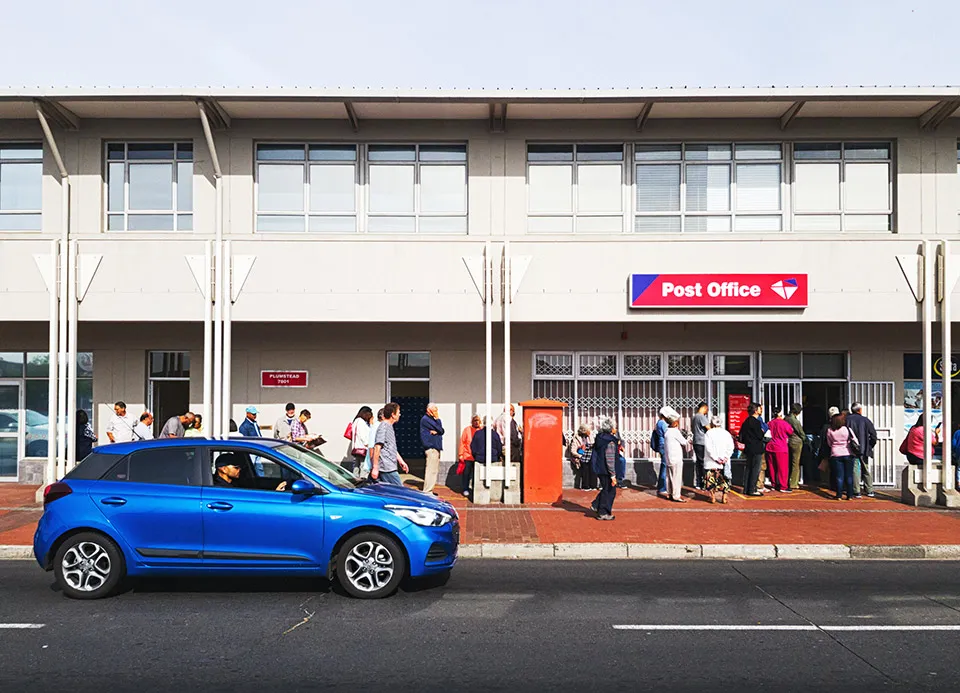
One day in 2020, the South African Social Security Agency (Sassa) got an unexpected call from the government. Sassa, which pays social grants to South Africans, had been identified as a Covid-19 super-spreader, the government said. The problem was the sheer size of the queues at Sassa paypoints for grant recipients.
RELATED READING
“We want you to solve the problem and we are giving you two weeks,” Fanie Sethokga, general manager of grants operations at Sassa, recalls being told. “Quickly, we went to the banks to see what services they have to enable us to serve clients without clients coming to us.”
It wasn’t a straightforward task. Some 18 million South Africans are grant recipients, and each of them requires data processing on verification on things like identity and income sources. Sassa links to most government departments and agencies.
Covid added another layer of verification and disbursement: 15 million applied for the Social Relief of Distress (SRD) grant because of the pandemic. That brought its own administrative burden, along with a requirement from the government that rails be established to enable Sassa to push payments to all qualifying clients regardless of whether they had a bank account at the time of application.
On average, Sassa was processing 32 million records a month, and for the Covid SRD would push through files with 15 million records apiece to the banks for verification across multiple data sources, requiring banks to come back to them over a cycle period of on average eight hours.
“The bank that does business with us should be able to have the capacity, the adequate data processing power to be able to play that game,” Sethokga says.
Many couldn’t do it. South Africa had 30 registered banks at the time; Sassa found it interesting that when it sought digital solutions, only the big four banks and four smaller banks raised their hands.
Low-cost profits
One of the banks to answer the call was TymeBank, a digital provider that has the lowest cost for bank accounts in the country, something it is able to afford to do by use of the cloud and through partnerships with groups such as Pick n Pay, a consumer goods store brand. It has 15,000 retail points of contact through store till points, 1,450 kiosks in its partner stores and a network of 1,135 ‘retail ambassadors’ – real people helping customers through the process (it describes itself as light-touch on the back end, high-touch on the front).
Regular readers may recall it as the bank Commonwealth Bank of Australia bought in order to reverse engineer its fintech skills, then later sold again (to African Rainbow Capital).
We will become a successful, profitable bank because of our work with Sassa
Rachel Freeman, Tyme

TymeBank has 7.2 million customers in South Africa, 1.9 million of them grant recipients. “Because we’re so low cost we are able to serve profitably the social grant recipients,” says Rachel Freeman, chief growth officer of Tyme, the overall company that also includes a digital bank in the Philippines.
The bank has the so-called value segment as one of its key markets.
“Not something on the side. A core strategy,” Freeman says.
Able to turn a profit even on serving low-margin grant recipients, Tyme made great efforts to be able to bank them.
Initially, it couldn’t do so, before realising there was a gap between its digital model and the requirement for paper-based material from grant recipients in their interactions with Sassa; it modified the strategy and got printers to accommodate them.
The prize, after all, was considerable in scale: 46% of South Africans are grant beneficiaries.
“We will become a successful, profitable bank because of our work with Sassa,” Freeman says. “We look at these customers as super-valuable. They’re like salaried people because every month they get a grant.”
Getting them on board, says Bongani Maponya, managing executive of value banking at TymeBank, required a lot of work.
“When Sassa responded to Covid, not everyone in South Africa had a smartphone or access to the internet,” he says. “So, we needed someone to stand up and say: ‘Let’s go out to the community and see the people, help them to be able to apply for their grant’.”
An application it built called TymeBank Sassa Switch, allowing grant recipients to receive their money through TymeBank, required staff to go out to the villages with a tablet to help people apply.
“Other banks were sitting back,” says Maponya. “We went out to the people.”
New products
From Sassa’s perspective, it was running its systems for social grants on an old and cumbersome mainframe system.
“Mainframe systems are not agile, and for us to be able to build a solution for this pandemic was going to take four months,” says Moipone Shabalala, manager of business solutions maintenance for Sassa. “We implemented a system in two weeks using one of the newest technologies in the industry. It forced us.”
One product TymeBank developed, called Grant Advance, allows people early and interest-free access to their grant.
“We know grant beneficiaries face day-to-day issues as all of us do, but you and I have the comfort of reaching into our overdraft. They don’t have that,” says Maponya. “Banks aren’t even looking at that.”
The community needs it, and can be put into a desperate situation without that access. “Products like this are important because otherwise those people will hit a brick wall and go to loan sharks,” says Pontsha Tamontsha, communications manager at Tyme.
Those loan sharks can take half of the extended money as interest.
It indicated from a regulatory point of view we needed to do things differently
Moipone Shabalala, Sassa

There is, though, a danger in extending advance credit to the poor: it comes with a responsibility not to allow people to over-borrow.
The product, and Sassa, limit borrowing to 30% of the following grant amount. The window for borrowing only opens on the 20th of the month; most people get their grant in the first week of the following month.
In the process of all of this, a problem with unbanked South Africans was considerably improved.
Prior to the pandemic, grant beneficiaries were banked – they had to be, as a condition of receiving their money – but there was a problem with onboarding them, and in particular the mechanisms to allow them to apply for the Covid 19 SRD. Now, people can apply without a bank account, at which point Sassa will give them a list of banks who can onboard them in order to make it possible, then liaise with the bank to open the account.
This collaboration between banks and Sassa will have a lasting impact.
“The big thing is we are now in a mode of co-creation,” Sethokga says.
To Sethokga there are some useful lessons in the experience.
“You need to link up innovation to the needs of the people in some form,” he says. “At the same time, you need the government to be able to create enabling conditions. In this case, we have leveraged on what fintechs who have acquired banking licences are able to do, and have used their technologies to attempt to resolve government problems.”
He also says that the whole experience moved the banking system from a position of claiming they were digitally capable, to proving it.
“The issue was, I don’t think the banking systems were tested for this, for data exchange and data processing,” he says. “When a person is dying and you put those things on their chest to resuscitate… they were never tested like that.”
There was an evolution in capability and trust, particularly as it related to the sending of records between Sassa and banks, but they got there.
“What I’m trying to say is ourselves and the banking industry were able to achieve something through the use of partnerships,” Sethokga says. “We were able to confirm and test the strength of their systems. The Reserve Bank was excited to see it: these rails were new.”
It is a lot of progress.
“We come from an era in South Africa where we were transporting money in trucks to different villages,” he says. “It’s a painful arrangement. You have national security on your case. Being able to push money into people’s accounts and enabling clients to decide where they want to put and withdraw money” is a considerable achievement, he says.
More efficient relationships
He also says relationships with the banking association have become more efficient and useful.
Getting this done required work between Sassa, the central bank, legislators and banks like TymeBank. Without one piece – the legislation, for example – “this thing is like a vehicle driving with the rear wheels bound,” Sethokga says. “Surely this car will not go anywhere. The whole thing – legislators, central banks, fintech companies – have got to find common ground for you to be able to talk. There has got to be some flexibility to enable the country to move, and to move for the citizens.”
The legislation piece is worth remarking upon.
Moipone says that, in Sassa’s very regulated environment, any solution had to go past regulators first. But the urgency of the pandemic meant that Sassa was able to go ahead and implement solutions, and the regulators then followed them in order to change the regulations to be more adaptive.
“It indicated from a regulatory point of view we needed to do things differently,” she says.
To Sethokga, this was quite the turnaround after a career of being told what to do by others. “I never felt so great in my life, having to dictate to legislators,” he says. “Me dictating what changes I wanted to see happening, and them playing along.”