When Tim Scheffmann co-founded Laos-based LTS Ventures three years ago, he had a goal that continues to elude many well-meaning policymakers across large swathes of southeast Asia: to drag financially excluded citizens into the formal banking system.
“My main motivation was and is to financially include people,” the chief executive of the Vientiane-based fintech tells Euromoney. “I have been in the region for 10 years. I created a mobile-money startup in Myanmar and a blockchain-based remittance company based in Bangkok. Then this comes along.”
Our customers are from rural areas, so if a system is over-sophisticated, it won’t work in any meaningful way
Tim Scheffmann, LTS Ventures

‘This’ was a contract awarded by German development agency GIZ in 2019, to build a simple and reliable platform it could place atop any of the country’s 6,000-plus village banks and 122 microfinance institutions (MFIs), plus countless domestic savings and credit unions, to help them reduce risk and cut fraud.
With his Laotian co-founders – managing director Lattana Keosihavong and chief operating officer Sonesak Sehavong – Scheffmann created ‘Lan Xang Banker’, named after the old name for the country, which means ‘a million elephants’.
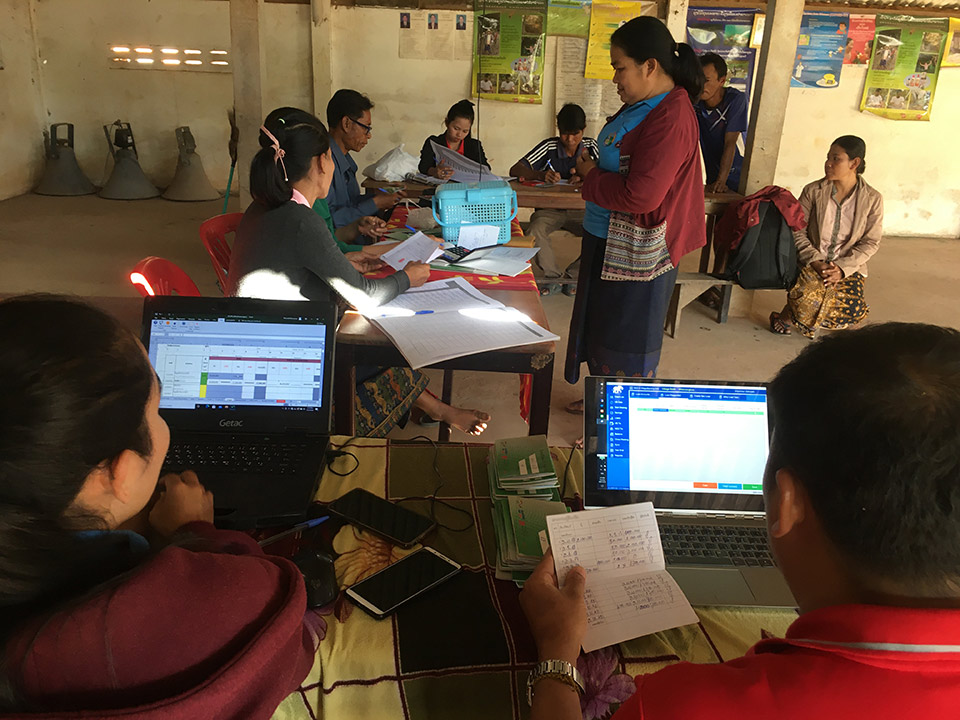
A shared microfinance platform that works online and offline, Lan Xang’s blockchain-like technology automatically synchronises records between central servers and laptops operated on the move by staff, giving more than 225,000 villagers better access to finance.
Building the platform wasn’t easy. At first, the aim was to join forces with a specialist software company, but Scheffmann says two problems soon emerged.
First, most such firms were keen to tally the sale – but then they disappear.
“They roll out a product and are gone, but we stay here with the customer to help them succeed,” he says. “We have calls with them every month to check what functions they need.”
Second, some villages lack internet and electricity.
He notes: “Our customers are from rural areas, so if a system is over-sophisticated, it won’t work in any meaningful way.”
Into the fold
When LTS won the tender, the Germany-born entrepreneur says he got “goose bumps”. GIZ was a “great partner” that worked hard with LTS to make the system work. But he tempered his hopes early on, having previously struggled to roll out financial inclusion products and platforms in neighbouring Myanmar.
And for good reason. Laos is not easy place to work. It is remote, rural and poor, and its large agricultural workforce is overly reliant on the vagaries of a deteriorating climate.
GIZ has done much over the years to improve access to basic financial services. It set up shop in Laos in 2003; six years later, it unveiled its Access to Finance for the Poor programme in league with Australian Aid and Bank of the Lao PDR (BoL), the central bank, with the aim of bringing hundreds of thousands of villagers into the financial fold.
It achieved this with room to spare. At the end of 2020, GIZ was providing services to 831 village banks and most of the country’s microfinance providers.
The system worked, but the haphazard accounting of village banks and MFIs made it all but impossible to standardize data and to work out if, say, village A was better at assessing credit scores than village Z, or if a farmer was punctual with his payments or a loan risk.
Yes, we are working to do good, but there needs to be a clear commercial reason why we are in this business
Tim Scheffmann
“When we started [with Lan Xang], we saw that a lot of the data wasn’t where it should be,” Scheffmann says. “Loans were not entered properly in Excel sheets, and there was a lot of fraud and risk” embedded in the system.
“We told GIZ how we could make the structure more sustainable, they committed to the process, and we built the new system from the ground up.”
Three years on, the results are clear to see. Lan Xang is up and running in six of Laos’s 17 provinces, with the aim of pushing it out to 10 in the next two years, to reach a third of the population. Scheffmann reckons his firm processes 10,000 transactions a day, more than half of which are loan approvals.
It installed know-your-customer technology, so customers cannot get a loan without proof of identity. For years, village ‘banks’ or ‘funds’ – the terms are interchangeable – were self-regulated, usually by village elders. So, while one institution might be well run, another could be very badly managed, with a third somewhere in between.
Still, the system was riddled with issues when LTS nailed down its contract. There was no limit to the number of loans an individual could apply for and be granted. Today, customers are allowed no more than three: two ‘normal’ and one emergency loans, with the ceiling agreed on and set by the village bank or microfinance company in question.
Those decisions leverage LTS data using a credit scoring model approved by the BoL. Each customer now has a personal credit history and score, using a similar system to US credit reporting agency Equifax. Customers can print out and share that information with banks if they want, giving them “better and more transparent access to loans”, says Scheffmann.

Hard work
And on the list goes. Greater standardization and transparency let village banks see if a loan is overdue, what is owed, and what can be done to manage a specific portfolio.
Any loan worth over NK10 million ($579) is scrutinised and signed by an MFI or village bank, and LTS carries out regular quality spot-checks to flush out would-be fraudsters.
“If we see an ID number such as ‘1111’ come up, we advise the institution to take another look at the documents,” Scheffmann says. “We have less of this kind of fraud now, as people know we are checking.”
All the hard work has been noticed. In November, the Centre for Financial Inclusion, an independent think tank, awarded LTS the prize of ‘best financial infrastructure’, as part of its annual ‘Inclusive FinTech 50’ awards.
Scheffmann’s team is adding new products all the time and stretching its wings. It built a blockchain prototype with Unicef, to make it easier for mothers with unborn or very young children to access vaccinations. LTS carried out the fiduciary risk assessment and built a digital wallet prototype atop Ethereum’s blockchain.
And in November, it unveiled its first non-deposit-taking microfinance institution. He describes the upgraded village banking platform as “boasting all the newest tech” and “shelf-ready and waiting to go.”
The team wants to drive financial inclusion, but also wants to make money. To download its software, LTS charges domestic institutions between $1,000 and $5,000, depending on the size of their customer base. A monthly software maintenance fee ranges from $50 to $500, and it charges – again, based on a sliding scale – for data migration.
Scheffmann declines to discuss hard data but admits to being “a very strong believer that every company must make a profit, or it is very difficult to achieve sustainability. The same is true with village banks and MFIs. Yes, we are working to do good, but there needs to be a clear commercial reason why we are in this business.”
Expansion
The CEO puts the cost of building Lan Xang at $500,000, which the firm raised by throwing
itself into paid consultancy work in its early days. LTS is seeking pre-Series A investment of around $4 million and is in active discussion with two Japanese venture capital firms with the aim of breaking even by the end of 2024.
A portion of those funds will be used to expand its reach into Cambodia and Vietnam, though for now it may have to stick a pin in another target market, Myanmar. It is eyeing a potential collaboration with the UN’s Capital Development Fund in a part of the country not controlled by the military junta – though any investment there is more than tricky at present.
Beyond that, LTS is looking hard at the Philippines, Bhutan and Nepal.
“All those places are huge remittance markets to which we can connect our village banking system,” he says.
Financial inclusion continues to improve in Laos, albeit slowly and from a low base. The country still has an alarming lack of traditional banking infrastructure. The World Bank put the number of bank branches per 100,000 adults in the country at 3.2 in 2020, against 11.6 in Cambodia and 5.6 in Myanmar.
We see people build up a habit of putting a bit more savings each month into their account. That all adds up to more financial stability and poverty reduction
Tim Scheffmann
LTS managing director Keosihavong, a native of southern Laos, describes the limited nature of financial access in rural regions as “a challenge for communities” but believes things are moving in the right direction.
“This year, for the first time, we had more women-owned accounts – 51% – on our platform,” she says. “I like especially that old and young people alike can get financial knowledge that can change their lives positively.”
The company pools and crunches data from its own servers, as well as the World Bank and Switzerland’s University of Bern, to analyse poverty levels. Scheffmann reckons it is heading in the right direction, with the number of village banks growing by 5% a year, and the newly financially included growing by 10% a year.
“Every month, we see people build up a habit of putting a bit more savings each month into their account,” he says. “That all adds up to more financial stability and poverty reduction.
It is not unfair to say village banks, each of which typically serves between 25 and 400 people, once had a very poor record in Laos. Many lacked any kind of oversight and were little more than highly informal savings pools. Locals could – and many would – dip into them when they were hard-up, then fail to fill the pot again.”
That started to change when GIZ and others got involved. The German agency, which closed its Access to Finance programme in April 2022, handing the day-to-day running to LTS Ventures, started by giving each bank a safe box, pens, and paper ledgers to record transactions. It later sent experts to villages to train oversight committees.
LTS then took this to the next level. Because it records every transaction on its servers, customers know that if, say, a family home burns down, or their rice fields are destroyed in a summer storm – a growing problem with climate change – they can access an emergency loan to get their finances back on track. Year after year, this bakes more trust into system.
Pride in achievements
The firm is always looking for non-financial ways to make its platform more useful – and hence to augment its own financial value. Lan Xang offers a news feed that gives villagers national and localized weather forecasts, helping them decide whether to harvest a crop now if a storm is looming, or to delay planting by a few days or weeks.
The firm has also joined forces with The Asia Foundation, a San Francisco-based non-profit, to evaluate and improve the digital payment patterns of micro-sized, small and medium-sized enterprises.
“We help them to open bank accounts, set up a Facebook page, get paid for their goods and services, and connect to the village banking system,” Scheffmann says.
When it comes to raising financial inclusion and improving data transparency and oversight, much remains to be done. All domestic MFIs report direct to the central bank, but there are no standardized forms to use, and thus no uniform audit process to follow.
“The BoL only has limited capacity to oversee and regulate MFIs,” says Scheffmann. “Because a form doesn’t come auto generated and unchanging out of a system, there is no standardized reporting process. We can help, as we standardize everything we submit to the central bank.”
But the process is far from perfect.
In the final analysis, he is delighted with where the company is today, and the pride in its achievements, and particularly its recent award, shine through in his voice.
“We have a lot still to do, starting with financial literacy, and are working to cut child poverty by making the platform more youth focused,” he says.
“So far though, it has been a huge success. It has gone faster than I expected, and I can’t wait to see what else is possible. I’m genuinely happy for helping to bring financial access to families and communities across rural Laos. It helps them stay out of poverty.
“The next step is to bring our microfinance platform to more provinces and countries, and to educate more people on financial literacy and give them access to finance.”


