Creditas, Brazil’s largest secured loan fintech, raised $50 million in July to buy the Brazilian banking licence of Andorran private bank Andbank. It financed the move by extending a January 2022 Series F round that had valued the company at $4.8 billion, up from a previous valuation of $1.75 billion in December 2020.
It is quite a contrast to publicly listed comparables such as Stone and PagSeguro, whose values fell by 60% in the first half of this year.
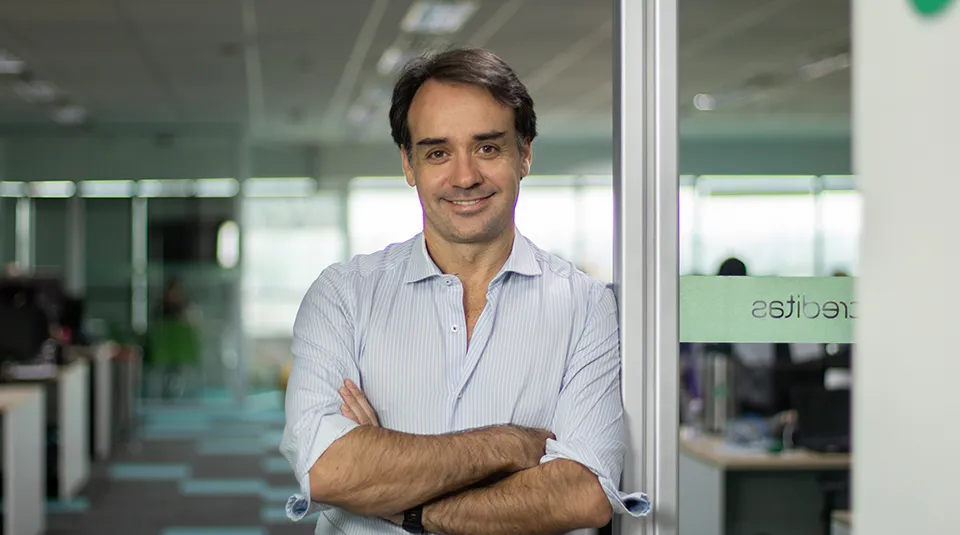
Sergio Furio, founder and chief executive of Creditas, says he bought the banking licence to broaden the firm’s funding base.
“I expect that in the near-term, having a banking licence will lead us to shift to a deposit-funding model of around 25%,” he says. “The main strategy continues being capital markets, but now with the banking licence we can complement it with a more efficient deposit-based strategy.”
I expect that in the near-term, having a banking licence will lead us to shift to a deposit-funding model of around 25%
Sergio Furio, Creditas
Furio thinks that Creditas’ credit portfolio, which today stands at R$5 billion ($980 million), will reach R$10 billion by the end of 2023, and could approach R$20 billion by the end of 2024. And he says this growth is likely to be achieved with the fintech’s current range of financial products.
That means he doesn’t foresee Creditas moving into new banking services, such as retail accounts, although he notes that there may be some synergistic opportunities around Creditas’ new benefits business, which offers individual ‘accounts’ to the employees of its client companies.
The vast majority of Creditas’ expected growth in its core equity lending business (secured real estate and car loans) will come from extending the distribution of the bank’s existing customer finance model.
Creditas has signed an agreement with Nubank to offer its car-loan product on the digital bank’s platform, for example.
Expanding assets
Andbank chief executive Carlos Aso tells Euromoney that its tie-up with Creditas will make operational sense because the private bank wasn’t using its banking licence and it can continue to serve its private clients through its broker-dealer structure.
Andbank has almost R$8 billion under management in Brazil, with a team of around 150 people who operate from the bank’s private banking centres in São Paulo, Rio de Janeiro and Porto Alegre.
According to Aso, the idea is to expand managed assets to R$20 billion in the next three to five years.

In addition to the $50 million Series-F extension, Creditas issued a $150 million convertible note underwritten by Andbank and other lenders. Neither party is disclosing the tenor of the deal, possibly as it could hint at the timeline for an anticipated IPO of Creditas (or other equity event).
Aso says that he expects regulatory approval for the licence sale to take around nine months and that in the meantime the two companies will continue to assess other opportunities for working together. That includes Andbank distributing Creditas’ capital markets funding to its private banking clients.
Difficult choices
Can Brazil’s other fintechs match the pace? Claudio Gallina, head of South American financial institutions at Fitch Ratings in São Paulo, warns that Creditas’ gravity-defying valuation is an exception.
He says the rapidly changing dynamics of the financial services market in Brazil are leading to an existential challenge for many mid-tier fintechs. Any that hadn’t already gained sufficient scale before conditions changed could face difficult choices.
“While it is true that there are very good companies already well established,” he says, “the increase in interest rates means that some newer fintechs that have deeper funding needs are facing higher funding costs.
“Also, as the days of abundant, cheap liquidity are behind us for now, both equity and debt financiers are paying more attention to forecasts and results.”
That means those that are still building will have to pay up for debt and equity financing – if they can find it at all.
The larger financial institutions are replicating full-service digital platforms, which can be good in terms of retaining clients due to their fully developed ecosystems
Pedro Carvalho, Fitch Ratings
They may also be losing their edge over traditional banks. Gallina says that Brazil’s banks have caught up with the digitalization of financial products and services in the last two years. That increases competition for customers, but it might also scupper one exit strategy for some fintechs – selling out to banks.
Pedro Carvalho, associate director of Fitch Ratings in Rio de Janeiro, agrees that traditional banks can often now match the tech of a fintech. And that is not all: the ability of banks to move existing customers onto new digital platforms means they typically have lower client acquisition costs.
Their broad service offering means better retention prospects, too.
“The larger financial institutions are replicating full-service digital platforms, which can be good in terms of retaining clients due to their fully developed ecosystems,” says Carvalho.
Even if banks see less need to buy fintechs outright, they are still interested in dipping into their talent pools.
Gallina says that the intense demand for IT professionals within finance (partly due to the implementation of open banking in Brazil) is another important aspect for companies to balance. Market trends may be moving in favour of consolidation among fintechs; evidence of their success in retaining key digital talent is mixed.
Value plays
In regulation too, the market is also moving away from the fintechs. In 2013, the Brazilian central bank brought in a new regulatory framework to free up smaller fintechs from much of the reporting burden that faces larger institutions. But as this regime has evolved – largely because of vigorous complaints from banks about unfair competition – the value of this regulatory arbitrage has fallen.
Carvalho says that the success of fintechs now will be largely determined by what stage of development they have already reached.

“We see some companies that were already well established and had already raised capital – they are very well structured and they still have a good path to long-term growth,” he says. “And there are others that were in the middle of the growth process.
“We all know how important it is for these companies to be able to show a very large number of clients and to be achieving high client growth. In many cases, fintechs were buying this market by not passing along the full costs of their services to clients – in other words, earning client growth at the expense of cashflow and profits.”
Those that might have been relying on fresh injections of capital now face challenges, he adds.
Life is even tougher when a fintech’s products are poorly differentiated from a traditional bank’s. Carvalho cites the example of credit cards, where barriers to entry are low.
“Credit cards are virtually all either Visa or Mastercard co-branded products, and for a business model, there isn’t much differentiation around the funding structure – they’re all collateralized loans,” he says. “The difference is the customer experience – and that’s not necessarily a long-term differentiator in terms of building out profitability on top of a client base that has been built through effectively acquiring market share.”
Game of skill
Back at Creditas, Furio thinks such arguments fail to appreciate the opportunities that well-run fintechs can still offer to investors. He points to the importance of fintechs being able to differentiate not just on business model, but on technological and operational execution.
“Financial services – whether you’re operating as a bank or a fintech – is a game of skill,” says Furio. “If you are not very highly skilled, then you are not going to be able to bring together the teams and the technology to build the best product with the best user experience that enables you to scale.”
That is the same for large platforms and smaller monolines, he adds. Both need the skill to create what he calls the “positive spiral” that enables a firm to grow faster than the market.
“Multiples of publicly listed fintech companies have fallen from historical averages of 10 times the next 12 months’ revenues to five times,” he says. “Companies that grow fast, as Creditas does, doubling every year, can catch up with their peers’ multiples by continuing to grow.”
Companies that grow fast, as Creditas does, doubling every year, can catch up with their peers’ multiples by continuing to grow
Sergio Furio, Creditas
This positive spiral also holds true for funding, says Furio. Investors reward those fintechs that repeatedly come to market with secured transactions that perform well.
He adds that, while high interest rates will naturally have an impact on the availability of cheap debt financing for financial services startups, they have also brought back demand for some types of deals, such as the local debentures that Creditas issues.
One of Creditas’ transactions pays its private banking clients 16% a year for three years – a risk-adjusted return that would be equivalent to an equity investment doubling in value during the same period, he notes.
“Yes, there is less interest in fintech from equity investors, but there’s more demand from fixed income investors, so it requires adaptability on funding models,” he says. “But the most important is a distinctive business model. That is the basis of the escape velocity – and it is possible to achieve in any market conditions.”