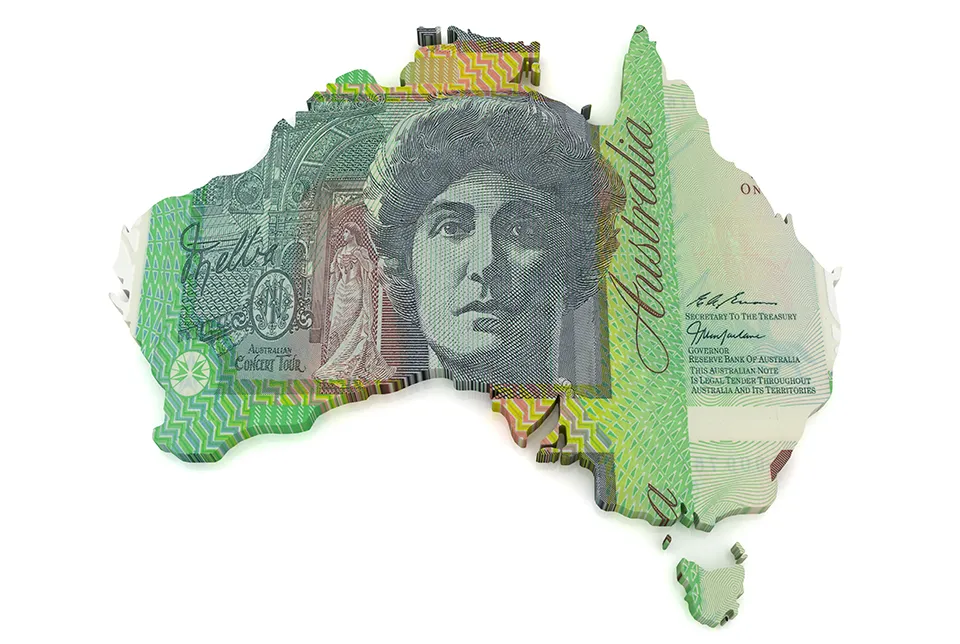
Should you be bullish or bearish on the Australian dollar? The country faces many of the same inflationary and interest rate headaches as the rest of the world, but also benefits from churning out many of the raw materials that others are now paying so much to get hold of. In recent months the Aussie dollar has weakened against the US dollar – surprisingly so, in some eyes. But it is also more vulnerable than some to any signs of China weakness.
In a research note last week, analysts at JPMorgan remained constructive on the AUD, saying that economic indicators mitigate the risk of the central bank having to overtighten, while the country’s commodity exporter status also provides natural insulation from stagflationary forces.

Some see that status as one of the reasons why the AUD looks undervalued.
“Over the medium term, fundamentals such as differentials in the terms of trade and interest rates are the primary drivers of the currency,” says John Bromhead, ANZ Bank FX strategist. “Our fair value model, which incorporates these drivers, is currently suggesting the AUD is cheap relative to fundamentals. This valuation backdrop should provide some downside protection should global conditions deteriorate.”
Tim Baker, head of Australia/NZ macro research and G10 FX strategist in the Asia-Pacific region for Deutsche Bank, reckons that AUD/USD weakness is slightly surprising. “Risk sentiment and China developments are always going to matter, but historically the domestic picture should matter a bit more,” he says. “Interest rate differentials are less in Australia’s favour now but they are still reasonable and would suggest the AUD should be higher.”
Interest rate differentials are less in Australia’s favour now but they are still reasonable and would suggest the AUD should be higher
Tim Baker, Deutsche Bank

That is especially the case when interest rates are considered in real terms, since Australia has less of an inflation problem than the US. The Australian economy is also getting a jolt from higher commodity prices – iron ore has slid in recent months, but the slack has been taken up by liquified natural gas and thermal coal prices, which have responded to the global energy shock.
“On valuation metrics that incorporate commodity prices and the current account position, with Australia having moved from decades of deficits to sizeable surpluses, AUD looks very cheap while the US dollar has rarely looked this expensive, so we do see AUD/USD rising materially over the next year,” adds Baker. “However, some downside seems more likely in the near term if equities wobble on mounting growth concerns, and China woes persist.”
Those woes include a tottering property sector and an economy whose growth prospects continue to be hampered by the country’s zero-Covid approach. China’s status as Australia’s biggest trading partner makes any weakness a severe risk for Australia. A pick-up in Chinese momentum was expected by now and there has been considerable stimulus aimed at the infrastructure sector, says Baker. “But the property sector issues need addressing before the Aussie dollar can really perform,” he adds.
Unsurprising, perhaps
But others are less surprised at the Australian dollar’s weakness against the US dollar. After all, the USD has been firm against pretty much every other currency, so AUD/USD may not be the best benchmark, says Geoffrey Yu, FX and macro strategist for EMEA at BNY Mellon. He thinks a better comparison may be with New Zealand.
“AUD/NZD, for example, tells a different story,” he says. “Even though market expectations for Reserve Bank of New Zealand hikes have been much stronger than those for the Reserve Bank of Australia (RBA), the NZD has not benefited much. In our positioning monitors, AUD has been the best performing developed market currency for a while now.”

For Parisha Saimbi, G10 FX strategist at BNP Paribas, the fall in AUD/USD over the last four months is largely reflective of USD demand from investors seeking a haven. But she also points to the supply-side driver of commodity prices as another factor.
“Although Australia’s terms of trade have improved, the nature of the commodity price shock has been supply-driven, which we find often yields a less positive impact for commodity-linked currencies like the AUD compared to demand-driven price rises,” he says. “In addition, global equities have responded negatively, offsetting any positive impacts from the terms of trade.”
Kenneth Broux, head of corporate research, FX and rates at Société Générale, notes that the cheap valuation of the AUD makes it attractive for investors or companies with a longer-term horizon, adding that when US interest rates peak and/or the Chinese economy turns the corner, the AUD will recover.
“But if commodity prices were to fall back because the world economy falls into recession, AUD/USD could stay weak because of the safe haven status of the latter,” he adds.
The nature of the commodity price shock has been supply-driven, which we find often yields a less positive impact for commodity-linked currencies like the AUD
Parisha Saimbi, BNP Paribas

Bill Evans, chief economist at Westpac, argues that although a very strong labour market and solid household balance sheets is holding back negative forces for now, growth in spending will slow in the final quarter under the weight of rising interest rates and high inflation.
The structure of the Australian mortgage market makes the economy particularly sensitive to interest rate rises, which are expected to start to impact growth in the second half of 2022 and in 2023.
“This will have implications for how far the RBA can raise interest rates relative to the US,” says Bromhead at ANZ. “On top of this, pressure on commodity prices will remain as global activity and trade volumes continue to soften. This is a headwind for commodity currencies like the AUD which are highly levered to the global cycle.”
ANZ believes that slowing global growth and tighter liquidity conditions will limit upside potential for the AUD over the next 12 months, and is forecasting 0.72 AUD/USD by year-end. At the time of writing, the pair trades at about 0.69.
Yu’s view that this is not a good time to increase exposure to AUD is based on market complacency around US inflation expectations that leaves BNY Mellon wary of adding to USD shorts at current levels.
“The Fed still has a way to go before it can really take its foot off the brake and the RBA will likely start doing so around the same time, if not sooner,” concludes Oanda senior market analyst Craig Erlam. “I guess we will see the true resilience of both economies in the next few months.”