Macquarie’s full-year results, announced today (May 6), brought yet another set of records: highest ever net profit, at A$4.7 billion ($3.3 billion), up 56% on financial 2021, which was itself a record; and 53 consecutive years of unbroken profitability since inception.
It is an outstanding group performance. But one of the more important numbers was that almost half – 48% – of net profit came from the Americas. All told, overseas income accounts for 75% of Macquarie’s total; Australia is now just a quarter.
All of these are records and it is easy to forget how recently the dynamic has shifted. It was only in the 2007 financial year that international income became the majority: until then the lion’s share was all Australia. And even then, Asia was the bulk of international earnings, not the Americas.
Today, though, so many of Macquarie’s engines are US-based that one begins to wonder about the group’s future. Three different cities house vital businesses.
Michael Silverton, chief executive of Macquarie Capital, effectively the investment banking arm (though nothing is ever quite that straightforward or mundane amid Macquarie’s federation of innumerable niche businesses), is based in New York, not Sydney.
Just over an hour’s train ride south in Philadelphia, global head of the public markets side of Macquarie Asset Management, Shawn Lytle, is based in a newly refurbished building on Independence Mall, overlooking Liberty Bell, and with Macquarie signage that can be seen from the Benjamin Franklin bridge as you cross into Pennsylvania from New Jersey.
This year the North American power and gas business made a big contribution because of structural things that happened in that market. It is not the biggest region ever year
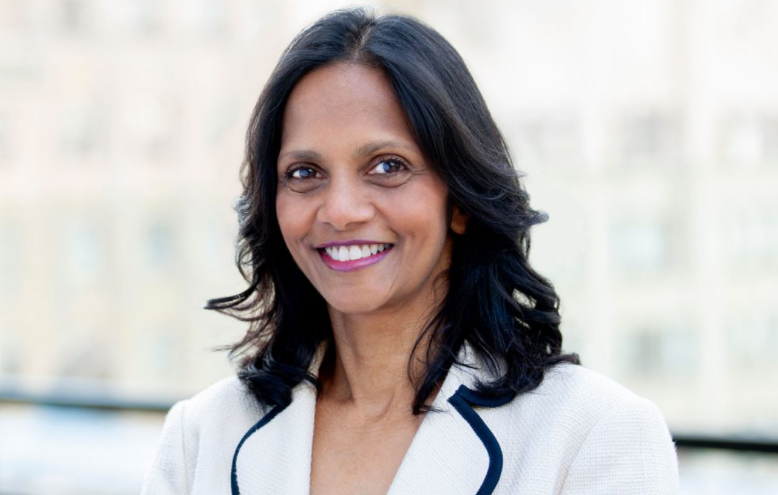
Shemara Wikramanayake, Macquarie Group
It is the most overt branding exercise Macquarie conducts anywhere outside Australia, reflecting the fact that its public investments business (things like mutual funds rather than private infrastructure funds) of A$535.1 billion in assets is in large part the legacy or subsequent product of two US acquisitions, Delaware Investments and Waddell & Reed.
And the commodities and global markets (CGM) business, the one that has completely transformed Macquarie’s profitability through the Covid years and that generated a A$3.9 billion profit contribution this financial year, up 50% on what was already a record previous year, has its chief executive, Nick O’Kane, in Sydney, but he built much of his career in Houston.
That remains the biggest driver of Macquarie’s supercharged profits, where the amalgam of three acquired businesses – Cook Inlet, Constellation Energy and Cargill – has provided a foundation for an exceptionally powerful and well-placed business across North American gas, power, oil, LNG, emissions and pretty much anything else you can trade or hedge. CGM is much more than this, with entrenched positions everywhere from forex to agriculture to precious metals in every part of the world, but just lately it’s been Houston that’s been firing.
A question
With the Americas now contributing almost twice as much profit as Australia, it is worth asking the question: in the long run, will Macquarie’s overall leadership be run from there? Will head office move there? The listing? Even the group’s domicile?
It has been considered before. There was a time when Macquarie looked seriously at moving to Singapore. The idea of relocating the head office in light of growing international income was considered in the 2007 annual report. Ultimately Macquarie decided it still called Australia home.
CEO Shemara Wikramanayake poured cold water on the idea of a change of domicile today for several reasons: most Macquarie shareholders, both retail and institutional, are in Australia; so are its regulators; so is its listing, though of course a second listing is easily achieved if desired.
Itis also fair to say we shouldn’t go overboard on the numbers from a fairly extraordinary couple of years. The North America figures from the last two years have been boosted by startling activity in risk management, inventory management and to some extent trading in North American power and gas. In the 2021 results they were propelled by an extreme winter in Texas and this year by a range of things from an absurdly hot Canadian summer to geopolitical uncertainty triggered by Russia’s invasion of Ukraine.
It was enough to prompt veteran analyst Brian Johnson, now at Jefferies, to ask if the business was in some sense dependent on extreme weather for its profit surprises. Ultimately, the business is much more about client hedging than anything proprietary done by Macquarie, but clients themselves have had to adapt to changing weather and this must surely impact their need for risk-management services.
Still, it won’t always be this way.
“This year the North American power and gas business made a big contribution because of structural things that happened in that market,” Wikramanayake told Euromoney today. “It is not the biggest region every year.”
Macquarie will always be, at its heart, Australian. But not in terms of profits, it isn’t, and it probably never will be again
But at the very least, it is likely that any future candidate for chief executive will have had to have spent time in the Americas. Wikramanayake has done so, living in New York for a time in order to lead the infrastructure funds management business there, and being closely involved in the Philadelphia acquisition of Delaware in the aftermath of the global financial crisis.
Nobody is quite sure how long Wikramanayake, who is 60 this year, will stick around; a decade is considered a decent innings for a Macquarie chief executive. Nobody is in any rush for her to go: she is popular and highly regarded both internally and externally, is an exemplary communicator on climate issues, guided the group deftly through Covid and has just delivered a preposterously good result.
But if she were to depart sooner, O’Kane would be the lead candidate to succeed her, and Silverton would probably be in the conversation too. The other main candidates – Ben Way, who heads Macquarie Asset Management overall, including all the infrastructure funds, and Greg Ward, the former CFO who now runs the Banking and Financial Services division – have not been based in the US, though Way spends weeks at a time there. Alex Harvey, CFO and, like Way, a former head of Asia, has US experience.
Spiritually Australian
Spiritually at the very least, the institution is Australian: its can-do, sharp-elbowed, say-what-you-think attitude at every level of the group is something of a reflection of a national mentality, and a very positive one for a financial institution. Backing individual entrepreneur-minded staff with good ideas and no fear has been the making of the whole place, along with a largely bulletproof approach to risk management.
So, Macquarie will always be, at its heart, Australian. But not in terms of profits, it isn’t, and it probably never will be again.