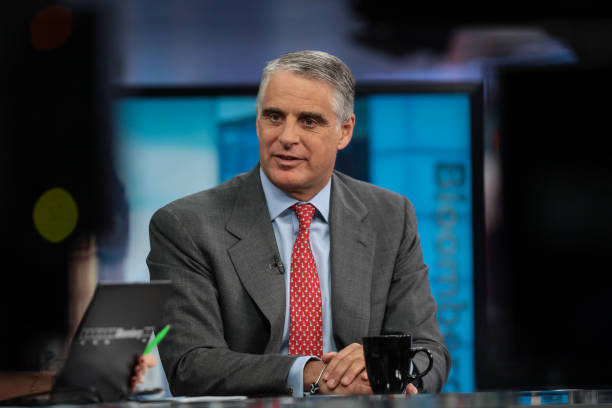
UniCredit has placed the emphasis firmly on growth and revenues in its first results under new chief executive Andrea Orcel, signalling a shift from what he called a period of “active retrenchment”.
Regarding M&A, Orcel told analysts: “I do see it as an accelerator” – assuming it is in shareholders’ best interests and if the bank is confident in its ability to execute a deal.
With these words alone, Orcel drew a clear line under Jean Pierre Mustier’s term as CEO.
Mustier, who left the bank in February, repeated a mantra of “no M&A” even as M&A fever gripped Italy and southern Europe more widely last year.
Orcel was clear, however, that “M&A is not a purpose in itself”. He will spend the next few months getting to know the team and the bank, before unveiling a new strategic plan in the second half of the year.
Reinvigorating net interest income, building our top line and delivering strong organic capital are key priorities for the team
Andrea Orcel, UniCredit
However, his comments during the results, and indeed his new team’s presentation of their recent performance, already suggest a change in approach at UniCredit.
Orcel says he wants to “move UniCredit decisively away from a phase of significant restructuring and retrenchment”.
The objective is to make sure the bank makes a return above its cost of equity. That is something Mustier wanted to achieve, too, although at times he argued he could do so in part by lowering the firm’s perceived risk.
“Reinvigorating net interest income, building our top line and delivering strong organic capital are key priorities for the team,” says Orcel.
Orcel naturally wants to maintain UniCredit’s reputation for conservative balance-sheet management – a reputation that Mustier built.
Indeed, the cautious approach under the former CEO largely underpinned the strong results that Orcel was able to present. Underlying return on equity rose five percentage points to 6.9%, in part due to writebacks of loan-loss provisions. The capital buffer over UniCredit’s maximum distributable amount (MDA) also rose to a record 689 basis points.
Revenues
Yet the results also highlighted how much revenues – and a lower cost-to-income ratio, at 51.5% – may contribute to UniCredit’s future profitability.
While trading revenue, up almost 50%, was a key factor, fees rose to their highest level in a decade, thanks to a 15.5% year-on-year rise in investment fees. That compares with 14.2% last year, although the communication of results under Mustier tended to display progress on capital and asset quality more prominently.
We will regain the market share that we lost
Stefano Porro, UniCredit
Stefano Porro, UniCredit’s chief financial officer, says that the investment-fee success this quarter is due to greater willingness of clients to deploy cash liquidity to assets under management and life insurance.
It was not due to any recent strategic change at UniCredit – Mustier having announced his exit in November. In other words, the offer to clients was the same in 2020 as it was in the first quarter of 2021.
Across Italy, as elsewhere, fees from asset management and life insurance are becoming even more important to banks, due to the swelling of retail deposits as consumers have amassed more savings during lockdowns, notes KBW analyst Hugo Cruz.
Risk decisions
Meanwhile, Orcel noted that pressure on net interest income could be worse at UniCredit, compared with competitors, because of its recent risk decisions.
The bank has been cautious in consumer finance and residential mortgages compared with peers, due to what Porro says is a focus on risk-return as opposed to market share – although this doesn’t imply a longer-term disadvantage.
“It hasn’t affected the capacity to serve the client; we will regain the market share that we lost,” he says.
Intesa Sanpaolo, Italy’s biggest bank, remains more profitable than UniCredit and still trades at a much higher stock valuation. This is mainly down to fees – again, especially investment fees – that make up a higher proportion of its revenues.
Mustier’s critics partly blame that on his decision to sell asset management business Pioneer Investments and online wealth manager FinecoBank while he was CEO of UniCredit.
UniCredit’s German business is strongest in corporate banking, so this is largely an issue for the Italian retail network. Unlike Intesa Sanpaolo, UniCredit distributes in-house asset management and life insurance products from the likes of Amundi and Allianz.
“The sale of Pioneer did not touch the capacity of the group to distribute products to its clients via the network,” Porro insists.
Nevertheless, rather than buying another Italian retail bank, some UniCredit investors may prefer any inorganic deployment of excess capital to be in asset management or insurance – perhaps including renegotiating some of these fund and insurance-distribution agreements – reckons KBW’s Cruz.
Orcel will been keenly focused on the new board’s interpretation of the bank’s interests as well.
Shareholders installed former finance minister Pier Carlo Padoan as chairman in mid April, when Orcel took over as chief executive.
A wider board reshuffle saw the exit of Stefano Micossi, formerly chair of the governance committee, and the entry among others of former Virgin Money chief Jayne-Anne Gadhia.
Lamberto Andreotti, businessman and son of former Italian prime minister Giulio Andreotti, remained as deputy chairman.