When Norbloc was founded in 2016, it took a few years to find its feet. Headquartered in Sweden, the data expert, specializing in know-your-customer (KYC) technology, set out to sell its digital wares across western Europe.
“In our early days, we worked with banks in Sweden, Norway, Belgium and Greece, and found that not an awful lot of financial digitization was going on,” says the firm’s chief executive and co-founder, Astyanax Kanakakis. “Banks were very sceptical about working with each other, even though they are symbiotic in many ways.”
So, the following year, it switched track and headed to the United Arab Emirates, opening an office in the Dubai International Financial Centre (DIFC), the region’s main financial hub.

At first, things moved slowly. The firm worked on a digital pilot scheme with a dozen or so local and regional banks – but again it developed slowly, bearing little fruit.
Then came its big break. In early 2019, Norbloc was approached by DIFC and Dubai-based Mashreq Bank. The two had a specific aim in mind: to create a digital ecosystem able to share the KYC data of corporate customers, seamlessly and securely.
“From there on, it snowballed,” says Kanakakis. “We now have 11 institutions committed to the effort” – most of them commercial lenders and local government entities – “and over 330,000 corporate KYC files on the network, which has been live since February 2020.”
“The project is still expanding,” he adds. “We are now looking to onboard a second wave of institutions.”
Several other organizations then joined the effort, including leading regional banks such as Emirates NBD, HSBC and Abu Dhabi Commercial Bank (ADCB). The initiative is today known as the UAE KYC Blockchain Platform and it runs on Norbloc’s platform, Fides.
Ecosystem for exchange
Abdulla Qassem, group chief operating officer at Emirates NBD, calls the platform a “nationwide ecosystem for exchange of verified KYC data.” It is supported by the UAE central bank and Smart Dubai, a state-backed scheme that aims to transform the Emirate into a leader in everything from artificial intelligence to blockchain.
Qassem says Emirates NBD will continue to expand the platform “to include other banking partners and financial institutions.”

Ratings agency Moody’s calls the move “credit-positive” for all UAE lenders, tipping the platform to “facilitate faster and more secure onboarding” of clients and to let members share “authenticated and validated digital customer data and documents through distributed technologies powered by blockchain.”
Why does this matter?
Kanakakis notes that while the platform allows members to share any kind of data, it chose to focus at first on KYC. “It’s a big pain point for financial institutions and their customers,” he says.
This is a problem for all banks but doubly so in the Middle East, where the US has a raft of sanctions in place on Syria and Iran, and also imposes targeted sanctions on individuals in Iraq, Yemen and Lebanon.
In this context, knowing who someone is before you let them open an account is essential. A lack of due care and attention can lead to financial penalties or worse at the hands of US and, increasingly, local regulators.
It’s a key reason why for so long, opening a bank account, even in a place as financially developed as Dubai, was such an arduous process.
Norbloc’s platform allows members to share: “Blacklist data and allows banks to raise alerts in the ecosystem with their peers related to certain accounts,” adds Kanakakis.
He says data streamed via Norbloc’s Fides platform is “agnostic”, noting that all notarized or regulated data can be shared securely. “Think of it as though we provide the ‘piping’ for the data to be shared between institutions – and it is the institutions that decide what that data should be,” he adds.
This is of particular benefit to small and medium-sized enterprises, the backbone of the regional economy, says Joel Van Dusen, group head of corporate and investment banking at Mashreq Bank.
He points to its rollout in September 2019 of NeoBiz, a digital banking service that caters expressly to startups and young businesses. The main draw was its KYC service, which allows clients to open or renew an account completely online.
The process “cuts their onboarding process from multiple days down to 20 minutes,” says Van Dusen.
“There is a federal drive to make it easier for companies to onboard. That will really benefit SMEs. One of the common themes… is that of government agencies getting really involved in helping” smaller enterprises to flourish.
“Corporate clients expect ease of onboarding” in 2021, he adds. “They expect a host of services and solutions to be presented to them and they don’t want it to be a laborious process where they have to call 14 different people.”
The push to ensure that banks know who they fund and serve is being driven from the top by a government keen to show it is a digital leader and a stickler for the rules.
In the last week of January 2021, the UAE’s central bank said it imposed financial sanctions on 11 banks for failing to “reach appropriate levels of compliance on anti-money laundering and sanctions” before the end of 2019.
The regulator declined to name the banks but said the cumulative fines totalled Dh45.76 million ($12.5 million). The offending institutions had been given “ample time” to meet new compliance rules, it added.
Corporate clients expect ease of onboarding… They expect a host of services and solutions to be presented to them
Joel Van Dusen, Mashreq Bank
In digital terms, this is just the start.
Norbloc is building a KYC system that leverages data from the UAE’s corporate registry. That “lends a lot of credibility to the data that is shared on the ecosystem and makes the validation process for banks a lot easier,” says Kanakakis.
Another key aim for his team and its financial partners is to “focus on how we can offer and expand services in a mutualized manner,” he adds. In other words, to ensure the technology it develops benefits the many not just the few.
That should also profit the Sweden-based fintech. There’s a lot of money to be made by selling data to all manner of financial and non-financial firms unable to perform KYC checks. “There has been a lot of interest in that from participants,” he adds.
Trendsetter
The UAE has emerged in recent years as a leader in everything from KYC to private banking to blockchain.
Again, the state is at the heart of this process. The Emirates Blockchain Strategy aims to put at least 50% of all government transactions on the blockchain by the end of 2021. The primary focus of the Dubai Blockchain Strategy is to make it the first place to be fully powered by the blockchain, unlocking – the Emirate’s leaders reckon – Dh5.5 billion in annual savings.
Dubai continues to position itself as a global logistics centre, even as it emerges as a financial technology pioneer. Keen to be more self-sustaining, the UAE is transforming itself into a vaccine hub. In the last week of March 2021, a local tech company called G42 signed a joint venture with China’s Sinopharm.
It has also signed a $7 billion deal with India to ensure food security. Each year, the country becomes a more integral part of global supply chains.
“There are big investments in energy security, in warehousing, in new reserves of clean energy,” says Sunil Veetil, regional head of trade finance in the Middle East, North Africa (Mena) and Turkey at HSBC. “Not many countries in the Middle East have built large-scale warehousing facilities for food and that process will pick up sharply.”
By most measures the UAE had a good pandemic. It struggled with lockdown at first but recovered well. When it opened its doors to business travel from late December, hotel occupancy rates soared. Vaccination rates are among the highest in the world. The central bank tips the economy to expand by 2.5% in 2021 and 3.5% in 2022.
If anything, the pandemic has sharpened its desire to be a digital pioneer.
Veetil describes Covid as “jet fuel poured onto digitization” and says the UAE in general and Dubai in particular: “Can become a global leader in digital business and blockchain. This can genuinely become the first fully digitally enabled country.”
The UAE government is a real trend-setter and is committed to technology
Sunil Veetil, HSBC
Again, he points to the government’s ambitions in digital that span the financial and corporate sectors. While many countries talk a good game, the UAE has resolutely set about forming and following an integrated strategy.
“The UAE government is a real trend-setter and is committed to technology,” says Veetil. “If the tone from the top is to adopt blockchain, then you will see very quickly the entire ecosystem adopting it.” That process is also being accelerated by a national push to attract the right kind of talent, from bankers to IT experts.
This digital acceleration is even more visible at ground level. Every big financial institution is busy rolling out a raft of new digital services in an attempt to retain clients, attract new ones and stay ahead of the field.
Mashreq Bank’s Van Dusen highlights Trade Tracker, a service that allows corporates to track the status of a trade transaction in real time, online and via email and text.
“When a client had a discounted letter of credit, they would ring up and ask where in the system the LC was,” he says. “Now, they just go online and it’s right there, like tracking a DHL shipment. That has certainly made their lives easier – and ours, as we don’t have to employ a bunch of people to answer the phone. Our clients aren’t going to go back to the old ways.”
At HSBC, regional head of trade finance Veetil is eyeing new ways to monetize and commercialize blockchain technology in trade finance.
“You’ll see more companies at HSBC onboarded on blockchain in 2021 and once they come in it will be only a matter of time before they are contained in a single ecosystem,” he says.
Staying ahead
Recent events have accelerated digital adoption among local corporates. “Clients in lockdown were not able to come to branches and they needed a solution,” adds Veetil. “During Covid our digital penetration shot up to 80%.”
He points to the example of Landmark Group, a Dubai-based conglomerate. “By implementing blockchain, they achieved a 30% to 40% increase in efficiency in working capital. This is huge.”
Dan Howlett, regional head of commercial banking for Mena and Turkey at HSBC, describes blockchain as proof that necessity is the mother of invention.
“A lot of our clients who were doing everything on paper, including logistics spanning every step in the trade process, had no choice but to embrace blockchain and digital” since the start of 2020, he says.
That compelled them to embrace digital technology faster than anticipated.
“What would have taken three to five years, we were able to do in 12 months,” says Howlett. “That makes it easier for us to serve our customers more efficiently and effectively.”
He believes blockchain is here to stay. “I only see that activity accelerating over the next 12 to 18 months. I haven’t seen one customer revert back to paper, who hasn’t wanted to stay on the digital platform.
“Blockchain over time will make the world of trade finance a lot more efficient. It will reduce fraud and other risks by increasing transparency among banks and counterparties and increase the velocity of trade by compressing the working capital cycle.”
Challenges remain as banks and regulators push to create digital frameworks that are safe and secure but also malleable enough to expand to meet future needs.
Emirates NBD’s Qassem points to the need for a national regulatory framework, a standardized platform with a full range of data privacy and security standards, and the widespread “acceptance of blockchain audit trails as a chain of evidence in the court of law.”
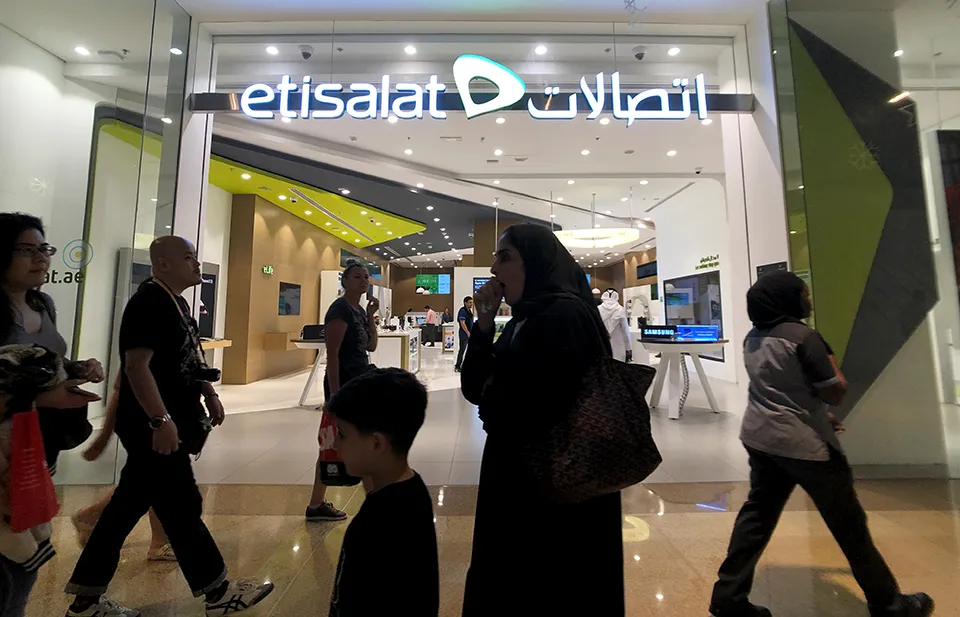
And banks know they aren’t only competing with one another. There are other innovators out there, including technology and telecommunications giants. Abu Dhabi telecoms operator Etisalat is both a provider and consumer of blockchain. It uses the technology internally to verify the status of employees. In September 2020, it joined forces with local firm Smartworld to launch Shahada, a blockchain-based platform that creates and stores individuals’ academic records.
Etisalat is also building a new platform, backed by blockchain and distributed-ledger technology, with the aim of helping commercial lenders to detect fraud in supply chain financing. It should launch in May 2021.
Mashreq’s Van Dusen embraces financial innovation by non-bank companies but adds the best in class are set to be partners as well as competitors. Pointing to the examples of Amazon, Etisalat, and Chinese payments platform Alipay, he notes: “We expect [them] to be our main financial payments competitors of the future.”