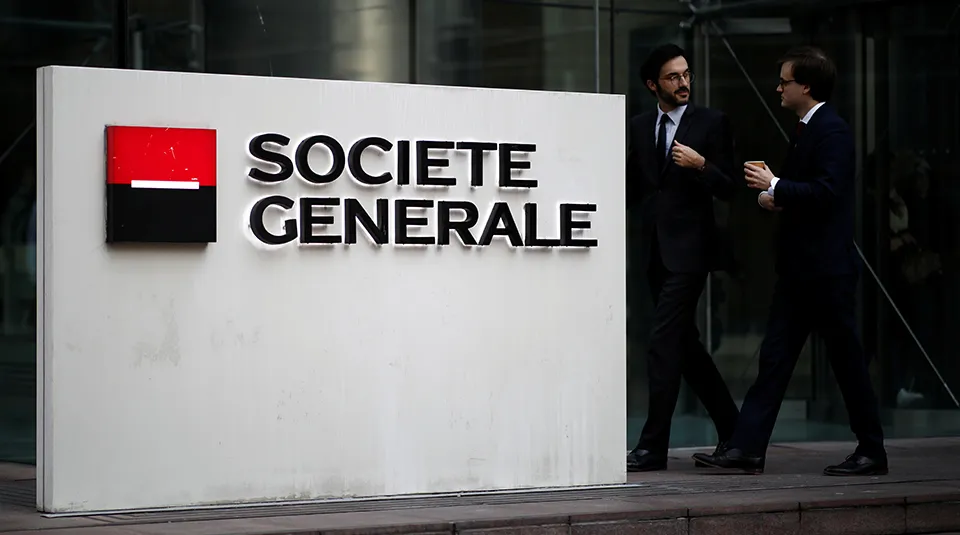
Societe Generale is billing a €825 million sale of asset manager Lyxor, best known for exchange-traded funds (ETFs), as the completion of a strategic reorientation process begun in 2018. But this refocusing, as it calls it, has come far short of turning the bank around.
Three years ago, according to Berenberg, SocGen was trading at a 20% discount to book value, while its French and eurozone peers were trading just below par. Today it’s even further behind, at a 60% discount to book value, while peers trade at a 30% discount.
In the past three years SocGen has cut costs and risk, especially in French retail and the investment bank. It has sold assets and simplified its business, including in central and eastern Europe, and now Lyxor, which it expects to sell to Amundi, majority-owned by Crédit Agricole.
In investment banking, SocGen is a second-tier player in a market where only the very strongest can survive
SocGen and its chief executive Frédéric Oudéa have tried hard to improve things recently. The bank has still underperformed, because it’s a fundamentally unattractive group of core businesses. In investment banking, SocGen is a second-tier player in a market where only the very strongest can survive. In France, it does not enjoy a big market share in retail banking.
It all makes for an obvious merger story. A player of mediocre positioning doing this badly should get taken over. SocGen, however, is already one of Europe’s biggest banks. Its balance sheet is almost €1.5 trillion. It would need to be taken over by an even bigger bank – BNP Paribas, most obviously – but global financial regulation understandably tries to mitigate the risk of such institutions by demanding bigger capital buffers as these banks become even more systemically important.
Piecemeal consolidation
The answer, increasingly, is piecemeal consolidation at the top. Outright mergers are more the domain of domestic mid-tier banks. But bigger and more cross-border deals need to happen too – mergers that would subsume the likes of not just SocGen, but also other lenders facing existential questions, such as ABN Amro, the big German private banks, and possibly Credit Suisse, especially after its Greensill and Archegos fiascos.
With the potential exception of a merger between Commerzbank and Deutsche Bank, the most likely outcome for all of these is that they remain standalone firms, even when they’re adding little to the sector except capacity – and desperation.
But deals involving big lenders are proceeding on a bolt-on basis, something that has been very much the approach of BNPP. Crédit Agricole’s Amundi is therefore the natural buyer of SocGen’s Lyxor.
It’s notable that another rumoured interested party was another bank-owned asset manager, Deutsche’s DWS. The Lyxor sale also follows BNPP’s purchase of Deutsche’s prime brokerage business in 2019, and SocGen’s purchase of Commerzbank’s equity markets and commodities business in 2018.
Whether all this is enough to solve the deeper problems of what look increasingly like zombie banks is another question. So far, it has not.