In global terms, Japan has had a complicated pandemic.
It was one of the first countries to be hit, one of the first to recover, one of the nations that has faced the most waves, but one where culture has been particularly relevant.
On one hand, it has long been quite normal for people to wear face-masks in Japan; on the other, there are few societies where working from home is less accepted.
As Japan’s biggest and most systemically important bank, MUFG is a barometer for the impact of Covid on the country’s financial system. In April 2020, 70% of the bank’s Japanese staff worked from home, an unprecedented level. Today the figure is around 50%, compared with 80% to 90% of its staff in the US and Europe.
The bank has reported a 30% year-on-year increase in the use of non-face-to-face channels, which has to be a good thing in a country that has tended to resist digital and stuck doggedly to cash, ATMs and branches.
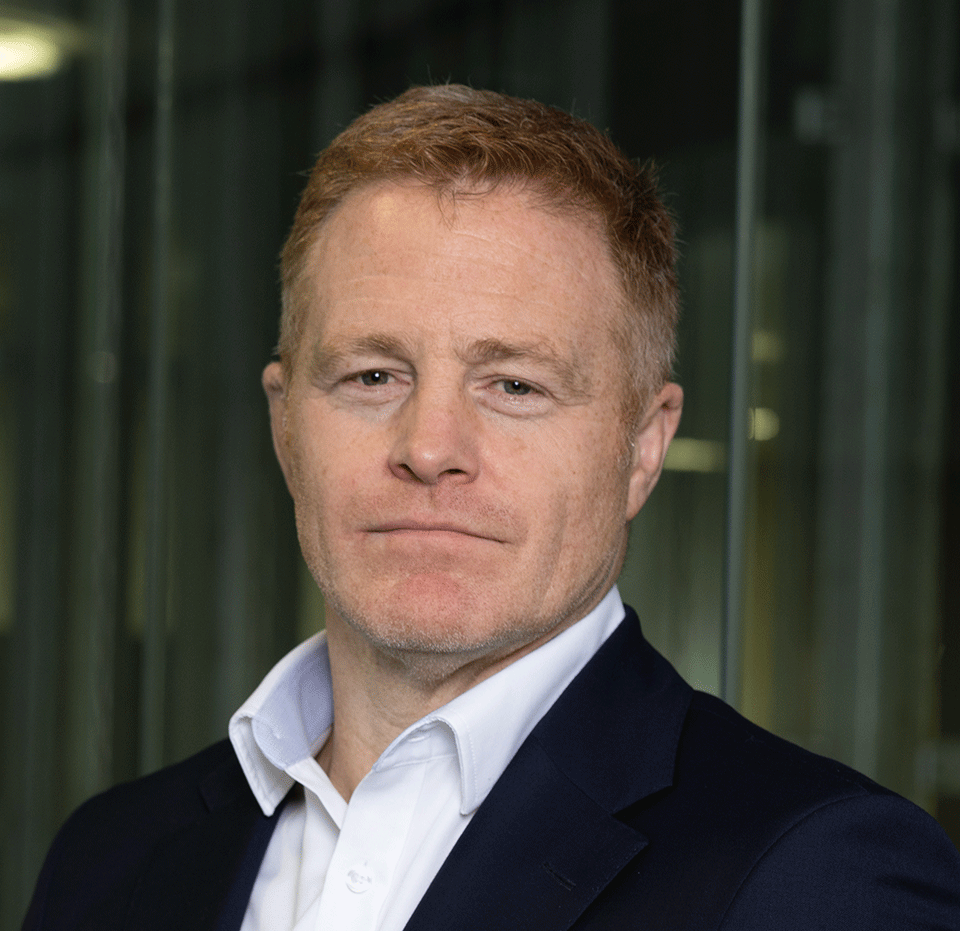
Asked about MUFG’s response to Covid, Takayoshi Futae, chief executive officer of the global commercial banking business unit and chief operating officer for international businesses, highlights lending and social responsibility. So far, the bank has issued around ¥5 trillion ($48 billion) in new lending related to the pandemic.
“And if you include things like commitment lines, we are providing over ¥15 trillion in capital support domestically and overseas,” he says.
CSR
The bank is also involved in corporate social responsibility initiatives “to support the frontline medical personnel tirelessly working to save lives, as well as local communities, students, the arts” and other affected sectors, he says.
Financially, the bank has done reasonably well in the circumstances.
Net profit (or profit attributable to owners of the parent, the local terminology) was ¥400.8 billion for the first half of fiscal 2021, representing the six months to September 30, 2020. That’s a 34% year-on-year drop but better than the bank had forecast.
Although it has taken a ¥200 billion hit from Covid to net operating profits, through declines in non-yen interest income, assets under management, new investments, investor appetite and general business, the bank had previously expected a ¥300 billion hit.
It has upgraded its full-year profit target to ¥600 billion from ¥550 billion, which would be an achievement and an increase from financial 2019.
One reason it can do this is the gathering strength of the bank’s international strategy – and not just the stake in Morgan Stanley, which contributed a vital ¥114.5 billion to the half-year profit number.
One of MUFG’s core strengths is our global business and, even amid Covid, our strategy to enhance this has not changed
Takayoshi Futae, MUFG
While domestic retail and commercial banking, and corporate and investment banking all shrank considerably year on year, global commercial banking and global markets were dramatically improved.
“One of MUFG’s core strengths is our global business and, even amid Covid-19, our strategy to enhance this has not changed,” says Futae, who serves on the MUFG Bank board.
Bank Danamon in Indonesia is now fully acquired, as is the Australian asset management firm First Sentier Investors. The vital US regional banking business – primarily Union Bank – has been reorganized under new head Greg Seibly.
This is vital work.
“Domestically, growth is stagnant amid structural challenges such as the low interest rate environment, declining population and aging populace, making incorporating growth in Asia and expanding our business in the US key pillars of MUFG’s strategy,” says Futae.
Part of this process has involved some tough decisions on where to allocate assets, from “quantity to quality,” says Futae.
In financial 2019 (to March 31, 2020) the bank monitored around 600 non-Japanese clients with low profitability and exited many of them, and reduced several hundred billion yen of low profitability assets.
This financial year it has raised its monitoring threshold and will probably cull many more.
Grab
Perhaps the most interesting international venture was the decision to take a nearly 5% stake in Grab, the leading southeast Asian fintech, through a $706 million investment announced in February.
Investments in bricks-and-mortar banks such as Thailand’s Bank of Ayudhya and the Philippines’ Security Bank have worked well, but Grab is a quite different proposition.
“I feel a strong sense of urgency that we cannot survive with strategy which follows existing precedent,” Futae says. “Our investment in Grab signifies our endeavours to provide new digital financial services.”
The investment is not just financial. MUFG is already lending through Grab’s app, with Thailand a natural place to start, given MUFG’s presence: it has launched a loan product targeted at drivers there, which received 6,000 applications in the first five days after launch in September.
“We are starting to see concrete results like these, and going forward, we plan to advance collaboration with other partner banks in various fields.”
So, there’s a plan for growth, but the costs of Covid must be reckoned with too. MUFG also raised its credit cost estimates (including funds set aside for bad loans) for the financial year to ¥500 billion from ¥450 billion. Around ¥1.9 trillion of credit exposure to air transportation isn’t going to help.
Only by harnessing the changes that Covid has accelerated can MUFG come out of the crisis enhanced. Futae has got the message.
“The business environment surrounding MUFG is changing drastically with unprecedented speed and we expect Covid-19 to be a driver for further accelerating the digital shift in society,” he says.