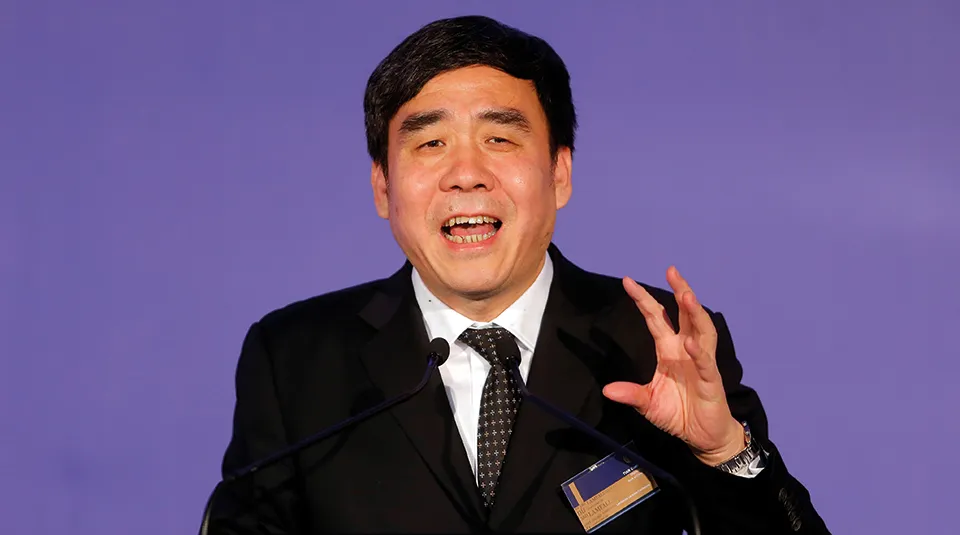

China Construction Bank’s interim report in 2019 was all about inclusivity. Chairman Tian Guoli and vice-chairman Liu Guiping directed investor attention toward a new strategy designed to position the bank as a bastion of sustainability. At the heart of it were home leasing, inclusive finance and fintech.
The headline act was Yunongtong, a new service aimed at accelerating rural financial reform, with the aim of creating what CCB describes as “smart rural areas”.
This year, inclusivity took a back seat to the pandemic. CCB’s interim report in 2020 was headlined, with a somewhat military flourish, ‘Fighting against the pandemic [and] supporting economic and social development’.
The bank then made clear why it exists – to fulfil “its responsibility as a major state-owned bank by earnestly implementing government policies.”
Financial coherence
Covid forced China Construction Bank and its peers to act fast. This wasn’t a carbon copy of the Lehman Brothers crisis – the government didn’t instruct state lenders to explode their balance sheets and they didn’t offer to.
Twelve years ago, the Chinese Communist Party and its state-run banks doled out staggering sums in a frenetic attempt to stave off recession. Many municipal bodies remain weighed down by the debt they accrued.
This time, CCB used its loan book to prop up firms and the economy, but it acted with far more financial coherence, taking care, it said in its interim report, to support the economy by “lowering lending rates, implementing deferrals on interest and principal payments and reducing fees.”
Boilerplate stuff – but being a Chinese bank, it still did all these things on a massive scale.
Between the start of the year and the end of June 2020, total assets rose 8.7%, to Rmb27.7 trillion ($4.22 trillion), with total loans up 9.5% to Rmb15.9 trillion and liabilities rising 9.3% to Rmb25.4 trillion.
Net profit fell 10.8% over the period to Rmb139 billion, with return on average equity (ROAE) down nearly 3 percentage points, to 12.65%. Impairment losses rose sharply of course, increasing 49.2% over the period to Rmb111.6 billion.
CCB’s risk controls are increasingly world class, as is its technology
The bank underwrote Rmb60.5 billion worth of special anti-pandemic government bonds in the first half and channelled Rmb119.5 billion in credit to 10,000 corporates viewed as critical in combating Covid-19.
But it didn’t forget about its earlier promises. In the first six months of the year, CCB issued 872,000 Yunongtong debit cards and 50,000 credit cards with the aim of boosting rural financial literacy and inclusivity.
Another new service, Mingonhui, designed to help financially excluded migrant workers, made its debut. In the first half of 2020, 8.75 million workers secured Rmb97.3 billion in personal loans.
More than Rmb2 trillion in agriculture-related credit was channelled to farmers in the first half, a year-on-year increase of 10.6%, to ensure the seamless delivery of food to every household during Covid. Another Rmb234 billion in capital was extended to society’s lowest tiers in an effort to alleviate poverty.
CCB is unrecognizable from the bank it was a decade ago. Its risk controls are increasingly world class, as is its technology. A prime example of this is Huidongni, an app that targets smaller firms.
Between January and July, the owners of 3.63 million smaller enterprises signed Rmb253 billion in loans, all of them applied for and approved online.
Wealth management
There is still much to do. CCB’s wealth management business remains an afterthought.
The bank generated Rmb7.38 billion from wealth management fees in the first half of 2020, down 1% year on year. China starts to open its wealth management industry to foreign players in 2021. To compete with them, all of China’s banks, CCB included, will need to up their game.
Other problems linger. The economy has sparked back to life, but China still needs Western firms and consumers to buy its goods.
Fears of weak export data and domestic consumer sentiment will weigh on the sector in 2021, a cause for concern for investors and bank executives.
CCB posted a profit of Rmb68.7 billion in the third quarter, down 4.2% on the same period a year ago.
ROAE continued to fall, slipping to 12.28% at the end of September 2020.
The bank’s non-performing loan ratio, after years of steady decline, was 1.53% at the end of September, against 1.42% at the start of the year.
Both the bank and the economy it serves are finishing the year in far better shape than many expected – but neither are out of the woods yet.