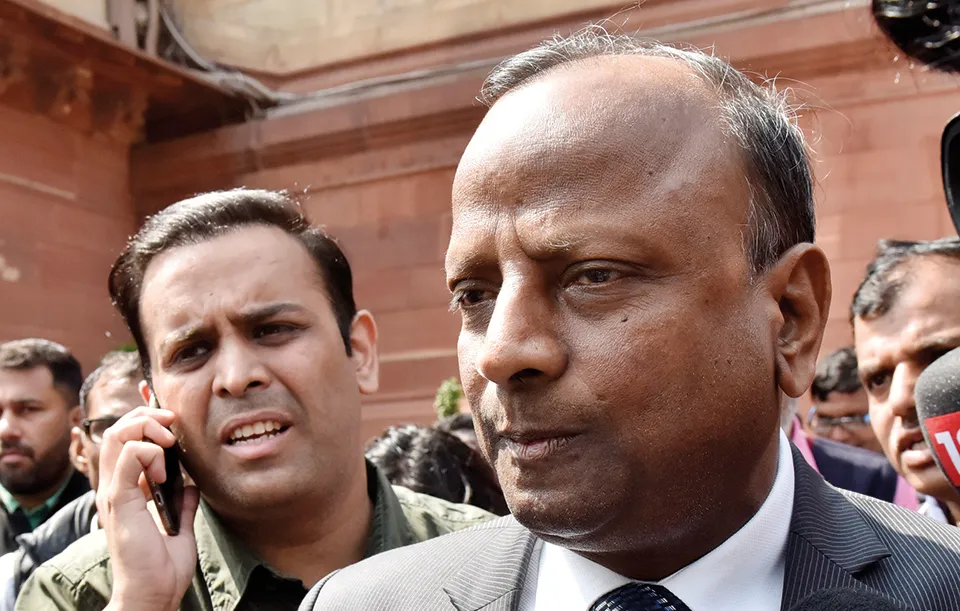

Dinesh Kumar Khara takes the helm as chairman of State Bank of India at a challenging time.
Rajnish Kumar, who stepped down after completing his three-year term in October, had to batten down the hatches as the bank faced up to Covid-19 in one of the world’s worst-affected countries. Now Khara must find a way to pilot the bank out of the pandemic in preparation for a post-virus future.
He has experience on his side. Khara joined SBI as a probationary officer in 1984 and has been a managing director since 2016, covering the global banking and subsidiaries unit. He was instrumental in the multi-sided merger that Arundhati Bhattacharya engineered during her spell as chairman.
Few can claim to know the ins and outs of the bank better than Khara.
Poverty challenges
SBI faces challenges on an altogether different scale to most institutions. It is listed and is expected to make profits like any other bank, but it is also 57% government-owned and has a continuing mandate on social responsibility in a country still afflicted by great poverty.
Bhattacharya once explained to Euromoney that it wasn’t quite fair to compare her bank with those of Western nations because Western banks don’t have a considerable proportion of customers who can’t read or write and must use their thumb impression to withdraw money, which then has to be counted out to them orally because they can’t read the numbers on the notes.
An institution with these conditions clearly has a tougher job than most when a lethal pandemic sweeps through. India has had 9.1 million cases of coronavirus, roughly one in six of confirmed cases worldwide. The true figure may be much higher.
Such is the density of the cities and the nature of the economy, it is no simple matter to tell India to work from home; and a great many of those afflicted – whether directly by health or indirectly by loss of livelihood – are within the SBI orbit.
Our assessment indicates an upward momentum in economic activities
Dinesh Kumar Khara, State Bank of India
In the first quarter of the 2021 financial year, SBI announced Covid-related provisions of Rs30 billion, ($404.7 million). (That fits within a broader book of what SBI calls ‘slippages’, which stood at Rs250 billion for that quarter.)
Whether or not that will be enough is hard to tell, because in March the Reserve Bank of India offered a moratorium on all term loans to the end of May, then extended it to the end of August, before permitting a one-time restructuring of loans affected by the pandemic.
That has helped banks, but it has also pushed bad news down the road.
The net non-performing asset ratio of 1.59% of total assets, down from 2.79% a year earlier, reported in the second quarter to September 30, sounds good, but it is unrealistic to expect it to stay that way. Around 9.5% of SBI’s home loan book is under moratorium, for example.
More comfortingly, tourism and hotels represent only 0.47% of SBI’s exposures, while aviation is about the same.
Still, even if we recognize that the latest results are not the full long-term picture, SBI is doing as well as can be expected in the circumstances. The second quarter showed a 51.9% increase year on year in net profit, with capital adequacy up at 14.7%, helped by an increase in net interest income, a tightening cost-to-income ratio and a drop in credit cost.
Silver lining
Like many banks, SBI has found the crisis has had a silver lining: it has driven up use of digital channels.
The bank launched a mobile app called Yono – ‘you only need one’ – in 2017 as an all-in-one solution for banking, investment, trading and online shopping. It now has 28.5 million accounts. Kumar says that during the lockdown, 60,000 new users were appearing every day, people who would ordinarily have gone to their branch.
In fact, contrary to what you might expect, more than 90% of customer transactions were happening away from physical branches even before the crisis. But such is the scale of the place – it has 490 million customers – it still needs 22,000 branches, a physical presence pretty much unmatched anywhere in the world.
Speaking in November for the second-quarter results in his first presentation as chairman, Khara was able to strike a positive note.
“Our assessment indicates an upward momentum in economic activities,” he said. “Most companies are suggesting that activity levels are touching 70% to 80% of pre-Covid levels.”
Vehicle registrations, including tractors (a vital economic indicator in agriculture-heavy India), were increasing and goods and services tax (GST) collections improving.
“These are tell-tale signs that the economy is recovering,” said Khara.
When the pandemic is over, age-old themes like the resolution of distressed Indian corporate debt will still be there to be dealt with.
Khara speaks of the last three to four years as “a blip on the radar as the Indian banking industry went through the most difficult phase of the corporate asset quality cycle.”
The resolution of Essar Steel earlier this year was a step in the right direction.