
Australian banks in general are coming through the pandemic in good shape, being predominantly domestic operations in a country whose only severe lockdown was in the state of Victoria.
It is not so easy for Macquarie, which earns 68% of its income internationally, 31% of it in the virus-hit Americas and 25% in Europe, Middle East and Africa (principally Europe).
Macquarie’s interim numbers for the first half of financial year 2021 – which, for Macquarie, means the six months to September 30, 2020, a period coinciding entirely with the pandemic – showed A$985 million ($718 million) of net profit, down 32% on the same period a year earlier. The market had expected a worse decline, and Macquarie shares jumped on the news.
Credit and impairment charges were up considerably, from A$139 million to A$447 million, and annualized return on equity fell from 14.5% in financial 2020 to 9.5%. But the impression was of slowdown rather than reversal. The balance sheet is strong following a slew of first-half fundraising. And it still paid a dividend, always a way to make oneself popular in Australia.
Time-honoured approach
These days it is best to think of Macquarie not as a classic investment bank but as a world-class infrastructure asset manager with some other strong businesses attached. Macquarie Asset Management contributed 47% of group net profits in the first half, even as assets under management fell 7% in value over the six months, to A$556.3 billion.
All told, what Macquarie calls “annuity-style activities” – asset management, the banking and financial services business, and some of the commodities business – account for 70% of net profit, while market-facing businesses – the Macquarie Capital investment banking arm and the global markets operations – make up just 30%. That diversification has proven useful in these difficult times, with annuity-related income down 7% year on year and market-facing businesses down 42%.
This is where Macquarie’s time-honoured approach of digging out every niche and angle it can think of proves very handy. So, sure, the aircraft leasing business isn’t looking great right now. But that’s OK because the bank did well out of selling Macquarie European Rail. M&A income took a kicking when nobody could travel anywhere to do deals. But not to worry, Macquarie Capital had a great six months in equity capital markets, helping companies raise the money they needed to stay alive.
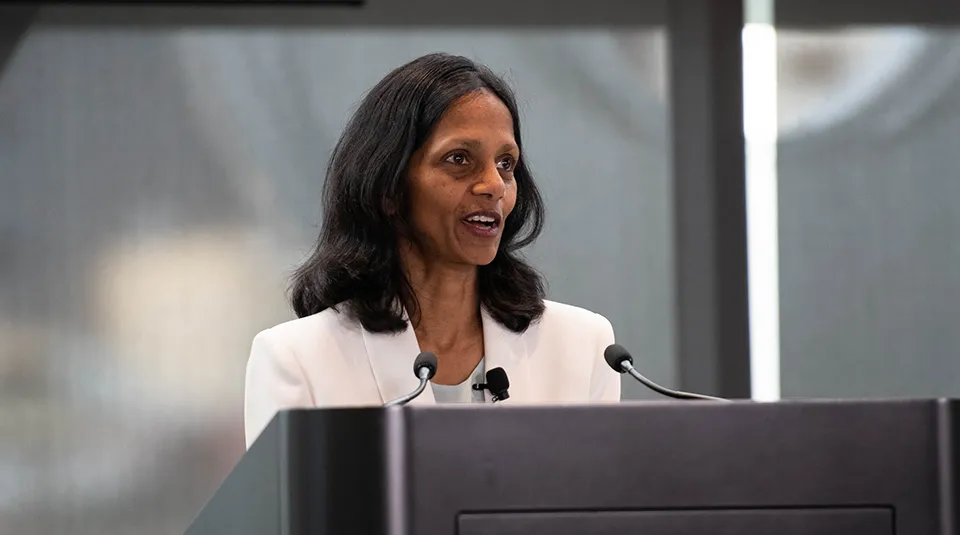
Euromoney asks chief executive Shemara Wikramanayake for examples of how the bank has adapted its businesses in light of Covid. The first thing she mentions – and this chimes with most banks – is the movement to an open-banking offering, allowing it to interact with clients remotely.
The need for investment in digital infrastructure is going through the roof
Shemara Wikramanayake
With some support sectors offshore shut down because of the virus, this required an extra domestic effort to support it, which Macquarie met partly by hiring furloughed employees from airlines, particularly Jetstar.
On the asset management side, Macquarie characteristically looked to turn adversity into a business opportunity. Seeing the activity of its thousands of staff who were working from home – and not just working but shopping and ordering food – the bank saw possibilities in internet traffic volumes.
“The need for investment in digital infrastructure is going through the roof,” says Wikramanayake. “We are investing much more in fibre-optic networks, cable and data centres.”
Quick off the mark, in April Macquarie Infrastructure and Real Assets acquired an 88% stake in AirTrunk, a Sydney-based hyperscale data centre company, barely a month after Covid was even acknowledged in Australia.
Then at Macquarie Capital, the principal finance side of the business went to work, looking for good opportunities to invest in renewable energy, infrastructure and technology.
“We also found opportunities to lend at very good returns,” she says. “On the investment realization side, that’s more challenging, but we can ride through that.”
Nimble
Wikramanayake says the bank has found itself to be nimble in working remotely. At the start of this financial year 98% of its 18,000 workforce, not counting those in portfolio companies, were working remotely. Since then, 60% have returned but on a voluntary basis.
“We have found we can deliver working virtually,” she says.
The fun with Macquarie has always been to dig around in the engine and see what’s happening. There, you are always surprised to learn something you didn’t know: that Macquarie is now the number two ranked physical gas marketer in North America; or that it launched the Delaware Wilshire Private Markets Fund to bring private market solutions to US wholesale in the middle of a pandemic; or that it has agreed to co-develop a 2.3 gigawatt portfolio of floating offshore wind projects in South Korea.
It is this enduring habit of getting the smartest available people, encouraging them to find apparently obscure niches and benefiting from the aggregate of all these curious pockets of ability that will see Macquarie through this most challenging of times.