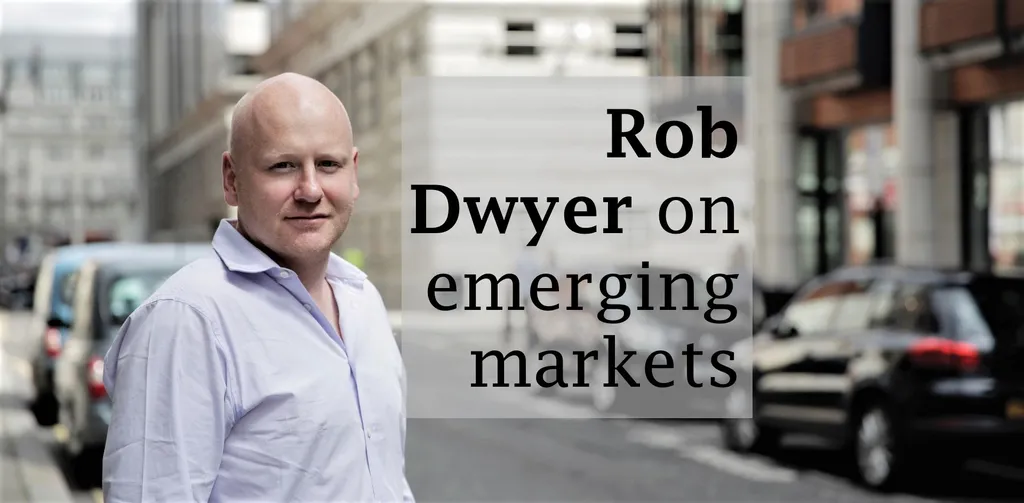
Investors and traders of FX and fixed income assets may have entered a harsh new environment, with record-low interest rates in many emerging markets (EMs), the emergence of quantitative easing (QE) policies among some EM central banks and episodically volatile currencies.
Dirk Willer, managing director and global head of EM FX and fixed income strategy at Citi Research, should know. He wrote the book on it.
That book – Trading Fixed Income and FX in Emerging Markets, co-authored with Ram Bala Chandran and Kenneth Lam – came out in September. Some of it was written before Covid, the rest during.
“History rhymes,” says Willer of the decision to commit to writing the practitioners’ guide – a dense but readable mix of theory and strategy.
“We have to write about the same issues all the time over the years and we usually draw the same conclusions, so it seemed like a good investment to put it down once and for all in writing – so we don’t reinvent the world every time something happens.”

So, what was Willer’s biggest take-away from researching and writing the book?
“The most pleasant surprise for me has been that the rules for trading EM FX and fixed income have survived the Covid test really well,” he says.
“And, personally, it has reminded me that I should trade EM FX on a more rules-based basis than I have been. It’s tempting to chase headlines, but if you don’t have a strong framework it just destroys alpha.”
Hang on though. When we say EM FX and fixed income, aren’t we really saying the carry trade? And if we are – surely that has broken down in many key EMs.
I’m based in Brazil: that the Selic interest rate is on the floor and the currency is the worst-performing currency can’t be a coincidence. If the cushion from interest-rate differentials in EM and developed markets has stripped away the cushion for FX depreciation, surely the carry trade is just dead? Isn’t FX – the most difficult asset class – pretty much all that is left?
Willer says that while “the big picture carry trade broke down a long time ago”, there are still “certain episodes where it still performs quite well on a vol-adjusted basis”. Looking at currencies on a volatility-adjusted basis is one of the book’s big FX rules.
He also says that positive real interest rates still have an important market dynamic.
Our approach isn’t to predict the long-term future, but figure out what happens in the short-term
Dirk Willer, Citi Research,

“Take South Africa and Brazil,” he says. “These are two countries with very similar fiscal stories – both are in serious trouble – but the fact that South Africa still has decent carry, which Brazil has lost, is part of the reason why the rand is performing better than the real.”
However, Willer does agree that with lower interest rates, EM FX is the larger component of the carry trade. “But it was always the biggest part of [the carry trade],” he points out.
What he finds more interesting is how lower interest rates might play out in EM FX in the coming years.
“At the moment we have low interest rates and the shock has been common to all countries,” says Willer. “What happens in the future when we get different growth rates? If rates get stuck close to zero, then rates can’t adjust to reflect the growth differentials and so then FX might have to do more of the adjustment.
“If that happens, it could become an even more volatile asset class – which will impact the carry-to-volatility ratio.”
Dollar bull run
One potential driver of simplification would be the much-discussed end to the dollar bull run. Since 2011, the dollar’s continued appreciation has been a strong headwind in investing in local credit and rates.
Should this turn – and Willer believes a more likely trigger for this will be the vaccine trade rather than any blue-wave moment in the US; there is no guarantee that the Fed would monetize higher deficits, he reasons – then investors will enter the market in a broad way. Even with low carry, it will still offer juice to local currency fixed income in EM.
What about the other popular refrain in finance: that economists make horrible traders? Shouldn’t potential readers be wary of an economist’s approach?
Willer laughs, saying: “Economists who can predict the future can make money, but it’s a painful way to do it. Our approach isn’t to predict the long-term future, but rather to figure out what happens in the short-term if certain things happen. For example, how should I react in Brazil if the central bank does QE.
“We are short-term focused: if you asked me where the dollar-real will be in two years’ time, well, that’s anyone’s guess really.”