
Awards for Excellence 2018
|
|
| Regional awards |
| View full 2018 results |

When western European banking groups went on spending sprees in the former communist bloc before the financial crisis, they met little competition from within the region. Few local lenders at the time had either the appetite or the capacity for large-scale cross-border expansion.
The notable exception was OTP Group. The Hungarian national champion began buying banks in neighbouring markets in the 1990s and by 2008 had built an international network covering six countries in southeastern Europe, as well as Ukraine and Russia.
As with other regional groups, this proved a mixed blessing over the following decade. Collapsing real estate markets, widespread deleveraging and economic stagnation created challenging operating conditions across the region, while in its home market OTP faced swingeing fines and taxes from 2010 onwards.
The bursting of Russia’s consumer finance bubble in 2013 also took a toll on the bank, which had positioned itself as a leading player in the segment, while in Ukraine OTP suffered alongside the rest of the banking sector during the economic upheavals that followed the Maidan revolution.
Nevertheless, the group managed to turn a profit in every year except 2014 and last year bounced back to deliver a record net profit of Ft284 million ($1 billion) and a return on equity of 18.5%. This was partly driven by a robust result in Hungary, where reduced bank taxes and reviving credit demand helped compensate for low interest rates, but also by another year of handsome returns from DSK Bank in Bulgaria and strong contributions from Russia, Croatia and Ukraine.
Asset quality also showed a marked improvement. Non-performing loans fell by 5.5 basis points to 9.2% of overall group lending at the end of December, the lowest level since 2009. Meanwhile an enhanced focus on risk management ensured coverage remained high at close to 100%.
Arguably OTP’s greatest strength, however, is its capital base. At the end of last year, the group’s common equity tier-1 ratio stood at 15%, a level that remains beyond the reach of most western European banks even after a decade of regulatory pressure.
This has given the Hungarian group a unique advantage in the realignment that has been gaining momentum in banking sectors across central and eastern Europe in recent years. As with most of its regional rivals, OTP realized soon after the financial crisis that maintaining subscale banks in small markets was neither sensible nor sustainable.
For western groups struggling to recapitalize, this meant either selling up – often at depressed valuations – or attempting to build market share through organic growth. By contrast, OTP’s ample capital cushion allowed the group to pursue an aggressive acquisition strategy.
The first results of this were seen in January 2014, when OTP announced the purchase of Banco Popolare Croatia and Millennium Bank Romania. This was followed in late 2016 by the acquisition of Splitska Banka in Croatia from Société Générale and last summer OTP won the bidding to buy Vojvodjanska Banka in Serbia from National Bank of Greece.
The integration of Splitska Banka into OTP’s existing operations, which is due to be completed by the end of the third quarter, will boost the group’s market share in Croatia to 11.6%, making it number four in the Croatian market, while in Serbia it now ranks at number six.
OTP suffered a slight setback in Romania in March, when the central bank refused to approve the agreed acquisition of NBG subsidiary Banca Romaneasca. Senior management have indicated, however, that the group will continue looking for opportunities in Romania, as well as in other markets.
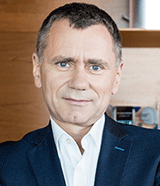 |
| László Wolf |
Integrating multiple entities across markets clearly presents challenges, but OTP has already acquired considerable expertise in this area. The group has also created a dedicated integration unit based in Hungary.
“Having a strong integration team is key to successful acquisitions,” says László Wolf, deputy chief executive of OTP Group.
The need for scale has also prompted OTP to broaden its product offering. The group had originally focused on consumer finance and mortgages across its international network but is now aiming to be a universal bank in all markets.
“Most CEE countries aren’t large enough to allow banks to survive with just one business line, which is why we are also developing SME and corporate finance,” says Wolf.
Digitalization is a key part of OTP’s revamped business model. The group launched a digital transformation strategy in 2015 and has been investing heavily in technology over the last three years. At the same time, Wolf is clear that the group plans to maintain its physical network.
“We believe that to have a high level of digital services and to gain the confidence of clients in digital banking, you must also be present with branches in the market,” he says. “We also believe that branches will continue to play an important but changing role in sales and advisory for customers.”
There is still work to do in some of OTP’s international markets. The group’s operations in Serbia, Slovakia and Montenegro were in the red last year. The losses in Montenegro were due to what is expected to be a one-off increase in provisioning, however, while the Vojvodjanska Banka acquisition should give the group the scale it needs to be sustainable in Serbia. All three subsidiaries were back to profitability in the first quarter of 2018.
In summary, strong fundamentals, an impressive turnaround story and an ambitious but well-executed expansion strategy make central Europe’s only home-grown regional banking group a worthy winner of this year’s award for CEE’s best bank.



