Awards for Excellence 2017
 |
| Full results |
It is genuinely impossible to have a conversation with anyone at DBS without it turning swiftly to digital initiatives. Whether it is a transaction services or an SME banker across the table, capital markets or even CSR, and most certainly if it is CEO Piyush Gupta, it is clear that the digital agenda pervades everything DBS does, which makes it a worthy winner of this year’s best digital bank. DBS is not alone in this, but it is the one bank that convinces you that its use of technology is not just about marketing and simplification, but is translating into profits and new business.
|
|
|
Piyush Gupta, DBS |
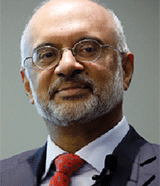
Gupta’s evangelical zest for technology has been reflected in his hiring decisions. Gupta hired Neal Cross, a man who started out making ZX Spectrum games as an 11-year-old before working at Microsoft, MasterCard and a Sumatran jungle foundation, as chief innovation officer. Gupta told him to disrupt everything and make DBS the most technologically innovative bank in the world. David Gledhill, chief information officer for nine years now, is similarly passionate.
Singapore is a relatively straightforward place to bring forward digital ideas. Progress here in the last 12 months includes the roll-out of DBS iWealth, the digitizing of its bancassurance partnership with Manulife, the rapid growth of the DBS PayLah! personal mobile wallet (450,000 users, up 50% year on year) and the launch of POSB Smart Buddy, which allows grade-school children in Singapore to pay for their lunch using wearable tech.
Another welcome innovation is the POSB Jolly app, a mobile proposition for low-income foreign workers who have phones but are often hindered by language barriers and complex remittance structures. DBS reckons this has saved more than 2 million man hours and lowered the cost of remittances for foreign workers.
DBS calculates that consumer banking and SME customers who engage with the bank digitally account for twice as much revenue, on average, as non-digital customers. Three million of its customers are online and 2.2 million mobile, which is not bad going when Singapore’s total population is 5.5 million. Gupta talks confidently about the impact tech will have on future cost-to-income ratios and has no doubt his bank’s leadership in the area is going to come back in the form of greater profits.
It is the international expansion through tech that really marks DBS out, however. DigiBank in India last year was a bold move and remains both a learning experience and a work in progress, but it already has 1 million customers with a staff of 60, which will be down to just 25 people by the end of the year, allowing a cost-to-income ratio of 30%. The next step is to roll out something similar in Indonesia.
It is also the bank that most genuinely seems to embrace disruption. It holds an annual hackathon, where employees from the bank work with start-ups, and builds incubator and accelerator programmes. Over 400 start-ups were engaged in these programmes in 2016 alone. In November, a new innovation centre, DBS Asia X, was launched.
And the impact of it all? DBS’s cost-to-income ratio improved two percentage points to 43% year on year and the bank attributes most of that improvement to digitization initiatives creating greater efficiency. In 2016, a quarter of new wealth customers were acquired through digital channels and 60% of SME clients.