The news that Poland has decided to take up the IMF’s offer to provide more than $20 billion to tide the country over the economic crisis tells us two things.
First, that many emerging economies, particularly in eastern Europe, are in deep trouble. Their economies are contracting at 5% to 10% this year, their trade accounts are in deficit and their banks and corporations are finding it difficult to meet repayments on the foreign-currency loans they have built up over the boom years since 2001.
Second, it tells us that the IMF and the G8 governments are determined to try to avoid a series of currency and debt default crises among emerging markets during the global economic slump. The dominoes are ready to fall over. At the very least, the process must be in slow motion.
But given the state of the G8 economies themselves, are they able and willing to stump up the cash? It seems that they have decided to provide more funds for the IMF to do the job. But they have also insisted that only the most deserving should get help. So there will be winners and losers among emerging economies.
At the end of 2008, available funds for the IMF to help stricken economies had fallen to just $150 billion, with potential borrowing commitments already reaching $50 billion. I calculate that the reduction in private capital flows to the emerging world this year means that about $570 billion will be needed from official sources (multilateral and bilateral) to avoid a collapse in the financial assets of many of these countries.
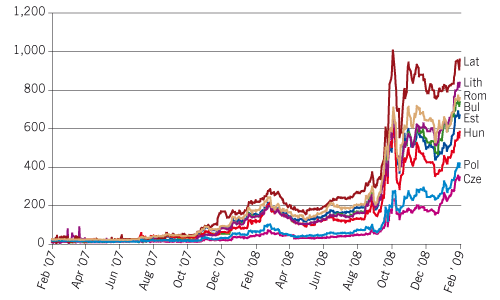
Eastern Europe sovereign CDS spreads |
Five-year, 2007 to 2009 |
 |
Source: Datastream |
The IMF got Japan to stump up $100 billion in January as a loan. In February, it asked its main donors to put in another $250 billion. The US agreed to contribute $100 billion and, after some arm-twisting, the EU said it would match that. That left a shortfall of $50 billion as the G20 met. After the G20 meeting, it appears that another $40 billion has been promised by China. In addition, the IMF will be enabled by its quota holders to raise another $250 billion by issuing Special Drawing Rights, the IMF’s special international money. This is quantitative easing on an international scale. But it only increases emerging market-dedicated resources by $70 billion to $80 billion as most of the SDRs are automatically credited to the rich countries. So the new IMF funding, if it fully materializes, will be barely enough to cover the shortfall for this year.
The IMF has revamped its financing framework and introduced a Flexible Credit Line that will provide more funds, more quickly, to recipients that have ‘good track records’ on meeting IMF conditions on borrowing. The FCL will divide emerging markets into ‘good’ and ‘bad’ borrowers, creating an exclusion zone of countries that can’t qualify for its funds.
Mexico became the first recipient of the FCL in asking for $47 billion to cover its foreign-currency capital flow shortfall this year. Now Poland is to join Mexico as one of the good boys.
The trouble is that this will leave many out in the cold. In emerging Europe, the Middle East and Africa, the good boys likely to get IMF funding the easy way will be the Czech Republic, Poland, South Africa and Israel, but not the Baltic states, Hungary, Romania, Bulgaria, Ukraine or Turkey.
Dire straits
All the excluded countries are now in dire straits. Latvia has already taken IMF money but only on condition that it reduces its huge budget deficit and cuts wage levels. But no Latvian government can impose these conditions on an irate electorate. The latest coalition government has got until June to come to terms with the IMF or funds will be cut off. If this happens, Latvia will default on its debt and its currency peg will break, probably knocking over other currency peg dominoes such as Lithuania, Estonia and Bulgaria.
Hungary and Romania have also taken IMF money and are finding it difficult to meet the draconian conditions imposed on them. So far, Turkey has balked at the IMF terms for the $25 billion to $30 billion that it badly needs to tide it over.
As we explained in this column last month, western Europe will not escape the consequences of any defaults or currency crashes in the east. That is because the banks that made loans to corporations and households in Hungary, Romania and the Baltic states are Austrian, Italian, Belgian and Swedish. They face serious losses that will destroy a substantial part of their capital base if the eastern European dominoes should topple.


