The rate of global economic decline has peaked but the world economy is still contracting. Deleveraging has a long way to go and the debt overhang will restrict the pace of any subsequent economic recovery.
The core problem remains the overwhelming burden of debt throughout the financial system and the continuing incapacity of borrowers to service it. This concept of stock and flow is central to how investors need to think about recovery. The authorities have done much to ease the short-term flow issues (debt service, etc) by borrowing from future generations to bail out today’s. This has prevented systemic implosion and explains why equity markets are off their lows.
But this has failed to address, and in many ways has compounded, the stock (of debt) issue. Large debts per se need not be problematic. Many of us live in homes we cannot afford to buy outright. As long as the value of our houses exceeds the value of our mortgages, and as long as we can comfortably service that borrowing, we manage perfectly well.
For an individual family, difficulties arise only if mortgage interest rates move appreciably higher (depleting discretionary income), the breadwinner loses his/her job (wiping out income entirely), or if the market value of the house drops materially below the book value of the mortgage. At a societal level, systemic stress can also occur if access to financing becomes constrained.
The authorities’ response to the crisis so far has been aimed squarely at relieving systemic cashflow stresses. But an orthodox approach has now run its course: massive fiscal stimulus has reached the limits of credibility and central banks have cut the cost of short-term risk-free capital to its minimum or virtually zero. There is no more gunpowder, dry or otherwise.
But for most borrowers, the availability of financing remains severely constrained. And even for those that can access credit, the absolute cost of capital has generally gone up from pre-crisis levels as risk spreads have widened.
The situation remains fragile. We can see this in the steady rise in home foreclosures, the low level of new bank loans and mortgages being granted, and therefore increasingly in corporate and consumer credit default rates.
Hitting new peaks |
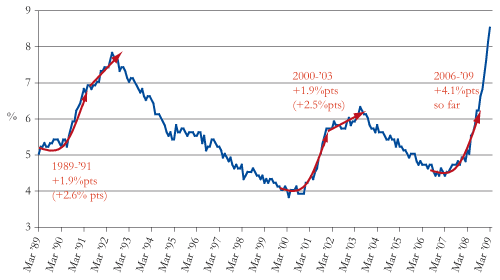
US unemployment rate 1989 to 2009 |
 |
Source: Datastream |
The global jobs market is even less conducive to a sustained recovery in financial market risk appetite. In the past two recessions, an initial period of rapidly rising jobless claims was followed by a second phase of more gradual increases. We still seem to be in the midst of the first phase. And while unemployment is up sharply in the US, companies in Europe are only just beginning to push through job cuts. Moreover, US home prices have dropped rapidly, by a cumulative 25% or so from their peak (or by a third in real terms). But they could easily fall by as much again over the next two years, even if the pace of decline begins to recede from here. This will leave more households in negative equity at a time when breadwinners are fearful of losing their jobs and interest rates begin to rise again.
So even if the marginal news flow has got a little less bad in recent weeks, little (if any) progress has been made on the global debt overhang. In this age of instant gratification, neither politicians nor their electorates seem likely to have the stamina for a slow workout of debts through tight cost-control and a return to organic profitability.
Everybody wants a quick fix. But a speedy debt workout cannot be achieved without pain. You either have to forgive it, swap it or deflate it. If you forgive debt, the lender takes the loss. If you swap it (for equity in whatever collateral might have been used to secure the loan), the borrower takes the hit. If you let inflation rip and the money illusion work its dark magic, everybody shares the pain.
Ultimately, generalized inflation will be the only palatable outcome. Most likely is a world in which we return to 5% to 5.5% nominal GDP growth rates among OECD countries. But whereas in the past this was made up of 3% to 3.5% real growth and 1.5% to 2% inflation, in the future we will see real growth of no more than 2% and inflation well above 3%.
David Roche is president of Independent Strategy Ltd, a London-based research firm. www.instrategy.com


