Budapest bourse fights for its life
 |
|
“Hungary does not need new austerity measures. We need to implement the measures we have already decided to introduce, and not to retract measures or open the debate again” |
The traditional pattern in Hungary used to be that governments dramatically widened the budget deficit before elections. The epitome of this came in the 2006 general elections. The deficit for that year reached 9.2% of GDP, the largest in the EU. The gross external debt to GDP ratio passed 96.7% and was on the way up. Standard & Poor’s downgraded the sovereign. Soon after being re-elected in 2006, Ferenc Gyurcsany, the socialist prime minister, broke the bad news: radical changes were needed to save the country from bankruptcy. No sooner had these changes begun to be introduced, however, than tapes were leaked to the press in which he admitted to lying about the economy in order to win the election. The opposition, unsurprisingly, cried foul, and the worst riots since 1956 ensued.
Two years down the line, Gyurcsany is still in his mosaic-filled offices in one of the world’s largest and most ornate parliament buildings. His coalition with the liberal party is battered but intact. Meanwhile, already ambitious targets for bringing down the budget deficit have been exceeded: for 2007 it will be around 6.2% instead of the planned 6.8% of an estimated GDP of $143 billion, largely on the back of unpopular tax increases and welfare-state cuts. Gyurcsany’s popularity is rated at around 15%.
And economic growth in Hungary has fallen to its lowest level in more than a decade this autumn, and at a bad time too. Rising energy costs show few signs of abating. Then there is the credit crisis in Europe, which could have an impact on investment by foreign companies in Hungary.
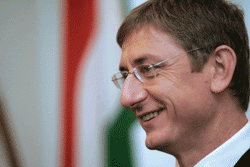
In an exclusive interview with Euromoney, prime minister Gyurcsany tells Dominic O’Neill why he is still confident of success.
Do you think enough has been done in terms of legislation to ensure that the budget deficit will drop sufficiently by the end of the decade to meet your targets and allow entry into the eurozone?
The Hungarian parliament adopted the main figures for next year’s budget at the end of November. This included targets for the deficit, which are lower than previously expected. Also at the end of November, the government supported and finally adopted the renewed convergence programme [with the eurozone]. We are obliged to submit it to Brussels. According to this, we will have a 3.2% of GDP budget deficit in 2009, from which can be deducted savings from private pensions accounts, which means the final figure will be about 2.9% [below the maximum 3% required for entry to the eurozone].
Hungary does not need new austerity measures. We need to implement the measures we have already decided to introduce, and not to retract measures or open the debate again.
In Q3, Hungary’s growth fell to just 1% on a year-on-year basis. If growth stalls, it might be more difficult to raise tax revenues and reach the budget deficit targets. What can be done to make sure that growth picks up, unemployment falls, and foreign investment continues to flow?
Implementing this very tough austerity programme, and regaining the balance in the Hungarian budget, obviously requires sacrifices. For an interim period, slower growth is the cost of the austerity programme. But aside from the austerity measures we are also enhancing the business environment in other ways. We have amended the relevant law to radically shorten the period needed to set up a company. Next year, it will be just one hour. Secondly, we have implemented a single-counter system for companies’ administrative procedures.
Thirdly, we are working on improving the Hungarian tax system. Our deadline is the end of January to make the coalition parties accept some important modifications to the Hungarian tax system, decreasing the burden on companies and employment.
All of our reforms, from education to healthcare, will result in a more effective, cheaper state, and this will allow businesses more room for manoeuvre.
Some critics say that up to now the emphasis of measures to cut the budget deficit has fallen more on the side of tax hikes, for example in VAT, than on the side of expenditure cuts, which has fuelled inflation. Even before the hikes, Hungary had a relatively high tax burden. If you cut taxes for companies and employment, will that be replaced by taxes elsewhere, or is Hungary’s overall tax burden going to diminish?
In the short term we are facing huge budgetary imbalances. It is unquestionable that measures were needed to increase revenue. But at the end of the four- or five-year-long budgetary stabilization process, the tax burden will be no higher than at the beginning, perhaps even less. Overall, we would like to decrease the average tax burden in Hungary by 0.5% of GDP in the next two years.
So when do you think this interim period will end? When will GDP growth start accelerating again?
Next year. Next year will be better than this one.
As the 2010 general election approaches, many fear the budget deficit will begin to creep up again. In particular, they are worried that there will be a catching-up effect when the freeze on public sector pay thaws in 2009. How can you ensure the pre-election swelling of budgets will not return?
The reforms we are working on will create long-term budgetary stability. But with a track record like ours, Hungary needs to be committed to implementing new rules and guarantees. We are establishing a new independent office to monitor the budget deficit, and in the Act for Budgetary Responsibility, the ultimate guarantee will be a strict rule that prevents governments from submitting a budget to parliament that does not ensure a primary surplus, and a permanently decreasing debt-to-GDP ratio. This is the toughest programme in Europe to constrain a government’s ability to allow the budget deficit to grow. The criteria will have to be met regardless of where we are in the electoral cycle.
I understand the government was hoping to enshrine this rule in the constitution. How likely is it that you will be able to secure the two-thirds parliamentary majority needed to change the constitution?
I hope this will be possible, and I would like the agreement of the opposition, because I think it is in our common interest. But the new rules and the new institution can still be set up without amending the constitution. At the end of the day, we have a sufficient majority to push through the most important guarantees.
Bringing the budget deficit down as quickly as you have done was certainly impressive, especially given the immense unpopularity of the austerity measures. How were you able to brave all the protests?
Politicians who want to implement unpopular laws have to face some protests and public debates. Politics is not a beauty contest. You have to serve your nation. I am not an actor; I do not have to be very popular. The next election is in 2010. Popularity goes up and down. I could not be popular at the price of not fulfilling my duty.
So if you lose the next election, do you think all the advances you have made in reducing the budget deficit will be lost?
Not at all. We are working on reforms that create long-term stability for Hungary, and these reforms are irreversible. They will not be able to be turned around as soon as a different government is elected.
Fidesz, the opposition party, has nevertheless collected a sufficient number of signatures from the general public to force a referendum next year on some of your reform measures. If the referendum succeeds, do you accept that this would be an official vote of no confidence in your government and a huge blow to your ability to push through the reforms?
Where I need confidence is in parliament, and I have a wide majority there. It does not take a referendum to know that most people do not like tax increases. In any case, the opposition is not trying to stop the reform process itself, but co-payments in healthcare and tuition fees at university, which are just tools for the reforms. This will not alter my commitment to reform.