
It’s the resources, stupid
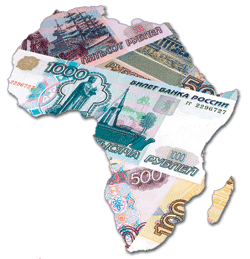
RUSSIAN CORPORATIONS, PARTICULARLY mining firms with strong state connections and deep pockets, are pushing hard into Africa after years of under-investment in the continent. Their impetus results from two forces. The first is economic rationale – such companies wish to transform themselves into global commodities operations, with mines and distribution networks on every continent. Africa, a continent rich in resources but in desperate need of jobs, wealth and reliable investors, is the first step on that long road.
The second force is political: companies are getting involved with Africa because that’s what the Kremlin is telling them to do.
Russia’s reactivated desire to impose its military clout is becoming clear, but less appreciated is Moscow’s yearning for the country to be treated again as an economic powerhouse, not an economic pariah. Again, Africa, which had intimate ties with Russia from the early 1960s until the end of the Cold War (Moscow helped build Egypt’s Aswan Dam, and hundreds of thousands of Africans studied in Russian universities), is the first step along this road.
In May 2006, Russia’s president, Vladimir Putin, said in his annual state of the nation address that an improvement of relations with Africa was one of his top priorities. In July this year, Russia’s natural resources minister, Yuri Trutnev, went further, urging domestic energy and mining groups to bolster their positions in Africa, and promising domestic corporations direct government support.
That message is clearly getting through. The charge back to Africa has been led by Russia’s dwindling clique of super-rich oligarchs, who rose to fortune under Boris Yeltsin, yet remained to curry favour with Putin.
“It’s very popular in Russia to invest overseas – or, I should say, it’s very popular with Mr Putin,” says a London-based consultant with long-established ties to Moscow-based corporations and financial institutions. “By investing abroad, you are showing that you are investing for the greater good of Russia, and you win a lot of kudos with the Kremlin.”
Take Renova Group, a large diversified company with interests ranging from energy, mining and commodities to financial services, chemicals and construction. Renova’s board of directors is chaired by a 50-year-old Ukrainian, Viktor Feliksovich Vekselberg, who rose to prominence in the 1990s as the chairman and co-owner of Tyumen Oil, a leading Russian energy firm, developing, among other partnerships, a joint venture with UK energy group BP.
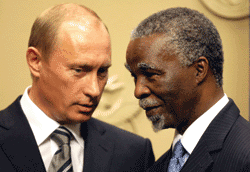
One of Russia’s few remaining oligarchs, worth an estimated $10 billion, Vekselberg joined Putin in September 2006 on a visit to Johannesburg to strengthen political and trade ties between Russia and Africa.
Also on the trip was Alexander Abramov (net worth, shared with brother Frolov: $4.9 billion), an oligarch who rose from obscurity to control a majority stake in Russia’s largest steel producer, Evraz Group. Both are investing heavily in southern Africa, using their deep pockets and strong Kremlin connections to snap up key mining interests and deposits.
Evraz, which is 41% owned by Millhouse Capital, a private investment group headed by Russia’s most famous oligarch, Roman Abramovich, has this year systematically increased its stake in South Africa’s Highveld to 79%. That has given Evraz control of the world’s largest supplier of vanadium, used in the production of industrial-strength steels, and South Africa’s second-largest steel producer after ArcelorMittal.
Renova has perhaps even bigger plans in the region. Mark Buzuk, project manager for Africa at the conglomerate, says up to $1 billion will be invested in prospecting for manganese in South Africa, with hundreds of millions of dollars more earmarked for investments in Namibia and elsewhere in the region. The company has already spent $15 million prospecting for manganese in the Kalahari desert, and $150 million more will be needed before drilling can get under way in 2009.
“We can say we’re pretty sure we have enough reserves to mine 1.5 million tonnes of high-quality manganese a year. We’re also prospecting for uranium in Namibia and looking for other opportunities,” Buzuk says.
Other leading Russian resources firms are also making their presence felt here. As one Moscow-based banker put it, for Russian firms in Africa, “it’s the resources, stupid”.
In March 2004, Norilsk Nickel, the world’s largest nickel and palladium producer, and Russia’s leading gold miner, bought 20% of South African rival Gold Fields for $1.16 billion.
In July 2007, Mirny, Siberia-based Alrosa, which controls 97.5% of Russia’s diamond production and a quarter of the global market for the precious stone, announced that it would form a partnership with Angola’s state oil firm Sonangol and Kansas-based Dark Oil to drill for oil and gas in the western African country. Alrosa, whose supervisory board is chaired by Russian finance minister Alexei Kudrin, also holds a 32.8% stake in the Cataca diamond mine in Angola and has plans to open up the country’s hydropower sector.
Yet another leading Moscow-headquartered resources company, RusAl – another group controlled by Vekselberg – is pushing into sub-Saharan Africa. In February it paid $250 million for a 77.5% stake in Aluminium Smelter Company of Nigeria from the Nigerian Bureau of Public Enterprises, the country’s state privatization body, and earlier this year said it would invest a further $1 billion in African mining projects.
RusAl, which in March merged with Russia’s Sual and the aluminium division of Switzerland’s Glencore, to create the world’s largest aluminium producer, is also planning a $9 billion London initial public offering in November, in what would probably be the largest IPO of the year. Russia’s leading telecommunications firms too are expected to expand into the region before long, as are leading Moscow-based oil and gas firms, notably Lukoil and Gazprom.
 |
|
Investments between Russia and Africa aren’t entirely a one-way street. South African corporations in particular have been busy in the frozen north – Standard Bank, the De Beers diamond group, brewer SABMiller and mining group Anglo American all have sizeable Russian operations, and bilateral trade is roughly doubling each year |
Investments between Russia and Africa aren’t entirely a one-way street. South African corporations in particular have been busy in the frozen north – Standard Bank, the De Beers diamond group, brewer SABMiller and mining group Anglo American all have sizeable Russian operations, and bilateral trade is roughly doubling each year. Exact statistics are hard to pin down, but a Moscow-based banker estimates total Russian mining investments at about $5 billion, and said that figure would rise 10-fold over the next 10 years. At home
Culturally, too, Russia and Africa fit together well. Some US and European corporations shy away from the continent’s poor record on infrastructure, dictators and debt repayments but Russians see themselves as very much at home on the continent.
“In comparison to Americans or Europeans, Russians are very open about the society here – and they are very positive about the investment opportunities here,” says Stephen Jennings, chief executive of Renaissance Group, the international emerging markets investment bank with headquarters in Moscow. “They don’t have the same insecurities about the place that for example the Europeans have.” He adds that Russians also instinctively recognize and appreciate the myriad challenges Africa faces, and understand how they can be combated. Moscow has, after all, spent most of the post-Cold War period being quietly patronized as its economy descended into chaos.
“What Russians see is a continent in disarray, and it’s easier for them to see how it can be improved and look better with 10 years,” says Jennings. “They see in Africa something of what they see at home. Russians will continue to buy a lot of global assets – there will be more foreign investment from them over the next decade.”
Renova’s Buzuk says that Africa’s economy is “very similar to Russia’s – it’s big on mining and resources, and most Russian companies have some connection to one or both of those areas. I feel very welcome here. No one bothers us, the people are very professional – good bankers, good metallurgical people. And more Russian firms are doing business here. You bump into [Russian business leaders] all the time.”
Nor is Africa’s investment story limited to its underground riches. A July 2007 report from Moscow-based Renaissance Group said that the opportunities for value creation in sub-Saharan Africa were “unique” in today’s market. Analyst Matthew Pearson noted in the report that sub-Saharan Africa GDP was set to grow by an average 6.7% this year – despite the debilitating influence of economic basket cases such as Sudan and the Democratic Republic of the Congo – up from 5.4% posted in 2006.
If that’s a decent jump, how about the surge in GDP set to be posted by oil-exporting sub-Saharan nations this year. IMF figures put them on track for an 11.6% rise in GDP this year, a rise of five percentage points over 2006. Renaissance’s Pearson compared the scale of the investment opportunity in sub-Saharan Africa to the one following the break-up of the Soviet Union in the early 1990s – ironically, and perhaps aptly, when Russia’s oligarchs made their entrance on the world stage.
Renaissance Group has bet big on Africa. The group is raising a $1 billion African investment fund, set to be launched in September or October, and has in little more than a year established a strong securities and research presence in three African cities: Lagos in Nigeria, the Kenyan capital Nairobi, and, somewhat surprisingly, the Zimbabwean capital of Harare. It also owns a 25% stake in Nigeria’s Ecobank Transnational Incorporated, one of Nigeria’s best-run banks, with branches in 11 African countries.
Watching the sun rise over the troubled Zimbabwean countryside as he speaks, Renaissance’s Jennings says most people don’t realize how far Africa has come in the past few years.
Excitement
“I believe it will be the fastest-growing area in the world over the next 18 months to two years [and] it’s the most exciting investment opportunity in the world right now,” he says. “GDP figures are strong and the number of conflicts has fallen dramatically. People think the problems here are intractable, but they’re not.”
Pointing to the level of interest shown globally in Renaissance’s billion-dollar Africa investment fund, Jennings says the fundamentals in Africa are generally sound. He notes that some states continue to struggle, but believes even the mounting problems in Harare, where Renaissance is building up a significant research office, are solvable.
“This country will get on the same escalator as the rest of the region, once a few obvious changes have taken place,” Jennings says. “It used to have the second-biggest stock market in the region, it was the bread basket of Africa, with great infrastructure, a lot of top bankers and the best judicial system. There’s no reason why they can’t get back to level.”
Two equity deals completed this year by Renaissance Capital, the securities division of Renaissance Group, highlight Jennings’ faith in the strength of Africa’s capital markets.
In April, United Bank of Africa, Nigeria’s largest lender by assets, raised $300 million in global depositary receipts from international institutional investors. And in July, another Nigeria-based lender, Access Bank, increased a stock placement to $300 million from $250 million, thanks to strong investor demand – briefly pushing Renaissance Capital, which co-arranged the stock sale with JPMorgan, into Dealogic’s global equity capital markets top 10 list for the first time.
Jennings says the global demand among institutions for Access Bank shares surprised him. “When we first talked to clients about Africa, we were surprised at the level of openness and knowledge, and capacity to invest, among a broad set of US, UK and European funds.”
Africa’s business environment is certainly improving, thanks in large part to abundant natural resources and a flood of new foreign investment. Figures from the IMF estimate that Angola could boost real GDP by one-third in 2007, to $70 billion, or roughly half the size of Nigeria’s economy. National debt is plummeting while foreign reserves are escalating. The IMF predicts that Nigeria’s oil boom will help boost foreign reserves to $110 billion in 2009, from just $7 billion in 2003, and foreign reserves across sub-Saharan Africa are set to rise to $131 billion this year, a $23 billion increase over 2006 figures. All of this is attracting capital back to a region once dubbed the lost continent.
“Improvements in Africa’s business climate are a major reason for the recent increase in foreign investment into Africa,” says Thierry Tanoh, director for sub-Saharan Africa at the International Finance Corporation, a member of the World Bank Group. “Increasing political stability has helped reduce the perception that Africa is a tricky place to invest.”
Renaissance Group is expected to be just the first of many Russian banks to make a push into Africa. The continent has good lenders, and Russian lenders like Alfa Bank are widely expected to make a push into the continent before long.
Many of their rivals are already there, or looking to move in. In March this year VTB Bank, formerly Vneshtorgbank, opened the first majority foreign-owned lender in Angola – Banco VTB Africa SA, with registered capital of $10 million. VTB Bank chairman Andrei Kostin said the Russo-Angolan lender, owned 66% by its Moscow-based parent, will focus on lending to Russian corporations operating in Angola, notably in mining, power generation, construction and telecommunications. And during his September 2006 Africa trip, Putin said there was scope for greater cooperation between state-owned Vneshekonombank and South Africa’s Industrial Development Corporation.
Power generation is another likely area of cooperation and investment. Russia’s state-run developer of power production equipment, Technopromexport, is already building two power stations in Angola worth a total of $1 billion.
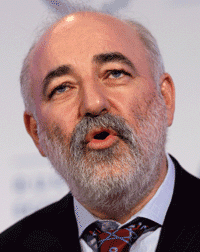 |
Renova’s chair, Viktor Feliksovich Vekselberg, joined president Putin on a visit to South Africa to boost ties, while RusAl is pushing into sub-Saharan Africa |
In the final analysis, Russians and Russian companies get on well in Africa for several reasons. Analysts say Russians fit in well, and tend to put in strong local management teams – unlike, for example, Chinese corporations, which prefer to import workers and managers from home. African pride and increasing confidence is also creating a backlash against the ‘briefcase banker’ – a term used for the kind of investment banker who blows in, usually from London, to broker a deal; one of the reasons why many global investment banks are considering beefing up their presence on the ground in Africa. China and another emerging market powerhouse, India, are pushing hard into Africa, seeking to buy, mine and ship out huge quantities of resources to fuel their booming economies.
Chinese oil companies PetroChina, CNOOC and China National Petroleum Corporation all have significant operations in Africa, which provides Beijing with one-third of its petroleum needs. Sino-African trade is believed to have been around $55 billion in 2006 – rather more than the estimated $2.5 billion in trade that flowed between Russia and Africa last year. Beijing’s total engagement with Africa reached its peak last June, when the leaders of 43 African states visited Shanghai to pay homage to Chinese president Hu Jintao.
China’s headlong rush into Africa irks many local government officials and corporates, who see the People’s Republic as a neocolonial power intent on prising away precious natural resources while exporting shoddy products such as textiles and household goods that undercut struggling African producers. India’s star has also been tarnished by recent industrial projects, notably a giant soda ash factory on Lake Natron in Tanzania that could destroy the main breeding ground of the pink flamingo. The plant is being built by a local subsidiary of Tata Chemicals, which is in turn owned by India’s Tata Group.
That’s not of course to say that most Russian corporates are squeaky clean. But at least, in the eyes of many Africans, they provide a welcome, wealthy counterbalance to the Chinese, who are becoming “an increasing irritant with their arrogance” in Africa, according to one South Africa-based banker.
Fear
Then there’s the added benefit that Russians, thanks to their sometimes ill-earned reputation for being able to start a fight in an empty bar, simply scare the pants off many locals.
“There’s no two ways around it – the Africans fear them,” says a London-based consultant. “There’s a saying about when you’re in an argument, you never give a Russian a way out. But it’s worse to give him a way out, because if you do so, he’ll think you’re weak. The Africans understand that mindset. That’s why the two sides are made for each other.”




