Bank Acquisition: Saxo Bank makes its first acquisition

Takeover of partner Synthesis Bank is central to planned expansion into wealth management.

Synthesis’s former shareholders, including its chief executive and majority owner, Charles-Henri Sabet, will hold about 6.7% of the enlarged Saxo

Synthesis’s former shareholders, including its chief executive and majority owner, Charles-Henri Sabet, will hold about 6.7% of the enlarged Saxo

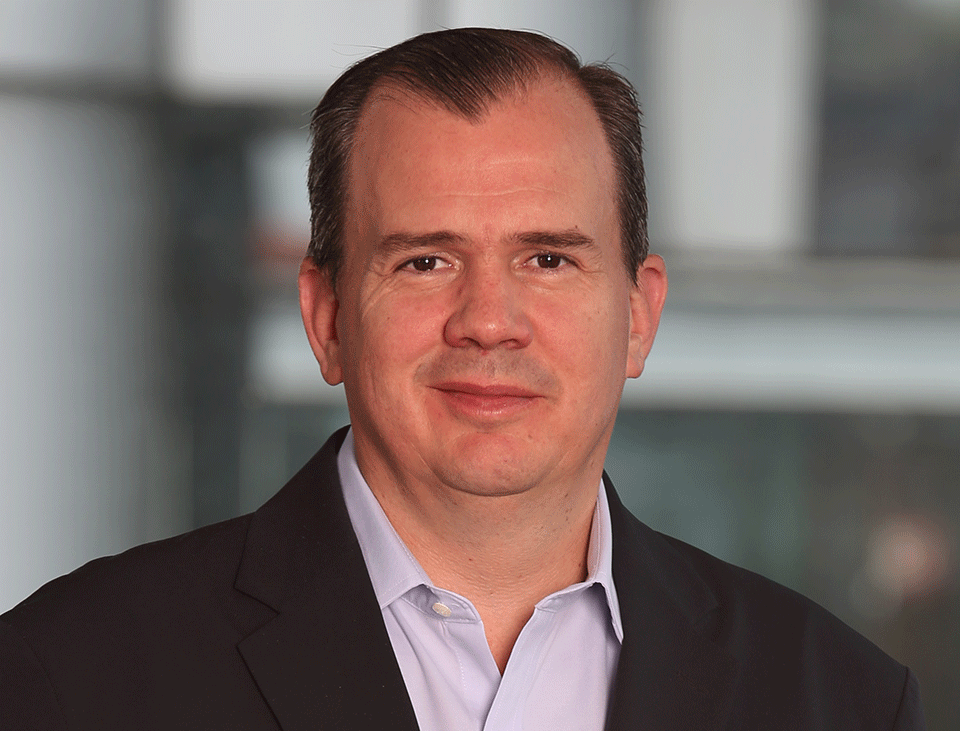
Saxo Bank, like Oanda, is a predominantly retail FX provider that believes it has reached sufficient maturity to expand its client base into new areas (see Investment in Oanda platform underlines retail sector’s importance, Euromoney, October 2007). The bank announced on September 13 that it had acquired Synthesis Bank of Switzerland in an agreed transaction. The two institutions have had a partner relationship for more than three years. Although technically a bank, Synthesis is a relatively small but successful trading operation, which had white-labelled Saxo’s SaxoTrader platform. Saxo declined to put a precise value on the transaction but said Synthesis’s former shareholders, including its chief executive and majority owner, Charles-Henri Sabet, will hold about 6.7% of the enlarged Saxo; they also received an undisclosed cash amount. Sabet will now become a board member of Saxo’s senior management team and oversee its trading activities.

What Synthesis does have, as well as a successful trading operation, is a Swiss banking licence. Although such licences are not seen as particularly difficult to obtain, that held by Synthesis does provide Saxo, assuming that all regulatory hurdles are overcome, with what it sees as an easier route into the wealth management business.

At a press conference in Geneva, Saxo’s co-founders and joint chief executives, Lars Seier Christensen and Kim Fournais, explained the rationale of the acquisition. According to Christensen, Synthesis will play a big part in helping Saxo to achieve the goals outlined in its internal strategy plan, which runs until 2010. So far, the bank has managed to grow organically at 50% a year since its launch. Christensen recognizes that as Saxo matures it will become increasingly difficult to maintain this rate of expansion. Furthermore, the ability to integrate acquisitions is something that he feels the bank’s management will need to be able to prove ahead of any potential public offering of its shares.

“Synthesis is a perfect fit,” Christensen said at the press conference. “Our strategic objective is to be located in major financial centres, even if not on every street corner. We want to expand into wealth management. Switzerland is the key to that. We want to expand our model from pure trading to include wealth management components. In that context, Switzerland is absolutely a key location.”

Fournais played down any fears that Saxo’s expansion plans would be seen as a threat by its existing liquidity providers. “Our business model is that of being a friendly facilitator,” he said. “We do a big chunk of business with the world’s leading investment banks… The only change is that we expand our range of products. This will only strengthen the relationship we have with our banks.”

Saxo has appointed private wealth management veteran Søren Mose to head its planned Swiss operations. Mose, who was previously chief executive at Jyske Bank’s Swiss subsidiary, explained the importance of having a presence in the country. “If you want to be the best producer in bacon, you have a farm in Denmark. If you want to be the best wine producer in the world, you acquire a vineyard in France. If you want to be in investment banking and mergers and acquisitions, you operate from London. But if you want to develop in private wealth management, you have to have a bank in Switzerland.”