If you cast doubt on the future of the Dubai real estate market, those with stakes invariably tell you that they have heard it all before. “Every year they tell me something will go wrong, and every year I see Dubai growing stronger,” Adel Al-Shirawi, CFO of Dubai home financier Tamweel, told Euromoney earlier this year.
As the decade draws to a close, however, it would appear more likely that the factors conspiring to prove the nay-sayers right might finally triumph. By early 2009, a 7% governmental cap on rent increases will have had its desired effect on inflation. At around the same time, long-delayed construction will have been completed, and supply will be much higher. Furthermore, the expatriates who prop up the higher end of the market might, in the next year or two, start to turn away from a city that had become just as expensive, if not more expensive, than their own countries.
Immigrant labour from India might also start to dry up as workers from that country find more opportunities back home.
Property peak
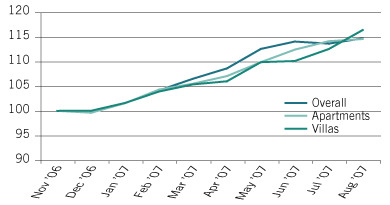
According to a report released at the end of September by Egyptian investment bank EFG-Hermes, property prices in Dubai will reach a peak in the second half of next year. The report estimates that prices will start falling in 2009, with a cumulative decline of 15% to 20% by 2011.
“We now expect the peak year of supply to be 2009, with 68,000 units being delivered,” the report says. This compares with just 11,000 being delivered during the first nine months of 2007, a figure that was lower than expected because of delays.
“Most of the commercial space additions are expected to hit the market in 2008 and 2009 and we expect to see a marked decline in rents. As a result, we expect to see Dubai commercial property yields sliding back gradually toward the international average,” the report concludes.
So what would be the effect of a serious downturn in the property market on Dubai’s financial sector?
The government imposes a 20% ceiling on the amount banks can invest directly in real estate from their core deposits. But the problem is defining exactly where their exposure to real estate ends.
Banks are invested in real estate directly. They are also invested in real estate through loans issued for property purchases, projects, or developments. People’s ability to repay loans they took out for non-property purchases might be put in danger by a real estate crash. Personal loans, furthermore, can be used for real estate investments unbeknown to the banks.
|
Dubai property price rise |
|
Villas, apartments and overall; index base = 100 |
|
|
Source: Better Homes and EFG-Hermes |
One senior emerging markets investment banker in London reckons that in practice Dubai banks have a 25% exposure to the local real estate market at an average level of leverage of 10 times. Other analysts based in Dubai put forward more conservative figures, although the exposure of some banks is still a potential concern. The bank with most exposure to the real estate market, according to Mohamed El Nabarawy, a banking analyst at Shuaa Capital, is Dubai Islamic Bank (DIB). He reckons that about 23% of DIB’s total lending is in real estate. This compares with an average of around 11% for the other banks in the UAE rated by Shuaa.
DIB’s capital adequacy (the ratio of a bank’s capital to its weighted risks) is similar to that of other banks in the UAE, about 15%. But DIB has a further $315 million in direct real estate investments. It also maintains significant stakes in Tamweel, and local developer Deyaar, both of which the bank helped to set up.
Among Dubai’s other main banks, National Bank of Dubai (NBD) and Emirates Bank International also have significant, if smaller, exposures to real estate.
According to a report issued by EFG-Hermes in March, some 16% of National Bank of Dubai’s lending was to the real estate sector, with the remainder going to commercial and business lending (62%) and personal loans (22%). Emirates Bank International has only 6% of its loan book exposed to the real estate and finance sector according to the report. But Emirates also has some $80 million in direct property investments, and is said to be buying another 20 towers in Dubai.
Senior bankers and analysts are divided over the effect of the bubble’s bursting, when it comes, on the Emirate’s financial sector as a whole.
Faisal Hasan, head of research at Global Investment House in Kuwait, says the effect of a real estate downturn on the banking sector will be mitigated by the low penetration of mortgages in the Emirate, as well as the protection afforded by high levels of government ownership in the main banks.
Similarly, Shuaa’s El Nabarawy says DIB might be protected by its diversified business plan (DIB’s spokespeople were not available to confirm this when contacted by Euromoney).
However, a senior analyst of UAE banks at a leading ratings agency, says that the biggest risk to the banking sector in Dubai is the real estate market. “Although loan-to-value ratios for mortgages in Dubai average around 80%, sometimes they are as high as 90% to 99%.
“Often it seems that banks and financers are of the opinion that property prices are only going to go up. Given their levels of exposure to real estate and their leverage, if there is a dramatic drop in property prices, some banks may be in trouble,” the analyst says.



