 |
“I am working in my capacity as a full secretary and there are no restrictions on me” Tarcísio José Massote de Godoy |
Investors and bankers are starting to shape opinions on Tarcísio José Massote de Godoy, the interim secretary of Brazil’s national treasury since January, the third person to hold the position over the past year. They like his in-depth knowledge of the institution, abilities as a technocrat and the seasoned team he has assembled. However, they worry about his inexperience outside the treasury, lack of star quality and the interim tag still attached to his name. Preceded by Joaquim Levy, who quit in March 2006, and then Carlos Kawall, who lasted just nine months, Godoy was appointed in January. The interim tag is likely to be dropped once finance minister Guido Mantega is confirmed in his role for the second mandate of president Luiz Inácio Lula da Silva. “I am working in my capacity as a full secretary and there are no restrictions on me. I have no concerns about this,” says Godoy.
Maintenance
If his appointment is indeed confirmed, as most analysts expect, his priority will be to maintain and run the institution rather than build it, a role that his predecessors undertook, he says. The ministry of finance has been investing heavily in professionalizing the treasury function and focusing on training and developing in-house teams. That is paying dividends, with senior staff having long levels of experience and solid training, says Godoy. “I have very experienced teams in the areas of fiscal policy, debt management and relations with sub-sovereign issuers. My only real concern is the institutional function,” he says.
Godoy believes his career at the treasury means he is well positioned to oversee an institution he knows intimately. He has been there since 1993 and, by working in different key functions – for example, he worked as the general coordinator of public debt management and as deputy secretary in charge of fiscal policy – he has gained a good bird’s eye view of the institution. He is puzzled by critics who say he has no direct experience of markets. He points out that he has seven years’ experience of public debt at the treasury, in which time he built strong relations with investors. Furthermore, he points out, there is a highly experienced debt management team under Paulo Valle. Valle has been with the treasury since 1992 and has overseen debt operations for seven years.
|
Appetite for Brazilian debt |
|
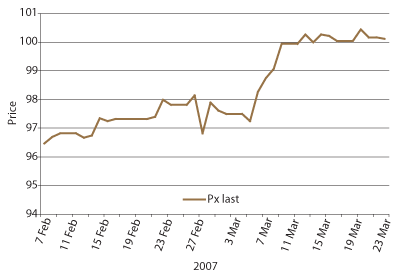
Brazil’s R$1.5 bln 20-year global bond performance |
 |
|
Source: Bloomberg |
On debt issuance, Valle notes that the federal republic has reached long-term, quality investors through its programme of global, real-denominated bonds. “The type and number of investors has improved greatly. These are investors that buy and hold debt,” says Godoy. “You can see the strength of appetite by looking at the secondary markets,” adds Valle. “The global bond issue of 2028s has tightened since its launch in February and is now yielding 10.25% compared to 10.68% at issuance.” In fact, the sovereign placed a successful R$750 million ($307 million) tap of the 2028 bond last month. Recent emerging market bond turbulence has had little impact on Brazilian government bond prices and the real has remained stable too, at around 2.10 to the dollar, Godoy adds. He says that for now market movements are well within treasury projections and he has not had to reconsider the scale or timing of issuance. Some overseas investors worry that liquidity in the dollar bond markets is suffering as a result of the emphasis on local-currency issuance. Valle says that with the plan to reduce the stock of dollar-linked bonds from 12.7% at the end of 2006 to 10% to 12% by the end of this year, the issues will be focused on key points of the curve, particularly 10 and 30 years. “We reopened the 2037s at the beginning of the year with $500 million in issuance and we now have $2.5 billion outstanding at this point,” he notes.
Lisa Schineller, director, sovereign ratings group, at Standard & Poor’s, says Godoy has many positive attributes. “He knows the country’s fiscal accounts intimately. He has a strong respect for prudent fiscal policy and is respected by his peers,” she says.
Ilan Goldfajn, economics professor at the Pontifícia Universidade Católica do Rio de Janeiro and a former deputy central bank governor, is more critical of the appointment. He believes that overall the quality of managers appointed by the federal government at financial institutions is weakening and undoing years of good work. He points to the appointment in February of Paulo Nogueira Batista, an economics professor, as executive director for Brazil to the IMF as a prime example. “He is not market-oriented at all. This is my fear – that the government is slowly unravelling the good work of institution building. The treasury had star players in the past, he says. It is a shame to see the government move to a policy of appointing senior staff without that quality.”