Euromoney Awards for Excellence 2006
Emerging markets Best bank I Emerging Markets Best investment bank I Emerging Markets Best debt house I Emerging Markets Best equity house I Emerging Markets Best M&A house
|
Also shortlisted in this category: Credit Suisse Morgan Stanley |
Take its business in Latin America, for example. While the bank acted as a bookrunner on Unibanco’s $758 million secondary offering, the biggest equity deal in Brazil last year, arguably its more interesting trades in the region were two relatively small IPOs: Banco Macro Bansud’s $278 million listing on the New York Stock Exchange, which is the first equity offering in Argentina since 2001, and Inversiones Aguas Metropolitanas’s $398 million transaction, which is the first internationally distributed IPO in Chile.
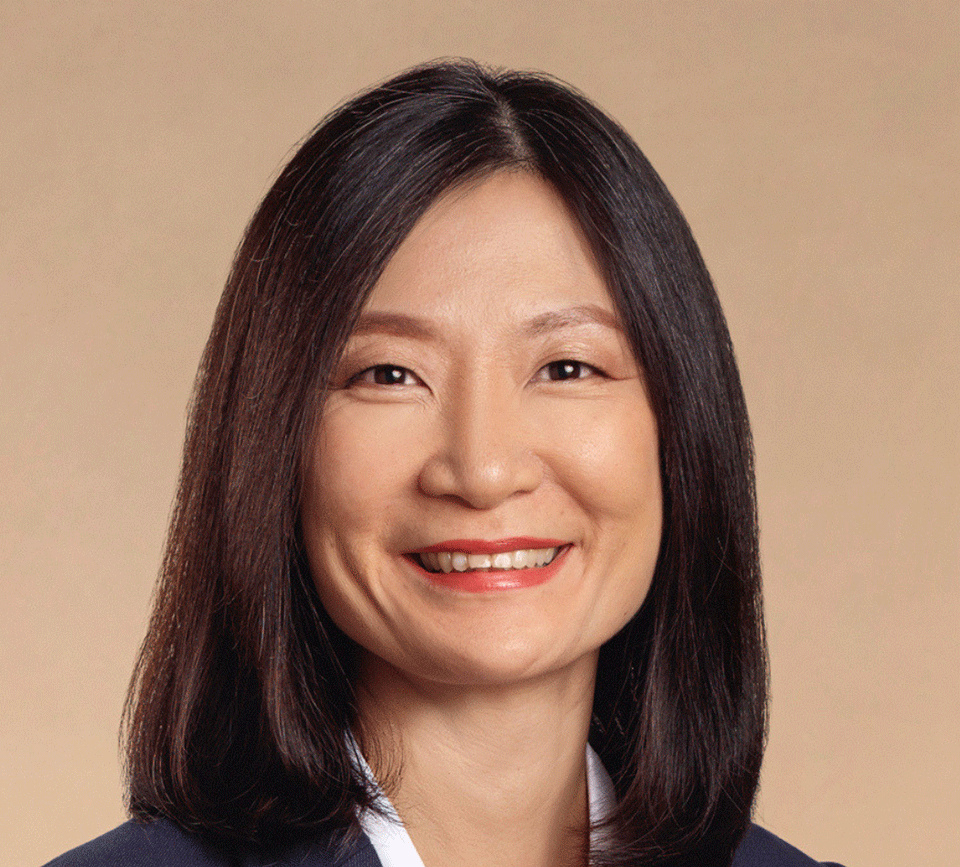
| Louise Wilson: emerging Europe has been a stronghold for UBS for a number of years |  |
In Asia, too, while the Bank of China IPO and Chunghwa Telecom’s $2.5 billion offering are obvious headline-grabbers, it’s the less sexy $122 million deal for Philippines’ real estate firm Megaworld, the $110 million transaction for China Medical Technologies and the $100 million offering for India’s Hindustan Construction Company that best illustrate UBS’s strength in depth. Matthew Koder, co-global head of equity capital markets at the bank in Hong Kong, says that there are plenty of opportunities in the region for investment banks beyond the very largest companies. “There’s a huge mid-cap space in the region and it is generally under-researched and relatively unknown,” he says. “In India, for example, mid-cap companies are growing dramatically. The same will happen in China and Indonesia.”
Mid- and small-cap offerings appeal in particular to dedicated long-only investors, adds Koder. “These investors are more inclined to focus on mid- and small-caps because there is more value and it’s less crowded than in the large-cap space.”
Another UBS strength is its ability to arrange deals in the local market. The Swiss bank is the leading trader in Singapore and is number one in Thailand in terms of secondary market volumes. The focus now is on China, where the bank has won regulatory approval to buy a 20% stake in Beijing Securities. It will, therefore, become the first foreign investor to control a Chinese brokerage.
Its local markets capabilities are very much in evidence in central and eastern Europe too. Last year, for example, it managed, together with Deutsche Bank, the $1.49 billion-equivalent sale of Deutsche Telekom’s remaining 10% stake in Russia’s Mobile TeleSystems. The trade was executed domestically and demonstrated that Russia’s equity market had the capacity to absorb big deals. UBS was also involved in the $1.3 billion-equivalent IPO of Turkey’s Vakifbank. The deal was seven times oversubscribed, with foreign institutional investors accounting for 70% of the shares.
Louise Wilson, head of European equity capital markets in London, says that emerging Europe has been a stronghold for UBS for a number of years. In Russia, for example, the bank has had a presence since 1997 when it formed a joint venture with local player Brunswick Securities. In December 2004, UBS bought out Brunswick’s share to make the outfit a wholly owned subsidiary. The only other bank that has a similar penetration in Russia is Deutsche Bank, following its acquisition of UFG.
Wilson says that UBS is continuing to build its franchise in other markets in the region. She points out, for example, that the bank has beefed up its investment banking team in central and eastern Europe and has bought a brokerage in Turkey. It is also winning business in the Middle East, especially in Israel.
Key to UBS’s success in the equity capital markets is its secondary market business. “The primary business has always been driven by the secondary business rather than the other way around,” says Sebastien Chatel, head of Latin American equity capital markets in New York. “The secondary market business at UBS is a standalone profitable business.” The bank has top-notch research capabilities as well as big sales and trading teams covering the emerging markets.
Emerging markets Best bank I Emerging Markets Best investment bank I Emerging Markets Best debt house I Emerging Markets Best equity house I Emerging Markets Best M&A house