 |
|
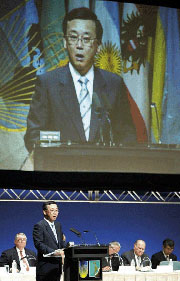
A novel experience: Japanese finance minister Sadakazu Tanigaki addresses the Inter-American Development Bank annual meeting in Okinawa |
Okinawa was always a rather improbable place to hold April’s annual meeting of the Inter-American Development Bank (IDB), so perhaps it was not so surprising that this year’s event had such an Alice In Wonderland feel to it. The role of Alice was played by hundreds of Japanese and Korean delegates, who took the opportunity to take their families to the beach while learning about the opportunities of trade with Latin America. Most had never been to an IDB meeting before, which probably made the whole event even curiouser to them than it was to those of the repeat delegates.
But the meetings really did make incredibly little sense on many levels. First, of course, there was the location: it was not unheard-of for people to have passed through seven different airports to get there. On arrival, most delegates were then rather shocked to find that their hotel was a 45-minute taxi ride away from anything else. The standard business of any development bank meeting – men in suits running around having dozens of meetings in a series of luxury hotels – immediately became a comedy of missed connections, GSM phones that don’t work in Okinawa, and $100 cab rides in the middle of tropical rainstorms that result in the news that the person you were supposed to be meeting has been unavoidably delayed in the place you just came from.
Curiouser and curiouser
At the Okinawa Convention Center, site of the official meetings, things were just as weird. The main subject of conversation was when and whether China should be able to join the IDB, following in the footsteps of Korea, which joined, with great fanfare, this year. Proponents of Chinese membership were foiled at every turn by the wholehearted agreement of opponents of the idea, who never seemed to say what they meant. “China can’t join because it isn’t a democracy,” or “China can’t join because we’re very close to Taiwan” always seemed to come out as “We would love to welcome China into the IDB, just as soon as we sort out a couple of minor technical difficulties” – difficulties that were always left unspecified.
On the other hand, if conversations about China excelled in doublespeak, it was only when Argentina came onto the agenda that the rhetoric was raised to the level of outright impossibility. Argentina has said that it will not service the bonds of creditors that did not tender into its bond exchange – which means that some $24 billion in debt is set to remain in arrears for the foreseeable future. The IMF has said, many times, that it will not lend to countries in arrears unless certain conditions are fulfilled, including that the country be in good-faith negotiations with its creditors. Since Argentina has evinced zero interest in talking to its holdout creditors, there seems no way that the IMF can possibly come up with a new programme for Argentina. Nevertheless, the official sector seems to be unanimous that this problem is minor and easily surmountable – albeit, once again, in an unspecified manner.
It was Argentina’s finance minister, Roberto Lavagna, however, who waltzed away with the Black-Is-White prize. Sweeping into the Laguna Hotel with poise and panache, he assured a large room of delegates that Argentina had restructured its debt and come out of default. Fully 86% of the country’s debt, he said, was now performing, and Argentina had managed to rehabilitate itself through the debt exchange without the help of the IMF.
It was a magnificent performance, marred only by the fact that the exchange hadn’t happened, the deal hadn’t closed, and Argentina’s new bonds hadn’t been issued. In fact, at the end of March, Argentina’s lawyer, Jonathan Blackman, had warned a New York court that there was a very real risk that “the exchange offer can’t go forward, the work that we have been doing for the last three years will basically go to naught, and we will be back to square one, with no satisfied creditors”. As Lavagna spoke, that risk was still very much alive, with New York’s Second Circuit Court of Appeals yet to rule on the case. Yet no-one in Okinawa seemed particularly worried by the failure of Argentina to close its deal, and in fact most delegates – led by Lavagna himself – seemed to be under the impression that it had already happened and was a thing of the past.
Perhaps the ignorance was driven by a lack of analysis, and the lack of analysis was driven by a lack of analysts. There was a huge number of no-shows this year, led, most notably, by the entire team from Deutsche Bank.
Deutsche cancelled its own annual IDB conference at the last minute, and sent not a single banker to schmooze finance ministers or mollycoddle clients. The banks that did send big teams were not crowing: all of them privately admitted that Deutsche had probably made the right decision, and that they rather regretted making the trip themselves. After all, the IDB was held very late this year, and nearly everybody would meet up again only a week later, at the spring meetings of the World Bank and IMF in Washington.
Falling demand for bankers
More to the point, the expertise of the big emerging-markets houses is in very low demand these days. A few years ago, Latin finance ministers, desperate for funding, would use the banks’ conferences to try to persuade dedicated emerging-markets investors that they really were creditworthy and a good medium-term investment. The issuers needed the investors, and both of them needed the banks.
Today, the situation is very different. Latin America is booming, the fiscal situation across the region is generally strong, and crossover investors are lining up to throw money at the region. Countries are increasingly able to fund themselves domestically, meaning they have little need or desire to tap the international capital markets. And when they do come with a bond issue, they don’t need to use a shop with bottomless emerging-market expertise: bond issuance has largely become commoditized these days, with houses competing on price rather than execution.
One of the biggest paradoxes of all, then, in this paradox-filled meeting, was that Latin America’s impressive growth of the past couple of years has done more harm than good for those investment banks that have been most committed to the region. Many senior bankers have resigned, retired or simply been sacked, and the junior ranks are much thinner now than they used to be. Competition is up, fees are down (Deutsche bid just one basis point in fees for a mandate from El Salvador), and the parties are noticeably less lavish than they were in the years of crisis. If this is what happens when the asset class matures, there is likely to be a large contingent of bankers hoping that 2006’s slate of elections across Latin America unleashes a new wave of uncertainty and volatility. Their jobs just might depend upon it.


