 |
|
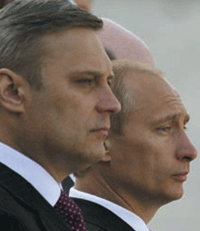
Kasyanov: has not seen eye to eye with his president, Putin, but he is a key figure in Russia’s reform process |
President Vladimir Putin surprised everyone with his appointment of unknown technocrat Mikhail Fradkov to replace sacked prime minister Mikhail Kasyanov. Fradkov is Russia’s envoy to the EU, based in Brussels. Before this, he was director of the tax police. In many ways, he is a compromise candidate between the two Kremlin factions of the security services and the liberal reformers. He has served in the Russian security council, giving him links to the former, and also served in Yegor Gaidar’s reformist government in the early 1990s, giving him some credibility with the latter group. He is not well-known but regarded as a competent bureaucrat who will, above all, be loyal to Putin.
Kasyanov’s days were numbered, according to the consensus. Putin inherited his prime minister from the Yeltsin administration and Kasyanov was dogged with rumours of imminent dismissal more or less from his first day. He was particularly unpopular with the security services, which blamed him among others for enriching the oligarchs at the state’s expense in the 1990s.
By sacking Kasyanov ahead of the elections, a move which is likely to be popular with many ordinary Russians, Putin is hoping to raise interest in the election and promise a new direction to voters. Since Putin commands more than 70% support in opinion polls, his main adversary in the vote will be apathy – the elections are only valid if more than half the eligible population vote.
“This decision is caused by a desire to clarify my position on what course the country will take after March 14 2004 [presidential election day]”, Putin told the country.
The appointment of Fradkov clarifies two things: Putin will continue to centralize power and he will continue to put pressure on Russia’s oligarchs to share their wealth with the state, a campaign that began with the arrest of Yukos oil company major shareholder Mikhail Khodorkovsky last October.
Fradkov’s background in the tax police “will give him plenty of information over the oligarchs, and a weapon to wield against them”, says one analyst.
He is likely to continue with the government’s push to raise taxes and crack down on tax minimization schemes in the energy sector, which could be bad news for Russian energy companies.
Ambiguous at best
Roland Nash, chief strategist at Renaissance Capital, says: “The Kremlin policies that Fradkov will implement…have ambiguous at best implications for the privately held natural resources companies – tightening of control over the natural resources economy has potentially negative implications, both for tax and corporate governance, for many of the larger stocks traded in Russia.”
The market reacted mildly negatively to the news, falling by 1.6%. Many market participants were hoping for the appointment of a more obviously liberal candidate. However, some were also relieved that Putin did not appoint a more hardline candidate from the security services.
The obvious hardline candidate was Sergei Ivanov, defence minister and a close friend of the president’s. Like Putin, a former head of the Federal Security Services (FSB, the successor to the KGB) and reputed to be one of Putin’s most trusted confidants, Ivanov is also seen as a leading member of the faction known as the siloviki. These Kremlin hardliners have been credited with engineering the crackdown on the oligarchs in general, and Khodorkovsky’s arrest in particular.
Since Khodorkovsky’s arrest, many have speculated that the siloviki have carried out a quiet palace coup and are establishing control over the government before moving on to the main economic assets. Ivanov’s appointment as prime minister would have been seen as a defeat for Russia’s liberal forces and the start of a slide back towards renationalization of some of Russia’s most valuable assets, the oil companies.
However, Ivanov’s political capital has been damaged in recent weeks by the military’s embarrassing failure to test-fire unarmed nuclear missiles during much-hyped military exercises.
But the market was also disappointed that the hoped-for liberal candidate, finance minister Alexei Kudrin, was not chosen as Kasyanov’s replacement.
Pro-reform, Kudrin has been leading a fight for a more liberal but cautious move to a market-oriented economy. He was the ideological architect of the stabilization fund, which absorbs excess oil revenues to cushion Russia’s oil-dependent economy against external shocks. However, he is seen by some investors as disorganized.
Instead, Putin has appointed a prime minister very like himself when appointed prime minister under Yeltsin – not that well-known, with connections to the security services but also some liberal credentials, and experience of working abroad. Roland Nash says: “Putin has appointed a ‘Mini-Me’, and a totally loyal, reasonably faceless ‘mini-me’ is the best way to ensure even greater centralization of authority in the Kremlin.”
Indeed, some investors are concerned that with Kasyanov’s exit and Fradkov’s appointment, no one is now left in the government who is capable of standing up to Putin. Jerome Booth, head of research at Ashmore Investment, says Kasyanov is “the only person who has a proper dialogue with Putin. If Kasyanov goes, the siloviki win. Nobody, apart from Kasyanov, can stand up to them.”
No one, perhaps, but Putin himself. The president has so far shown himself capable of playing off different Kremlin factions against each other without becoming captured by any particular one. His new government, which will be announced after his inauguration in May, is expected to contain a balance of both liberals and siloviki.
But Fradkov’s appointment preserves uncertainty as to who will succeed Putin in 2008. The president hinted in February that he would bring forward a successor in his second term. Fradkov will be 58 in 2008 and is unlikely to be that successor. The real fight between the siloviki and the liberal/big-business faction has yet to be fought.