 |
|
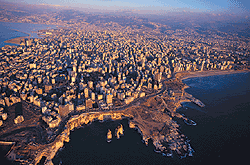
The Beirut corniche: more twists and turns to come before Lebanon’s budget is sorted out |
Hopes that fiscal consolidation would begin paying off for Lebanon in 2004 were dashed by the draft budget approved by the cabinet in late October.
After more than a month of political infighting, the 30-member cabinet led by prime minister Rafiq Hariri approved a budget package that forecasts an increased deficit of 32% on budget expenditures. An earlier forecast was for a 2004 deficit of between 27% and 30.8%, and the new figure also greatly exceeds the now overly optimistic 24.7% deficit forecast for 2003. The budget will see gross debt creep back to the level recorded before the Paris II lending conference of November 2002, where European and Arab donors offered $4.4 billion in soft loans to allow the government breathing space in which to institute reform.
For a country with a public debt of around $32 billion – over 180% of GDP – the budget has been roundly dismissed by market observers as disappointing. No privatization or securitization receipts are part of the package for the coming year. Instead the realization is dawning that the government will make little progress towards fulfilling the promises made to Paris II donors that public utilities would be privatized and mobile phone licences auctioned.
François Bassil, the chairman of Lebanon’s Byblos Bank, has warned that radical change is necessary to save the country from financial disaster, while Standard and Poor’s on October 10 revised its B- credit rating on the country from a positive to a stable outlook. Credit analysts Ala’a Al-Yousuf and Konrad Reuss wrote that the revision reflected S&P’s view “that the draft budget for 2004 implies a postponement in fiscal consolidation and hence delays the envisaged reduction in the government’s debt burden”.
Vested interests Despite Lebanon’s being one of the most sophisticated financial hubs in the Middle East, since its 15-year civil war ended in 1990 government finances have been a cause for concern. The sectarian political system, in which eight different confessional groups are given parliamentary representation, has fostered political infighting and vested interests scupper reform.
“The fact of the matter is that Lebanon’s debt problem is not going to be solved without privatization, by selling assets and devoting the revenues to debt reduction”, says James McCormack, senior director of sovereigns at Fitch Ratings. With the government running only small primary surpluses, he adds, without substantial privatization receipts it will never be able to address the debt stock itself.
However, with a presidential election due late next year and tensions between prime minister Hariri and president Emile Lahoud running higher than ever, the political will for reform is almost non-existent. Marcel Cassard, head of emerging markets economics at Deutsche Bank, says: “There is no political will at large for change because there is no pain. Typically, changes occur either following a financial crisis or under an IMF programme.” Although finance minister Fouad Siniora has warned that “further delay [to implementing Paris II promises] would be detrimental for Lebanon”, Cassard believes that “without an external push, the government will continue to muddle through”.
With foreign currency reserves topping $10 billion and a trade surplus of $3.2 billion for the first eight months of 2003, the government’s amortization schedule is not too onerous for now. However, debt levels are unsustainable in the longer term and the country’s debt dynamics mean there is a significant medium- to long-term risk.
This risk is not so much to foreign investors, given the low level of private foreign investment outside the banking sector, but primarily to Lebanon’s banks, which hold most of the government’s treasury bills and Eurobonds. The central bank, the Banque du Liban, alone holds about 20% of the government’s domestic debt. Although Lebanon’s bankers have traditionally been willing to assist the government, they are becoming increasingly frustrated at the lack of reform. If deposit growth weakens or stalls, they may be both unwilling and unable to help.
The budget also puts future international lending at risk. Although the soft loans of Paris II were not conditional on reform, the government’s failure to keep its promises means a Paris III is increasingly unlikely. According to Francis Beddington, head of economics and sovereign strategy for Africa and the Middle East at JPMorgan: “Donors have shown a remarkable degree of patience with Lebanon, but we are detecting disappointment.” Domestic banks and investors will now, more than ever, be the government’s first port of call for financing.


