Awards for Excellence 2016

|
|
Also shortlisted: |
|
Bank of America Merrill Lynch |
|
HSBC |
|
Goldman Sachs |
It has been another difficult year for investment banking in the emerging markets, with volatile deal-flow and the economic stresses of Brazil’s crisis, the slowdown in China, the de facto closure of Russian public markets and the Middle East’s disorderly adjustment to low oil prices. And yet despite the departure of many European banks, investment banking from Asia to Latin America remains hotly contested.
In this challenging environment, Citi has continued to impress clients and rivals. Over the past year, it maintained its market-leading franchise across products, supported by its large-scale sales and trading operation, strong balance sheet and on-the-ground presence. Over the awards period, Citi demonstrated creativity, repeat business and long-term relationships in fixed income, equity and M&A.
Citi played a leading role in many of the most important transactions in the emerging markets.
It advised Naspers on its $1.2 billion acquisition of a 50.5% stake in Russia’s Avito, in one of the largest technology transactions in EEMEA. It acted as joint bookrunner on the first CEE issue of 2016 for the Republic of Poland. In Latin America, Citi was exclusive financial adviser to Axtel in its $2.1 billion transformative merger with Alestra in the Mexican telecommunications industry. It also showed its cross-border prowess advising Brazil’s BBM in the sale of an 80% stake to China’s Bank of Communications.
In Asia, Citi faced strong competition from the other bulge-bracket firms in equity capital markets and M&A, but staked its territory firmly in the debt markets. It executed record-breaking transactions for many of its long-standing clients, including the largest Asian exchangeable bond in the last 15 years for China Overseas Land and Investment; while corporate and sovereign offerings included the largest dollar and euro offering for Sinopec, and the lowest-coupon Asian offering in euros for Temasek.
|

|
|
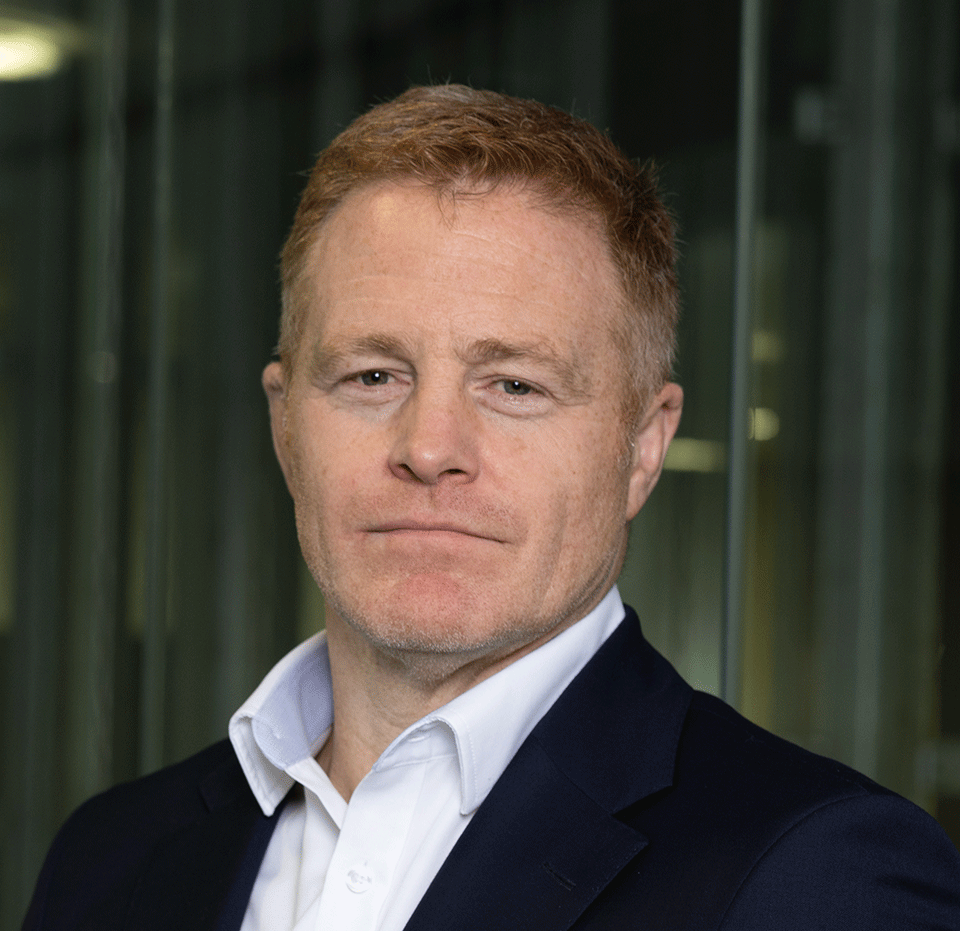
Mark Slaughter, Citi |
Mark Slaughter, Citi’s head of corporate and investment banking for Asia Pacific, claims the bank’s universal product offering allows it to ride cyclical volatility. “Over the past 10 years, fees for ECM activity in Asia have been significantly volatile year on year – and volatility is the hardest thing to manage as a business,” he says. “The investment banking dynamics in Asia have been challenging for all banks, given a reduction in the volume of activity, particularly in Chinese equities. Over the past year, we have benefited from our strengths in the DCM space, which has defied the volatility in the equities market. We benefit from a leading franchise across all the major currencies.”
He adds: “Market conditions continue to be strong for M&A, particularly cross-border, driven by acquisitive Chinese companies.”
The culture of emerging market banking at the universal banks has shifted away from product silos to integrated working-capital and financing solutions in a bid to maximize the share of any particular client’s business.
Slaughter gives Citi’s perspective on the challenge: “A large amount of day-to-day investment banking activity is building relationships with our target clients and delivering the benefits of the combined corporate and investment banking franchise. From IPOs to cash management, what distinguishes Citi from our competitors is the range of activities that we can offer clients.
“We created the combined corporate and investment banking structure in 2009. It takes time for this institutional change to take root and create a new culture. You have to ingrain a new mode of behaviour so habits change, and by its nature that takes time. The integration has worked well, and we have corporate and investment bankers who act as equal partners.”
The relative stability of Citi’s personnel – with experienced syndication and origination officials dedicated to emerging market transactions – and the strength of its corporate relationships across Latin America and Asia continue to pay off.
Citi, though, must watch its back. Competition with HSBC is rising as the latter moves firmly away from its status as simply a debt powerhouse and begins to win some important business in ECM and M&A. HSBC also offers, like Citi, a full suite of services for the Hong Kong Shanghai Stock Connect, including execution, research, brokerage, custody, clearing and hedging.