Alexei Kudrin is an inconspicuous apparition, arriving without entourage in a quiet restaurant in the English countryside this summer. This is, after all, someone at the very height of the Russian elite, one of president Vladimir Putin’s oldest allies.
With rumours swirling of a new rift between Putin and his protégé prime minister, Dmitry Medvedev, Kudrin is even tipped as the potential leader of an alternative, pro-market government.
 |
| The presence of Alexei Kudrin looms over his successor as Russia’s finance minister, Anton Siluanov |
Over supper, near the small collegiate town of Winchester, Euromoney’s finance minister of the year for 2010 – now dean at St Petersburg State University – acts surprised at the suggestion he might be thrust into the prime minister’s role. Nevertheless, after the illiberal drift in Russia’s government since elections this March, an alternative Kudrin-led administration looks possible, and for investors, highly desirable.
Immediately after ordering food, Kudrin brings up his so-called Civic Initiative Committee. He says he created the group earlier this year to encourage political debate and pluralism in Russia. But his comments do not dismiss the suggestion that a new political party, led by him, might emerge from this initiative.
“There were too few parties to vote for in these last elections in Russia,” he acknowledges. “We now need a new platform to be able to implement change. All the old parties are not good enough. You can’t build a new platform with the old parties.”
Kudrin resigned as Russia’s finance minister and deputy prime minister in autumn 2011, a few days after the announcement that Putin, then prime minister, would run again for president in the March 2012 elections. Putin said that if he won he would swap jobs with Medvedev, who had been president since Putin stepped down in 2008 to comply with the two-term constitutional limit.
Kudrin very publicly fell out with Medvedev in the following days, ostensibly in protest at Medvedev’s intention to further loosen fiscal policy via a ramp-up in military spending. “It was the last straw,” says Kudrin. “The Russian economy is already too dependent on oil, mainly in terms of budget revenue.”
Some say the other reason was that Kudrin was eyeing the prime minister’s role for himself. Kudrin still maintains the stance he put forward just before his resignation: that he would find it difficult or impossible to serve in a cabinet led by Medvedev.
But he does not preclude the possibility of his own return to government, even under Putin. “It all depends on the tactics of the government and the willingness of the government to talk to the opposition. I will help the opposition to form,” he says.
Kudrin says it is too early to tell who exactly would lead this opposition, and if it would be him. As examples of opposition leaders, he points to elected city mayors outside Moscow, where opponents of the ruling United Russia party have recently won elections. “There’s a layer of people there with new views,” he says.
Nevertheless, especially if he were to lead a new, post-Medvedev cabinet of ministers, Kudrin might have the answer to the two main troubles facing Putin’s government: a growing anti-Putin protest movement; and the cash to fulfil the government’s pre-election spending promises.
Since allegations of fraud in legislative elections in December, demonstrators have taken to the streets more often, particularly in Moscow, than at any other time under Putin’s rule. “The government’s biggest mistake has been the lack of dialogue,” says Kudrin. “The government can be flexible. If it is not, then the protest movement will be stronger.”
One spark for the protests has been Putin’s questionable adherence to the constitutional limit of two consecutive presidential terms. The job-swap at the top allowed Putin, Russia’s president between 2000 and 2008, to return for a third term.
It was a nominally legal move, but it was hardly within the spirit of the law, which is to prevent the consolidation of power in one person. Putin’s power probably never really diminished when he served as prime minister under Medvedev’s presidency.
Until last autumn, it was just possible to maintain the illusion that the Putin-Medvedev circle dance was necessary to smooth the transition to more stable democracy rather than a tango to consolidate Putin’s personal rule.
But in the eyes of the protesters, Putin’s return to the presidency, and the implication that he could continue to hold power indefinitely by rotation with Medvedev, has undermined belief in Russia’s democracy. The anti-corruption element to the protests argues that the merry-go-round has done nothing to discourage similar transgressions of the spirit, if not the letter, of the law across Russia.
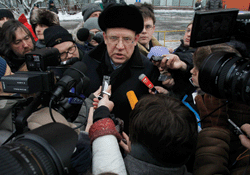 |
| Alexei Kudrin |
Kudrin says he sympathizes with the protesters. He even says they have the capacity to bring the reforms Russia needs. He says the people on the streets tend to have jobs in the private sector; that they are the “more creative, intelligent people” – in other words, the liberal middle classes. “It is very good that they exist,” he says. “They should be the basis of everything.”
The majority of the population still supports the government, says Kudrin. But he says this is largely because the economy is so dominated by state patronage through public-sector jobs and contracts. After the election, says Kudrin, this support base among the public sector has run up against another problem: the unrealistic spending promises made in return for supporting Putin and Medvedev’s return.
“The dilemma has not been solved,” says Kudrin of the government’s post-election fiscal situation.
After the election – especially if Medvedev stays – the government will find it difficult to renege on its side of the political bargain. Cutting back on spending might offend the government’s support base among the military or public-sector workers. Doing that now could be riskier than ever. Salary increases, for example, were one of the main paybacks for ignoring the tilt towards autocracy in Putin’s third term.
But as Kudrin notes, while it would be hard for the government not to honour its spending promises, particularly to the military, nor does it have the cash to carry out its plans. “It has been 100 days since the new government was formed and there is still no sign of what it is going to do,” he sighs.
Although it would not be without risks, Kudrin could solve the Kremlin’s troubles in one swoop, and in a relatively sustainable manner. Having resigned over lax fiscal policy in the immediate aftermath of the Putin-Medvedev job swap, Kudrin achieved distance from a discredited government. At the same time, he underlined his position that Russia needs to tighten up its finances.
A new government under Kudrin would therefore remove, at least, the less popular part of the ruling duo – Medvedev. It would also be able to more easily throw out pre-election spending plans, such as Medvedev’s pledge to triple military salaries and spend $700 billion upgrading armaments.
Medvedev’s exit might already be in preparation. Observers see a growing rift between Putin and Medvedev in Putin’s apparent contradiction this summer of Medvedev’s proposition that he alone ordered Russian troops into Georgia in the August 2008 war.
An international crisis such as a break-up of the eurozone might provide the excuse to get rid of Medvedev and replace him with someone known to be better versed in economic matters. This would be even more likely if the eurozone crisis began to affect oil prices more than it has done.
Because of spending increases, Kudrin reckons Russia is less prepared for a rapid fall in the oil price than in 2008. He points out that if oil revenues are excluded, the government’s budget deficit has almost doubled over the past four years to more than 10% of GDP. This could rise even further if pre-election spending promises were implemented.
If the oil price were to fall, for example, to $60 a barrel, Kudrin says the government could finance the deficit for perhaps a year to 18 months via its sovereign wealth funds. But after that it would have to cut spending dramatically.
The rouble might collapse; living standards would plummet. And as Kudrin points out, Russia might experience the kind of political cataclysm that led to the collapse of the Soviet Union, or the fall of Viktor Chernomyrdin’s government in 1998.
Since 2008, says Kudrin, because oil prices have remained buoyant, Russia has become more vulnerable than ever to any fall in global demand for energy. The country depends on high oil prices, he says, not just through a stock market dominated by corporations working in the energy industry, but perhaps most importantly in its political structure built around oil-financed patronage networks.
Because of high oil revenues, Kudrin says the liberals in government are now increasingly isolated. He says his successor as finance minister, Anton Siluanov, is one of them. He also points to Arkady Dvorkovich, the youngest of Russia’s seven deputy prime ministers, as well as Elvira Nabiullina, former economy minister and now a presidential aide.
Perhaps these are indications of who from within government could be in any cabinet that Kudrin might choose. Kudrin says he has confidence in Siluanov’s ability to implement a new budget rule that would limit government spending to historical rather than projected oil prices.
Kudrin also says he is encouraged by Siluanov’s plan for a new federal financial agency to manage Russia’s sovereign wealth funds. He underlines the importance of investing no more than 20% in Russia.
“It’s important to implement the budget rule,” says Kudrin. “Business and the economy rely on [the budget rule], and the government should have done it long ago. But it depends on whether or not the government can work on the expenditure side.”
Were Kudrin to be in government and Siluanov retained, the latter would clearly have more political backing to shore up Russia’s post-election spending. Kudrin says the government should limit the non-oil budget deficit to 5% of GDP, in line with IMF advice.
Kudrin says the government needs urgently to revise the long list of allowances for early retirement. He reckons spending on health and education could be increased, while the government must cut spending on industrial subsidies and on the military.
But Kudrin’s rather sporadic criticism also points to the fact that, for example, if he was further removed from government, he might not have been able to set up his committee without more obstacles from officialdom. In fact, Kudrin has been an ally of Putin since the early 1990s in St Petersburg, when both were deputy mayors.
Putin has continued to make complimentary remarks about Kudrin. “We’re old comrades and he is my friend,” Putin said on television two months after Kudrin’s resignation.
This might mitigate the extent to which Kudrin is seen as an independent. A Kudrin government might not be so radically different to its predecessor: just more able to implement the fiscal policies that Kudrin advocates and that Putin might also find useful.
For example, despite his enthusiasm for the protesters as a group of people, Kudrin is decidedly lukewarm about the man who is the movement’s most prominent leader: Alexei Navalny. The anti-corruption lawyer’s rise to prominence since the protests was followed by his arrest this summer on charges of embezzlement. Navalny says the charges are spurious and politically motivated.
“Navalny just says some radical slogans, but he hasn’t got really got a policy programme,” says Kudrin.
A Kudrin government, then, might not be revolutionary. But as long as Putin remains the ultimate arbiter of power, it might be Russia’s only alternative.


