 |
|
| Egypt’s finances will weather the storm | |
| The latest word in country risk | |
| Key political and economic risk indicators | |
| Methodology |
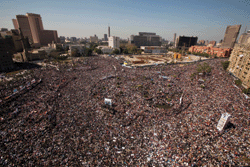
IT IS THE biggest geo-political story since the invasion of Iraq. The military leadership of Egypt, the most populous nation in the Arab world, had been a staunch ally of the US since Anwar Al-Sadat signed the Camp David Accords in 1978. After two weeks of popular protest, this convenient model of Egyptian governance came to an abrupt and unexpected end. The unity of purpose displayed by the protesters in Tahrir Square stunned observers. Now, that determination must be matched by a unity of action within Egypt’s interim government if the country is to avoid serious economic deterioration.
These epoch-defining moments have naturally increased risk in the region, which is reflected in the latest Euromoney Country Risk scores.
Egypt falls 23 places, Tunisia is down 12, Yemen falls 25 places and Saudi Arabia drops three. (The turmoil in Libya did not unduly affect our experts’ opinions of the country, already placed a lowly 79 in the ECR table). In the Gulf, the political risk posed by the protests was offset by the resurgent price of oil. Qatar (up one), UAE (up one) and Bahrain (up two) saw modest gains. Nevertheless, the survey results highlight the seismic changes taking place in the region: the average political risk score for MENA countries has fallen by 9% since September.
Despite concerns over Egypt’s ability to cope with a significant hit to its economy, the relative strength of the country’s finances mean the regime has some breathing space. “Public debt peaked at 110% of GDP in the mid-noughties, but is now only 70% in gross terms,” says Gabriel Sterne, an economist at Exotix, a frontier-market investment-banking boutique. “When the crisis began, external debt was only 20% of GDP, hardly enough to ring even faint alarm bells.” Although a $1 billion Eurobond is scheduled to mature in July, this represents only 3% of end-2010 reserves. Egypt’s finance minister has assured investors that Egypt will not default on any of its debt obligations in 2011.
However, a prolonged political impasse could be a problem for a country with a hefty public sector wage bill. For Ayah El Said and Rachel Ziemba, analysts at Roubini Global Economics, the concern is that foreign reserves are already being drawn upon to support the Egyptian pound and government expenditure.
 |
“In addition to the $36 billion of official foreign reserves – equivalent to six months of exports – that the government has amassed recently, $20 billion in state funds is also being held in Egyptian banks. However, we fear that the latter already have liabilities attached,” says El Said. The government’s fiscal position is likely to come under pressure from increased public expenditure in the form of wage rises and subsidies. The latter already consume as much as 25% of government spending, with wages the next largest expenditure. Increased pensions alone could cost the economy as much as $1.1 billion, according to Roubini. These pressures, allied to lower growth estimates, are likely to send the budget deficit to 10% of GDP.
Dangers
The danger is that the economy will be badly hit by reduced tourism, a sector that employs 10% of the workforce; 90% of all tourist bookings for 2011 have already been cancelled. Meanwhile, international companies including BG and Nissan have announced cuts in production and the repatriation of foreign staff. The government will have to work fast to reassure investors that normality is returning to Egypt.
“Investors shouldn’t see the protest movement as an un-invitation to do business in Egypt,” says Bernie de Haldevang, head of political risk at Aspen. “It is highly unlikely that any successor government would wish to pull up the drawbridge to foreign investment.” For Sterne, the worst-case is an extended flight of capital from Egypt, accompanied by devaluation of the pound. “A situation with parallel exchange rates and dollarization of the economy could easily ensue, with profoundly damaging effects.”
Jordan can ill afford the kind of unrest witnessed in Tunisia, Egypt and Bahrain. A $225 million package to reduce food and fuel prices was announced shortly after King Abdullah dismissed his cabinet. “The incentives are not addressing the underlying grievances, but they are an attempt by Abdullah to do something,” says Ziemba. The government has little fiscal room to manoeuvre. Before the increase in food prices, Jordan was running a 5.5% government deficit; with the cost of maintaining food and fuel subsidies, that figure is likely to rise to 6% or 7%.
Europe continues to suffer
In the developed world, the recovery from the global financial crisis continues, though not uniformly. Since Euromoney last compiled country risk data in September, Portugal, Ireland and Greece have all continued their slide down the ECR rankings. Elsewhere, the public finances of Spain, Belgium and even France have come under scrutiny. Concerns about elevated public- and banking-sector debt levels in the developed world remain, with none of Germany, the UK or the US making it into the top-10 safest countries.
Sluggish growth, high inflation and high levels of government debt continued to weigh upon the UK and the US in the Euromoney rankings. The UK fell one place to 16th after the economy contracted by 0.6% in the fourth quarter of 2010. Although business activity ticked up sharply in January, inflation hit 4% in the same month, double the Bank of England’s target. The US rose one place in the rankings after posting positive production and job figures. “Uncertainty still remains over the sluggishness of the recovery in the US and UK, given the looseness of monetary policy,” says Johann Krijgsman, formerly head of country risk at BCI. “Neither country’s banking industry is out of the woods yet. The continued problems in mainland Europe have done nothing to improve sentiment.”
Both Portugal and Ireland fell to the third tier of the Euromoney Country Risk rankings. Since being forced to negotiate an €85 billion programme for assistance from the EU and IMF, Ireland has fallen from 21st in the table to 38th. Portugal fell 12 places to 44th as economists responded negatively to the country’s escalating public debt problems. The Portuguese economy contracted by 0.3% in the fourth quarter of 2010.
The Nordic countries remain the world’s favourite safe havens. The combination of broadly diversified economies, strong social welfare provisions and institutional strength continues to reassure investors and economists alike. The Nordics are joined at the top of the table by Singapore, whose stellar growth in 2010 has propelled it to 6th in the table. Spurred by the strong performance of Malaysia and Indonesia and by a rebound in domestic manufacturing, Singapore has climbed six places since September. The city state, which retained its number one position in the World Bank’s Doing Business Survey, overtook Hong Kong, whose close links to China affected its performance. It fell by two places, dropping out of the top 10.
Russia, India and China all fell in the first half of the year. Weighed down by low scores in political risk and corruption, Russia fell five places and now ranks below Mexico, Turkey, Indonesia and Lithuania in the table. “Political risk in Russia remains elevated due to the dominant position of United Russia and the inability for a credible plural opposition to operate freely,” says Mandy Kirby, a political analyst at Maplecroft. “The harsh verdict on and sentencing of businessmen Mikhail Khodorkovsky and Platon Lebedev in late 2010 on charges of theft and money laundering drew strong international criticism for apparent political motivation.”
India also fell by eight places as concerns mounted about the effect of food inflation on the country’s poor and the recent corruption scandal over the Commonwealth Games. “Recent corruption scandals in India are definitely damaging to the economy, in both the short and medium term,” says Rebecca Jackson, principal analyst at Maplecroft. “Besides the direct impact on the economy, the political turmoil caused by the 2G auction scandal has paralysed parliament, having a detrimental impact on key reforms, such as further delaying the goods and services tax needed to keep the country competitive.” The possibility that the Chinese economy might be in danger of overheating pushed the country down four places to 40th in the table.
The standout performers in sub-Saharan Africa are Nigeria (up 16) and Ghana (up 9). The Nigerian economy grew by almost 8% last year. Given the scope for development in the oil sector and others such as agriculture and telecoms, it looks set to continue on its strong growth path. Nonetheless, risks remain on the horizon: elections in 2011 could cause disruptions, while double-digit inflation, if left unchecked, could lead to dissatisfaction and potential unrest. Ghana experienced its first full year of oil production, but its politicians will need to develop the legal framework to govern oil revenue collection if it is to rise any further up the table.
The riskiest countries in the rankings remain the ones most affected by natural disasters or high levels of conflict, including the Central African Republic, Democratic Republic of Congo, North Korea and Haiti.


