
The collapse of bitcoin was fast and dramatic on Wednesday.
The dollar price fell by 30.8% at one point, before the world’s leading cryptocurrency recovered to end the day down just 11%.
But by then other cryptos had been caught up in the carnage, which came after financial bodies in China reinforced the ban on banks and payments companies offering crypto services to their customers and the country’s central bank insisted that they cannot be used for payments.
Ethereum also fell by 26.3% intraday, with litecoin down 32.5% and the Ripple XRP token 30.4% lower at one point.
The leading crypto exchanges were also hit.
Coinbase reported delays in ethereum and ERC20 withdrawals due to network congestion, while reassuring investors that their funds remained safe and deposits unaffected. Its shares, having closed on Tuesday at $239, traded down 11% to $213 on the day of the rout.
Some users attempting to trade on Binance and perhaps pick up a bargain found a message that there was no open channel to do so.
China control
The People’s Bank of China (PBoC) has taken the lead in creating its own central bank digital currency (CBDC) to make sure that the e-CNY sees off any challenge from new private forms of digital money – stablecoins or cryptos – that might give the population a means of exchange outside its control.
The Chinese authorities are perfectly happy for Alipay and WeChat Pay to provide the wallets from which Chinese people pay for goods and services. The one thing they will never allow is anyone else to control the currency that flows in and out of those wallets.
Marion Laboure, analyst at Deutsche Bank, points out: “It is no surprise that governments are not inclined to give up their monetary monopolies. Throughout history, governments first regulate and then take ownership.
“As cryptocurrencies begin to seriously compete with regular currencies and fiat currencies, regulators and policymakers will crack down.”
[Bitcoin] matters more and to more people than ever before. Whether you’re a sceptic or a true believer, it is hard to ignore
And it is not just Chinese regulators. The recent cyberattack on the Colonial Pipeline in the US, which led to fuel stations running short of gas, came with a ransom demand to be paid in crypto.
Even worse, the countless investors who now take investment advice only from Elon Musk’s Twitter feed find their guru wrestling with his own faith in BTC.
He is alarmed at rumours only now reaching him that maintaining the bitcoin network consumes inordinate amounts of electricity that might be better deployed charging the batteries in his cars.
Bullish on bitcoin
Even more overwhelming than the sell-off was the flood of comment that followed, excusing this correction and explaining that new investors simply have to take such volatility in their stride on the way to untold riches.
“Bitcoin’s pattern over the last 10 years has been meteoric rises followed by pull-backs,” Joe DiPasquale emailed to tell me, sensing my anguish through the ether, like some kind of crypto Jedi.
“The trend has been higher highs and higher lows: one year ago today, bitcoin closed at $9,927 while it now sits at about $39K. While it has certainly fallen from its $63K high, that is still a 300% rise.”
He added: “The fall in price is a natural consolidation period that we see as necessary for the support lines to form for future appreciation.”
DiPasquale is chief executive of a company called BitBull Capital, which runs crypto hedge funds, apparently. As the name requires, he remains bullish on bitcoin and confident that we will see it at $100,000. He is not alone.

Gavin Smith, chief executive of crypto investing firm and exchange operator Panxora, says: “We have seen the asset exhibit declines averaging 40% at least once every year before recovering to new highs.”
This volatility comes as cryptos become more established as a quasi-financial asset class into which big established banks and custodians are being drawn, as institutional investors allocate more money in the desperate search for returns in the everything bubble.
Bitcoin’s market capitalization hit $1.2 trillion in mid-April. It now matters more and to more people than ever before. Whether you’re a sceptic or a true believer, it is hard to ignore.
In April, central bankers keen to share their experiences in designing, testing and, in the case of John Rolle of the Central Bank of Bahamas, launching a CBDC were treated to a fireside chat with Michael Novogratz, the billionaire founder, chairman and chief executive of Galaxy Digital.
Novogratz, a former partner at Goldman Sachs and manager at hedge fund Fortress Investments, was happy to play the rock star in front of the central bank technicians at the OMFIF Digital Monetary Institute.
He joked that when he recently paid $1 million for a non-fungible token (NFT) of his favourite basketball player, LeBron James, his mother told him he was crazy.
“It traded for $5 million yesterday,” Novogratz shrugs. “Is that a bubble? Yes, probably.”
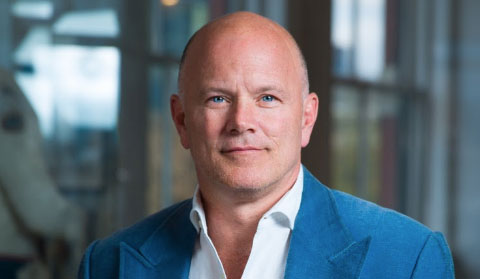
Novogratz reminded his audience that bitcoin first emerged as part of a rebel movement among those with no faith in central banks or commercial banks who wanted a new form of money.
But its 85% fall in 2018 meant that it would never be a transaction currency. Instead, it became a store of value, albeit an entirely faith-based one, free from the complexity of any fundamentals to analyze.
That should make central banks a lot less nervous, except for one thing.
“Bitcoin is a report card on how central bankers are doing, and right now people are nervous,” says Novogratz. “Its success recently has been because of central banks and the fiscal response to the crisis. We have lost the concept of independent central banks with the printing of money, and bitcoin is a hedge against that.”
Bitcoin sceptics shouldn’t rush to call its end.
“In any paradigm shift, you have frenzy and fervour,” says Novogratz. “It is wrong to think of this as a fad.”